
Barcode Scanning Isn’t the Finish Line in JD Edwards
June 1st, 2026
20 min read
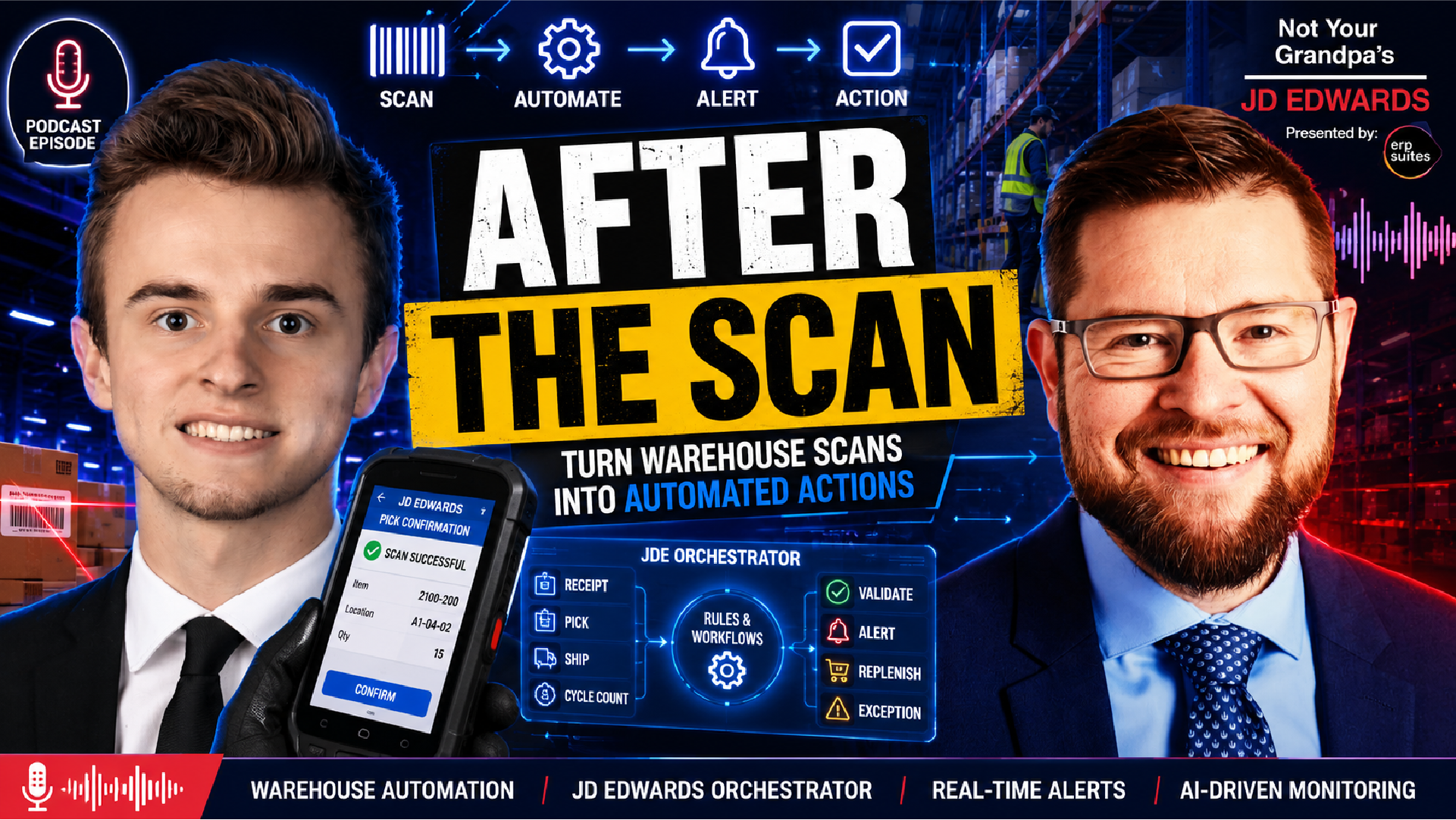
Warehouse barcode scanning has transformed data collection in JD Edwards environments, but many organizations still struggle with what happens after the scan. In this episode of Not Your Grandpa’s JD Edwards, Steve Clampitt of ERP Suites discusses how companies can move beyond simply capturing warehouse data and begin using it to drive automated actions, real-time visibility, exception management, and future AI-driven processes. The conversation explores common challenges with legacy scanning solutions, the advantages of JD Edwards-native orchestration-based approaches, and how organizations can modernize warehouse operations without undertaking large-scale transformation projects.
Table of Contents
- Intoduction
- The Gap Between Data Capture and Business Action
- Where Warehouse Modernization Still Falls Short
- Risks of Slow Action and Lack of Trust in Data
- The Hidden Cost of Legacy Scanning Solutions
- JD Edwards Native Scanning and Orchestration
- AI, Automation, and What Should Happen Next
- Practical Automation Examples and Modernization Strategy
- Key Takeaways and Next Steps
Introduction
Your warehouse is scanning barcodes, capturing transactions and feeding data into JD Edwards.
But what happens next?
Is that data actually helping your business move faster, or is it just creating another queue for someone to monitor?
Today On Not Your Graph is JD Edwards for breaking down how JD Edwards users can turn warehouse scans into automated actions using tools like Orchestrator, Real Time Alerts, exception workflows, and AI driven monitoring. We'll explore where many companies get stuck after the scan, what automation opportunities they may be missing, and how ERP Suites helps JD Edwards customers modernize warehouse operations without starting from scratch.
Welcome back to Not Your Grandpa's JD Edwards, the podcast for JD Edwards users who want to get more value out of the system they already have today.
We're talking about warehouse modernization, not just barcode scanning. We're talking about what happens after this game.
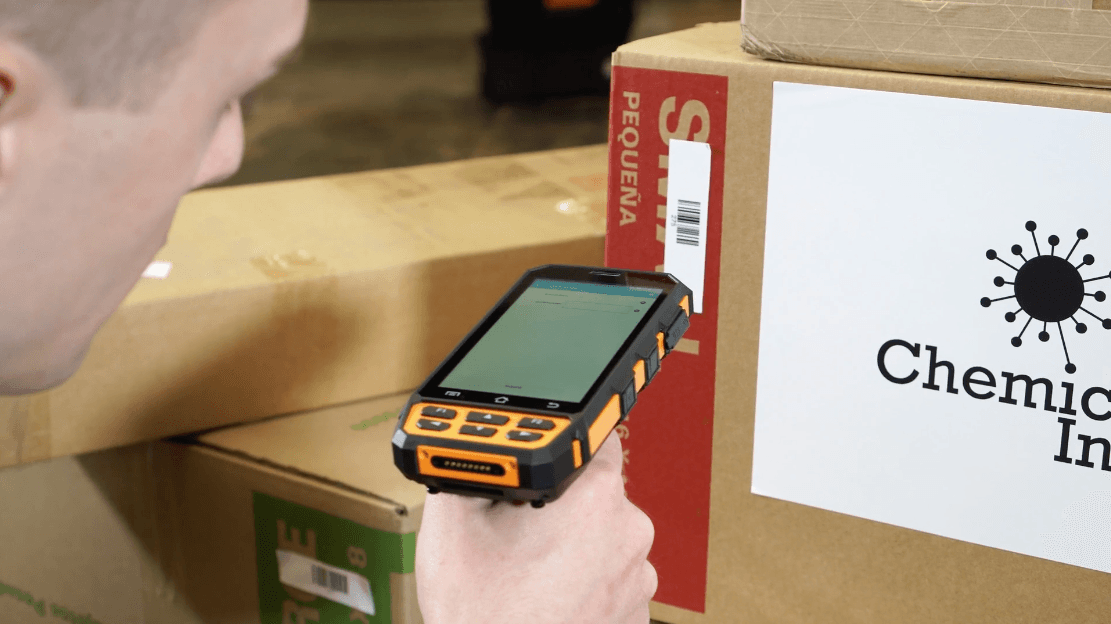
A lot of companies have already made progress in the warehouse. They've introduced mobile scanning, they've reduced manual entry, they're capturing inventory, movement, receipts, picks, shipments and cycle counts faster than they used to.
But once that scan happens, then what?
Does JD Edwards automatically trigger the next step?
The Gap Between Data Capture and Business Action
Does someone get alerted when something goes wrong? Does the scan create real time visibility or does it simply just create another transaction that someone must watch, review or fix later?
That gap between data capture and business action is where a lot of warehouse operations still have room to modernize.
But today we are joined by a reoccurring guest, Steve Clampitt from ERP Suites. Steve, how are you doing? Welcome to the show. And for the people that maybe don't know anything about your background, could you give us a little bit?
Yes, Sir. Thank you, Nate. Glad to be back. It's exciting to be here. So yeah, I'm. My name's Steve. I've been in JD Edwards space for 26 years this July. And with the emphasis on mobile data collection. So yeah, thank you for having me, man.
Of course, Of course. But before we get into the bulk of this episode of tools or even technology, let's start with the operational reality. Many companies have already improved how warehouse warehouse data gets captured. But the bigger question is whether the process around the data has actually changed, right?
So to start off, a lot of JD Edwards customers are already scanning in the warehouse. But from your perspective, where do companies still get stuck?
So you know the the beginning, you know, the last let's say 20 years ago, what we were aiming to help solve in the industry is getting rid of the data, the data collection from paper, right? We were pens and paper in the warehouse and, you know, many projects were out on the shop floor replacing the guy with the clipboard who was doing manual cycle counts. He was doing manual picks and ships.
And so while we have had a revolution in that phase of the game, right, we we've replaced a lot of that manual processing with barcode scanning and, you know, data collection, if you will. You know, at that point what we do after the scan, it has become where we've slowed down and where we're probably not utilizing modernization as we could.
This is the level of paragraph consolidation I'll use going forward—typically only 2–4 paragraphs per section unless the content naturally needs more.
Where Warehouse Modernization Still Falls Short
Yeah. And maybe to go a little bit deeper into that, what are maybe some examples of processes that might look modern because scanning is involved, but maybe you're so manual behind the scenes.
Yeah, I mean, I think you've got your typical process that would happen to warehouse, right? You're receiving, you're picking certainly cycle counting, right, shipping a lot of those, you know, we, we work hard to get that process put into barcode scanning, put into data collection, but that almost becomes like the end goal, right, versus the beginning goal, right. So we've, we've, we've done the hard work to do our receipts, to do our picking on a on a handheld, But what are we doing with that data after? And a lot of times that data is in the system and it's captured, but is it actually being utilized? Is it actually being acted upon after the fact?
Yeah. And the, and yeah, you got to put it perfectly, like that's a, it has changed the game in many ways of to make it the data collection a lot faster and it speed up a lot of these processes that used to take days to even get your warehouse sorted.
Absolutely, yeah. I mean, you need the cycle counting process a lot. You know, that could take a month, right, depending on how big your warehouse is. So yeah, absolutely. There's been, you know, the wild improvements from going to to a modernized data collection system obviously have helped, you know, in terms of getting the data into a system that you could manage right up, specifically JD Edwards in our case.
But yeah, absolutely. It's totally changed the game In, in, in, in companies being able to bring in that data quickly and ultimately improve their warehouse, right. And improve getting data out the out the door or, or, or creating product either way. Right.
Risks of Slow Action and Lack of Trust in Data
So what might be the risk there where a warehouse, obviously the warehouse teams are capturing this data quickly, but what if they're starting to act on it and they're a lot slower than maybe they used to, right?
Well, you, you've got your issues with, you could have delayed shipping processes, right? If you're, if you've received product incorrectly, right, your, your inventory is going to not be correct and you're going to have to work through that. You're going to have delays then on the on the, you know, research side, right? You're going to have to have people go into the system and OK, try to connect a, you know, somewhat separate data collection system into a sub. You know, your, your actual JD Edwards data, right? You're going to have to that, that takes time, right? Whether that's receiving, picking, shipping, whatever process that is. You've got to put more effort into managing pad as a whole, right? Managing the OK, what did we scan versus what happened and where did we go wrong?
And often times that, that is a team of people that might have to look into that, right? I've been on that team. I, I know that process of, OK, what, what went wrong? Where did we go wrong? And then how do we fix it? And so your, your, your level of effort kind of becomes, are our transactions happening accurately, right.
And you have those people that are less confident in their inventory and their operational data.
Absolutely. You you become less trustful of what the system is and then your user community becomes less trustful, right. And then that that kind of is a trickle down effect in that, you know, is what we're doing in the warehouse believed to be accurate and that and you don't obviously you don't want to be in that kind of a situation, right?
Yeah. And that's interesting because, yeah, like we just said, it has speed up this process of data collection so much to the point where you kind of don't trust it, which is a funny way of looking at it. But it it is something that we see because if you're not quick to utilize that data, if you're not monitoring it, if there isn't, if there aren't those safeguards in place, then yeah, you can run into those issues all the time.
But if you're doing it the right way, if you're on top of the how quickly everything is going, if you have some of this modernization that we'll talk a little bit more about, then that is no longer an issue for you. Obviously there's still issues that are out there and nothing's perfect, but it will close the gaps for a lot of these because, yes, scanning can absolutely be a step forward, but if the system is behind or outdated or disconnected or hard to maintain, even the company can still run into that friction.
The Hidden Cost of Legacy Scanning Solutions
Yes, absolutely. That kind of, yeah. That kind of brings us to the technology foundation behind the actual scan.
So many companies or many JD Edwards companies, I should say, have already have a barcode solution in place. What problems can really show up with maybe an older system or a bolt on scanning solution?
I think your, your main thing you're going to run into probably is going to be your challenge around support, right? Challenge around upgrades, challenge around security priority development style, right, Depending on on software. So you're going to get a lot of that it, it creates the need for a team of people, right, to maintain that, that piece of software because it is outside of your JD Edwards installation.
So you're going to need to maintain that. You're going to need to maintain those pieces that, you know that, like we said, like security, you're going to need to maintain all those things. And as I said, they're, they're, they're separate servers possibly, right? If it's a separate piece of software, it might need to be installed on a separate server. It might need to be installed on a separate database. You might have to have a separate security model in place. There might be and when it comes down to security, but you know, are you going to need to use a proxy user? Are you going to be able to use the JD Edwards user? Things like things like that that are are are fine, right And in the general scope of what what you're implementing, but that does like you said, it creates friction, right? It creates a another piece of hardware software that you have to maintain at A at a corporate level, right.
So it's so it's kind of like a tool that once helped the warehouse move a lot faster can actually become something that like blocks modernization.
Yeah, I think technology has brought us to the point where what once was great and, and, and perfectly acceptable and, and, and an improvement has now become, you know, behind in ways behind the modernization trend, behind the ability to use something that's architecturally within the four walls of JD Edwards, right.
I think it gives us that, that we have now advanced the ability to solve problems within JD Edwards architecture and kind of eliminate that process, eliminate that separateness of, of an, of an implementation.
JD Edwards Native Scanning and Orchestration
Yeah, so let's dive in a little bit of where that separateness could maybe go away. How does JD Edwards native approach change this entire conversation?
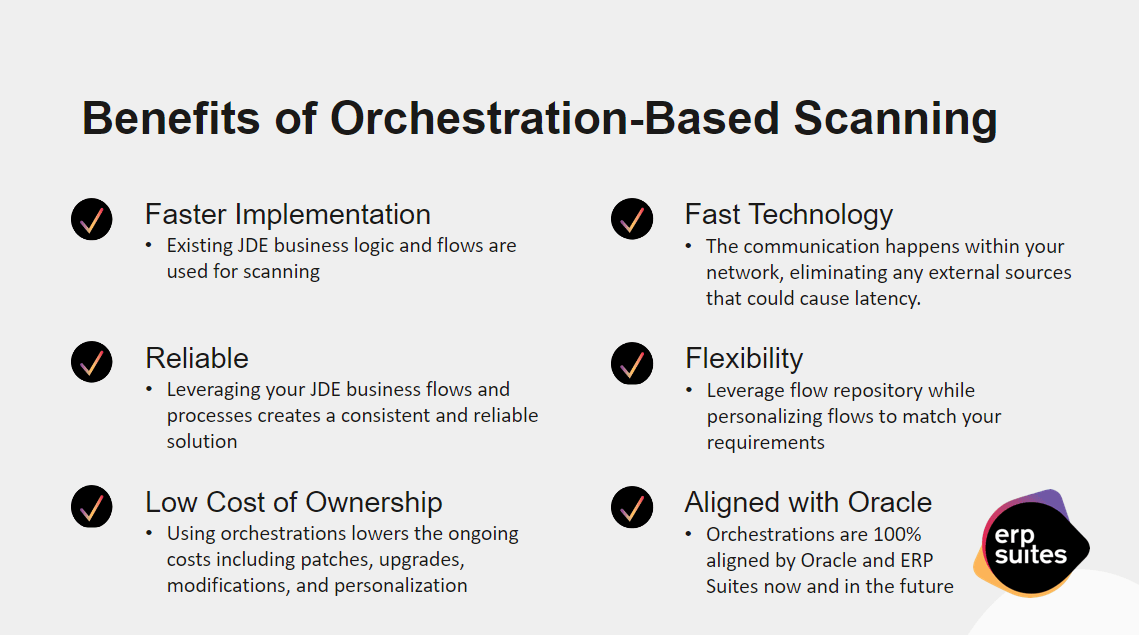
Right? So let's, we'll, we'll take our scan ability product, right? It uses orchestrations that are obviously built within JD Edwards and it utilizes JD Edwards processes. So I don't, I don't want to go into a deep dev orchestration studio because we probably talked about that before on the podcast, but essentially we're building orchestrations that perform the steps that you, the user would use.
So if you're going to do a peer receipt, right, the user is going to go to their application and receive that, Our scan ability tool will look no different. You're going to go in and you're going to be within the architecture of the system. So whether that's picking, receiving, shipping, cyber accounts, whatever, whatever JD Edwards solution that you use that's built into JD Edwards, that's ultimately what a tool that's native to JD Edwards is going to do. It's going to piggyback off the already in place architecture that was implemented.
And you're up in your in your last upgrade or when you first implemented JD Edwards, right? Which goes to the next point of like easier to upgrade, easier to secure because you're only doing it once, right? That whole process begins, becomes enveloped inside your JD Edwards installation, right? You're in JD implementation. So your supports going to be more in line. Your security is going to be more in line. Upgrades are going to be easier, right? Because the orchestration tool is just going to piggyback right off that up upgrade, right?
So the goal isn't just to scan, right? This is why we're here. The goal is to modernize the, the goal is to have your data collection become modern, right?
And so obviously AI is something that everyone's really pushing right now. How would this kind of integrate to a future AI agent to make some of these people's lives a little bit easier, right?
So essentially we're, if we're, if we've solved a problem where we're using orchestrations, right? To, to, to build applications and to build your, your, your essentialist workflows, we will be able to in the future state. Like we were working on a suite of, of agents and in particular, like, let's say AP, right? We're working on AP agents.
And so if you've used your scan ability tool to do your P receiving, right, we're going to have potentially have agents and this is not just for AP, but for inventory as well. We're going to have agents that are going to be able to be in place to help, let's say voucher matching processor or things that things of that nature where we're going to be able to automate so much more of your process.
That really kind of does have to do with with mobile data collection, but it's also enhancing an enhancement too, right? It's on top of so you'll open your world up, you'll open your world up to be able to take advantage of AI, which probably let's not even a few years ago that would that even be a conversation, right. Like I I think that that kind of wild. Did you even suggest that?
But yeah, absolutely, absolutely. We're we're there and we're building them now. So yeah. And that really does play into the what happens after the scan.
AI, Automation, and What Should Happen Next
Yeah, you probably won't see it. Like hopefully at least we're we're not to the point where there's a billion robots that are actually walking around and scanning things yet. We've all seen I robots. I'm just saying I bring up I bring that up on this podcast a little bit too much. At some point, they're going to have to start paying me.
I just watched that movie with my daughter this weekend, actually. She was like, what?
Yeah. Yeah. It's before it's time, 2004, way before it's time. I don't know exactly, but yeah, we're not to that point yet where we have AI agents that can walk around your store and they're true in your warehouse and actually scan everything by hand.
Yes, there are some processes that are in place that you could maybe maybe get around that, but we're not there yet. So this is more focusing on the after the scan where AI can truly take over and transform that side of it, where obviously, as we've talked about today, there are some issues there in terms of how fast we can really get going with it. Especially the larger the warehouse, the more data that's coming in, harder for you to get it up, right.
So yeah, once the foundation is really in place, the conversation gets a lot more interesting because the scan shouldn't be the end of the process. It should be the next beginning of maybe the next action. Let's go with that.
Yeah. So let's get into the core questions of why I have you on this podcast and something that we were just talking about. Once a warehouse scan happens, what should happen next, at least right now, right.
So as you and you just mentioned this, right, that that before Barker scanning was kind of like how to get data into the system, right? It was almost like the end of the process, whereas now we want to change the paradigm to say, hey, the barcode scan is actually the beginning of the process Is it's it's the it's your gateway into your data.
And as we grow more data and depending on how, you know, big your warehouses and how many transactions you do, right, the goal would be to get that data into your system so that an AI agent can take can take over, right? That that's the beauty of AI. You're going to be able to take that data and then build upon it.
But yeah, obviously after the scan happens, right, we're going to be able to automate the validation of that transaction, whether that transaction, you know, consists of an item quantity, things like that. All that all that stuff is going to be baked into obviously already the JD Evers application that we're transacting upon, right? Whether that be receiving, shipping, picking, you know, etcetera.
So, yeah, but that's also where introduce the idea of our orchestrations, right? And that's where orchestrations become important because that's where we're able to, you know, self architect inside JD Edwards. So we're we're inside the system. We're we're transacting AP 4312 hour operation within the system. So you're baked in sealer. So we're straight. We're we're seamlessly in the process of your warehouse.
You're like, I think you mentioned you're not going to see us, right? You're there, you're doing your work. But you the goal was to not see that we're there. The goal is to take that data, get into the system, and then how can we allow, you know, future state AI processes to take over?
Practical Automation Examples and Modernization Strategy
Yeah. And let's go a little bit deeper. Could you give maybe a few practical examples of scans triggering these actions right yeah, absolutely.
Like I I keep harping on pure seat. I guess my brain is on for your seats right now. But obviously, you know you're going to be able to validate your purchase order and in real time we're going to be able to to mash discrepancies, right alert receiving purchasing specifically in shipping and picking right.
You're going to be able to notify notify a supervisor if there's a short pick right or trigger or punishment. If you're in advance warehousing cycle count real time, you'll be able to, you know, validate quantity discrepancies in in, in variances in the real in real time, right, And kind of kick off notifications or, or kick off an exception handling process, right? Kick off a fail. You know, if a transaction fails, you might want to kick off a certain workflow that does certain things right.
So we're going to be able to take what data collection has given us over the last 20 years and expand upon it because we have a new framework of a solution, right? We, we can use JD Awards Orchestration Studio to, to enhance everything that we've built to this point in, in, in the history of mobile data collection, if you will.
Yeah. And it's funny that you say like, yeah, if this works perfectly, you'd probably never see us. I'd probably never see your mobile barcode scanning solution at least, right. Like at least in terms of the day-to-day. So that's perfect. That's exactly what you want. Because again, that is what slows down these processes is a bunch of manual work that you have to oversee at every single point.
And yes, they're still alerts that get sent out when something doesn't match up. And there is still that need for that manual intervention, but it cuts it down to a point where it doesn't slow down your process. And yes, there might be a hiccup for two there here or there, but it kind of eliminates the need of having us in house every single day to make sure everything is perfect.
Kind of like watching ATV show without commercial, right Yeah, right.
And it just it is it skips the commercials, right That we don't want to be we don't want to have those commercials in your workflow where oh, this exception happened and we didn't know what happened. Now we don't have any idea why it happened and now we don't know what we need to troubleshoot.
We want to eliminate that and by being so tightly integrated with JD Edwards, we're going to be able to give you that ability to do just that. Whereas you're not worried about the exceptions because you know where to go look for the exceptions, right? You know where they're going to be and they're going to be automated and they're going to be handled.
And I think that's the beauty of being so tightly integrated, using Orchestration Studio to integrate into the JD Edwards, you know, ecosystem, right.
Yeah. And even a step further into that, when AI is actually available to utilize for a lot of these companies that are out there that look, that's after the scan isn't only utilizing Orchestrator Studio, but it is going to step further and creating actual tasks and goals that are based off of some of these data points that are here and some of the stuff that we've said, but even goes further depending on how much you allow your AI to do.
Again, use caution I robots real, but it is something that we're looking towards as an entire industry.
So how does AI kind of fit into this conversation? And maybe where should companies be careful, right?
Well, I think AI obviously has the ability, which if you use it just on a personal level, you realize that it has the ability to catch things that humans can't catch manually, right? Like that. And especially if you throw the amount of data that you might throw at it from a, from a data collection solution, managing all your work flows, right.
You know, AI is going to be able to have help you catch problems that you may not even see happening. Anomaly detection, right, pattern pattern recognition bottleneck, you know, analysis, things like that. Predictive monitoring, you may be seeing an issue that you don't see before it even happens, right? That, that that's kind of like the pine sky, right? But it's also a reality where it's pine sky, but we're also it's like tomorrow, right?
So it's all there. I think, oh, process. I think it's most useful like when you can understand the data and you know, the data is reliable and relevant. And I think by setting ourselves up with tool like scan ability, you know, that's going to be in place.
So we're going to be able to piggyback off of, you know, quality transactions inside the JD Edwards system that you didn't even know happened, but they're there now. What you get to do with it is all kind of up to you. And you can help mom use your system, use AI to help you solve problems you didn't even know you had.
Key Takeaways and Next Steps
And I think that's pretty exciting for an industry that is as long in the tooth as you might think it is. I think it's it's an injection of the future into JD Edwards. And I think from my perspective, having been in the industry this long, I doubt that I would have seen this kind of revitalization before. But I think of the ability that we're going to get now where we can plug in modern tools and modern solutions into a JD Edwards system. I think how can that not excite people that run the system day in, day out?
Yeah. And there might be some people that are listening to this and they're like, oh, so you're just going to eliminate my job? No, it's not like that at all. It will support your warehouse team, but it won't replace your operational judgement because at the end of the day, that is what you're there for. It's not about these manual tasks that are repeatable and repeatable, and you're doing the same thing every day. That just doesn't make sense. It's about the next steps. It'll allow you to make more operational judgement calls than having to do the same thing every single day.
But so for companies listening, the path forward does not have to be a massive transformation project. The better approach is usually does. Start with one visible pain point. Prove the value and then expand from there. We talked about quick wins on this episode on these podcasts so much, but it is the right thing to do is start small and expand from there.
But for customers who say, all right, this sounds great, but we can't really take on a massive transformation project, maybe they do want to focus on one specific pain point. Where should they really start to figure out where that pain point is?
Yeah, I mean, I think you would want to start with a process assessment, right? You map what happens in your warehouse scans, receiving, picking, shipping, transfer cycle counts of the whole. It's a whole enchilada, right? Get an idea and, and, and I'm sure we can help you do this, but get an idea of what you're doing inside your warehouse. What happens with each of your scans?
And I know that might feel daunting, but but as nay said, you got to start small. And maybe you start with maybe you have a particular workflow that is a pinpoint, right? We can go there. And what's a high value workflow? What's something that you use every day that's kind of critical to your business? You know, what areas impact the business most, right? And where can we help?
But could we reduce shipping errors? Could we improve inventory accuracy? Can we eliminate manual review, speed up, you know, a process, improve visibility? Like we are here to help that modernization. And it doesn't have to be the whole thing. In fact, that's pretty daunting, right? You know, I don't think that anybody would want to take on just all of their, you know, mobile data collection solution. But we are here to modernize and we can't. We have the tools now to do that modernization. And I think if we start small, we can prove that value. And then once you prove that value, it's pretty easy to expand upon.
So are we talking about a phased approach here for scan ability?
Well, we have, yeah, we have third, we have about 30 continued workflows already, right, that are as is that kind of piggyback already off of the business needs of of a typical data collection barcode solution, right. So we offer that we can modify those. We can, we can create new ones. We can, we can give you that. We can hand over kind of the road map of here's here's what you might need to get started. Or obviously we can do assessments of what you do today, right? We, I've been on a couple projects already where we're, we're taking into account what, what do you have solved today? And then how can we, Yep, essentially modernize it, right?
So that, that makes a lot of sense. So it's you can take it as is if you are a typical warehouse or if you do think that, all right, we we have a lot of very Cus like customized situations processes that we have in here. You can also kind of adhere to that. So it's not a one-size-fits-all. It's a let's see what you truly need and we can see what we can plug in automatically and what might need a little bit more work. Am I right in that?
Yeah, absolutely. And I think a lot of your, a lot of customers out there are going to have, they're going to have within their solution of, of, of barcode scanning, you know, workflow scripts, whatever you want to call them. You're going to have your low hanging fruit, which are just simple, straightforward, like, OK, this, this transaction is super easy. We never worry about it. It always works. But they're also going to have the complicated, troublesome salute tap, you know, workflows that are like, Oh my gosh, this is a really difficult process. And in fact, we fall down a lot because of this or that, right?
So everybody's going to have, you know, an amalgamation of simple to difficult, right? But our goal obviously through all of that would be to help you get native, right. You use our orchestration tool based approach, right? To to to build a solution that's less maintenance intensive, right? Less prone to researching issues, tracking down failures and things like that, right?
So maybe for a team that's out there right now, what should maybe leaders ask their teams after hearing this episode, right?
I think you really want to boil down to what happens after a warehouse scan, right? What steps, manual or not happen, whether it's a possible you need reporting, what whatever you might do after your warehouse scan, you need to dig into what happens, what's going on after that, what cues those reports what what triggers a person to go check a table inside the system and how often does that process break?
Are there delays? What happens if something falls down? Does anybody know about it? Is anybody notified or is it just a, Oh no, this process and hasn't worked since Saturday morning That happens and I've been on that team. I know what that's like.
You know what, what is JD Edwards already doing for you? That is manual that we can automate as well. So I think there are there's a good set of questions you can ask your team to get started with just having the conversation of modernization.
If a team were to go back after this episode and they're going to their team and they're trying to figure out exactly what to say after watching this, what would you say the main take away would be?
Absolutely. I think barcode scanning mobile data collection is not the finish line. In fact, we're we're arguing that it's the beginning of the process. We're arguing that that's where they're really real value becomes from, right.
Is that at you've now as you modernize your software, as you modernize your data collection process, we can now create visibility trigger actions, you know, reduce manual monitoring and help you respond faster to your data collection that you've been doing for years, right?
We're taking that system that is worth for you. And now we're taking it, modernizing it, making it more in line JD Edwards, more within the architecture of JD Edwards by using native tools like orchestration studio workflows, our scan ability product. Obviously, we're going to take that process in place and we're going to modernize it. We're going to help make that streamline and less manual, less prone to failures here and there.
So if your warehouse is already scanning barcodes, but your team is still manually chasing exceptions, checking queues, refreshing reports, or waiting for someone to notice a problem, there may be a major modernization opportunity sitting right inside your JD Edwards environment.
ERP Suites helps JD Edwards customers connect to warehouse activity to real time visibility, orchestrator based workflows, simplifies securities, easier upgrades, and modern mobile data collections through scan Ability.
To learn more, visit erpsuites.com and explore ERP Suites Scan ability for JD Edwards.
But that's it for today's episode of Not Your Grandpa's JD Edwards. A huge shout out to you, Steve, for joining us and helping us think beyond the scam. Because captioning warehouse data is important, but what happens next? It's where modernization really starts.
If you found this episode helpful, make sure to subscribe, leave a review, or share it with someone in your operations warehouse IT or even your JD Edwards team.
But until next time, Kee modernizing, Kee asking better questions and Kee getting more from JD Edwards.
Catch you next time.
Topics:
.png?width=650&height=325&name=Blog%20Images%202_1%20(4).png)
.png?width=960&height=540&name=Blog%20Images%20(98).png)
.png?width=960&height=540&name=Blog%20Images%20(94).png)
.png?width=960&height=540&name=Blog%20Images%20(77).png)
.png?width=960&height=540&name=Blog%20Images%20(59).png)
.png?width=960&height=540&name=Blog%20Images%20(55).png)
.png?width=960&height=540&name=Blog%20Images%20(52).png)