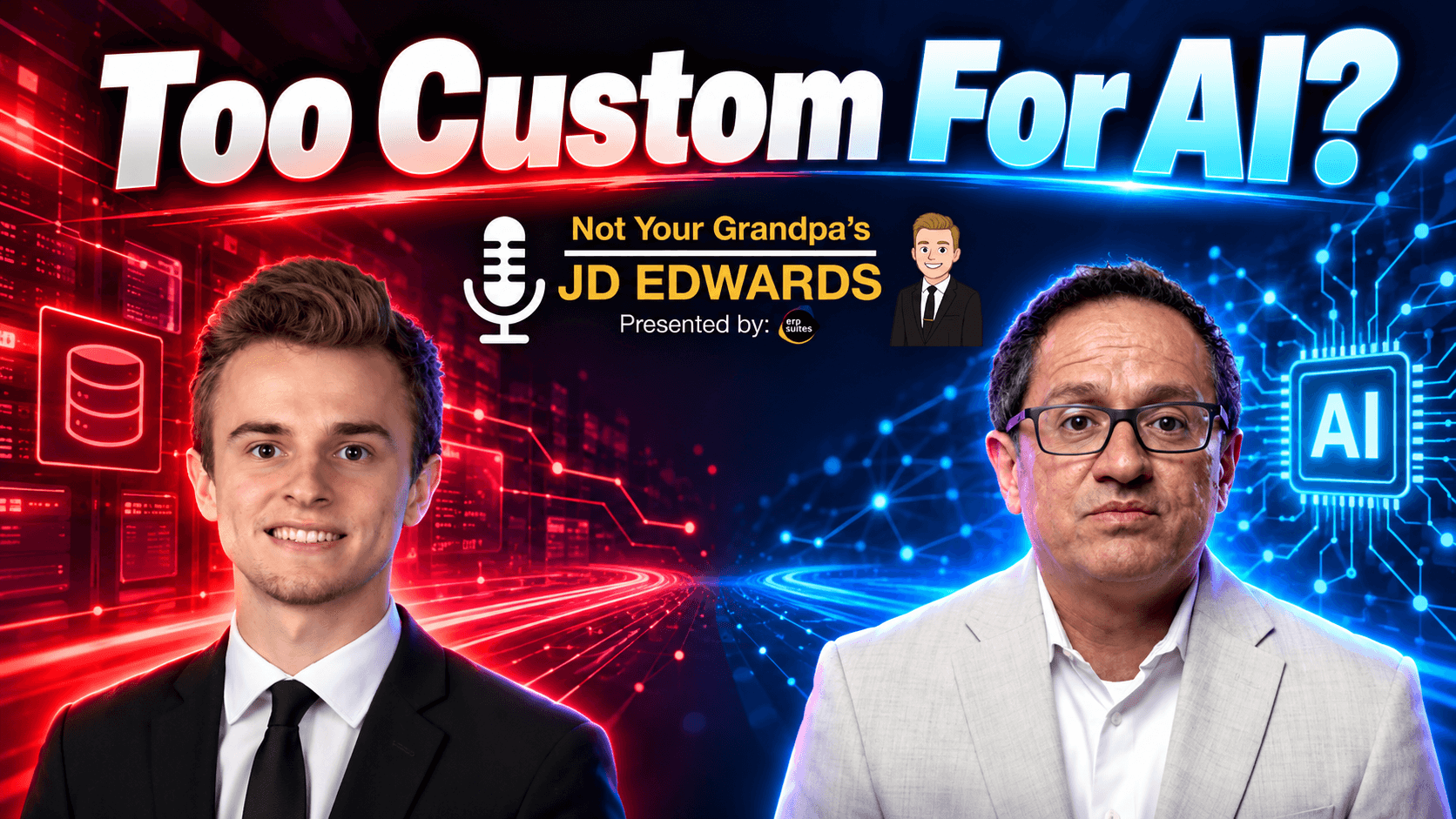

Should your company build its own AI or buy an existing solution? In this episode of Not Your Grandpa’s JD Edwards, Drew Robb joins Nate Bushfield to explore the costs, risks, and practical considerations behind each approach, including the option to customize an existing AI platform. They discuss data readiness, security, internal resources, and user adoption, with customer examples that show why the right decision starts with a clear business problem.
Table of Contents
- Introduction to Building Versus Buying AI
- Using Existing AI Models and Preparing Your Data
- Buying AI Solutions for JD Edwards
- Taking a Hybrid Approach to AI
- Comparing Costs and Risks
- Hidden Costs and Vendor Limitations
- Security and Control Over Company Data
- Evaluating Your Options and Customer Examples
- Choosing Your Approach and Taking the First Step
Introduction to Building Versus Buying AI
Introduction: Why AI Agent ROI Matters in JD EdwardsShould your company build its own AI or build a solution that's already available? And could choosing the wrong approach end up costing you more than you expected? Today we're breaking down the cost, the risk, and trade-offs of building versus buying AI. By the end, you'll have a clearer idea of which approach makes sense for your JD Edwards environment.
Welcome back to Not Your Grandpa's JD Edwards. I'm your host, Nate Bushfield. AI is opening up new opportunities for JD Edwards customers, but there's an important decision companies need to make before investing. Should they build their own AI capabilities or purchase something a vendor has already developed? Both approaches have advantages, but there are also cost challenges and responsibilities that aren't always obvious.
Joining me today is Drew Robb from ERP Suites to help us understand the differences and how businesses should approach this decision. Drew, welcome back to the show. Thanks for coming on. But for those out there that maybe haven't seen you on the show before, could you give them a little bit of a background?
Yeah, sure. Nate, thank you so much. And Nate also told me it's our 50th podcast, so he wanted to bring me back because I was actually the first one on the on the podcast. So thank you for having me back for this special moment. You've done a great job with the podcast. But yeah, man.
So my name is Drew Robb. I am the AI advisor at ERP Suites, but also work closely as we start to develop more and more agents in our ecosystem. So as well as advising agents on, you know, what kind of business processes they want to start to build agents around, I also work heavily on the infrastructure and technical side to actually deploy the agents to customers in production ready environment.
So can't wait to talk about this topic today. It's tossed around a lot, you know, because this is really the question that, you know, customers really think about is like, do we do we just build our own? Do we buy it? Right? And and I think we're going to get into this in a lot more detail today. And I can't wait to share with the insights we've gone through, especially with talking to customers and what we're seeing out there in the ecosystem. So thank you, Nate.
Yeah, of course. And yeah, you've actually been around a few companies that have decided to build their own, and you've also been around a few companies that have decided to buy. So let's start here. What does it actually mean for a company to build its own AI versus buying a vendor solution?
Yeah, Nate. And it really comes down to the fact that, you know, building really involves developing custom applications and existing AI models rather than be creating a model from scratch, because creating a model from scratch can cost a lot of money. So essentially what customers are really doing is they're going out in the renting. Technically renting models is a good way to say it, right? So they're connecting out to different ones such as Claude, OpenAI, ChatGPT, you know, Copilot and really leveraging them to help them with their AI services and connecting that to their data, you know, in their system.
But it's really important to really understand too is like, you know, going off of data, like how clean is your data, right? You know, when, when you're building it, you know, is it readily accessible? Do we have to connect to a lot of third party systems out there to get various amount of data? But you know, a lot of our agents leverage JD Edwards. But you know, you might need to connect to Salesforce, you might need to connect to internal file shares, you know, different Oracle or databases or SQL databases that don't live in JD Edwards. So that becomes a big, a big picture and, and how do we integrate those? Is also is also big right when you're building.
And I think a really important thing to understand is, you know, every AI model is not built the same. So you really got to understand your specific business requirements and pick the model that's going to best fit your business requirements and your, your business processes, right? And really start to leverage JD Edwards orchestrations. I don't want to get too much into our agents here, but we do leverage orchestrations to to call out to JD Edwards to get data from JD Edwards, push data back in the JD Edwards. So what you're going to see here is not just when building out your AI agents, you're also going to just improve automation by leveraging the, you know, tools and technology such as orchestrations when they're needed, right? And that's the important thing.
And I think it's also important when building the agents. And when we talked about and we talked about in past, you know, podcast Nate is to really build out an interface or a dashboard. And you don't really need that when your agents become fully autonomous. And we'll get a little bit more into training later and training your agents to become fully autonomous. And actually going back to a podcast I had with you is about autonomy and how much autonomy should you give an agent, right, in different levels.
But at the very beginning, it's important to build a dashboard because you'll have that human in the loop interaction, right? And in the, in the, in the, in the users will have visibility to to the agent, how it's operating and whether it's making the right choices or not and gives the users the ability to also train the agents as well. So those are various things you have to think about as well as really just the whole back end infrastructure when building an agent. That's very important. And in ERP Suites, we have an AI agent platform that we deploy all our agents on, but that is the foundation for making it so you could scale and build more and more agents as time goes on.
Now, you know, with buying agent, with buying, right, what you know, really with a vendor, right that that was the second question you asked me. You know, it really does provide sort of like a hybrid approach, but really the vendor does the whole stack, right? So the main vendor, you know, makes the model decision what model you're going to use for the business process. You might become locked to that model. You might become locked to a certain infrastructure. You know what at ERP Suites, we leverage OCI infrastructure there, but you may be locked to AWS or some on-prem infrastructure that the vendor deployed for you. So you'll be locked into that.
You don't have to engineer your specific solution, right. You you talk about the business processes with the vendor, which is very important to establish that, but you know, you don't really work on the I'm building it out, but you work on really the permissions, right. How does it interact with JD Edwards securely, you know, what prompts does it use and you're more inclined to spend a lot of time too. Once you have the business process figured out is really training your people once the agent gets deployed right and and and promoting usability.
But really what you got to think about too when buying is also, you know, it follows a usage pattern, right? So every single time you train the agent, every single time someone uses it, the tokens add up right against the model. When you're using the model and you're using the agent, everything adds up. So these are just some examples to really think about when buying. It does kind of inhibit you from making those customizations, especially if your JD Edwards system is very customizable and it becomes very hard to distinguish and build out a good solution, a good agent when you have to talk so much with the vendor about making it so customizable. And we'll get to that a little bit later when we talk about some customer examples.
Yeah, and it's interesting you bring that up because either way, you would have to customize your agent to be a part of this workforce, right. And when you're talking to a vendor, maybe it's there's that wall there of maybe they don't fully understand those customizations. And so you have to train them on the customizations so that they can train the model. If you're building it from in house and you have a true understanding of your customizations, then it might be a little easier in terms of time. But if you're hiring new people to actually build this out, then you have to train them anyways. And so you're kind of stuck in this weird loop of do you have the right people in house to build your AI agent right now or do you not? And that's where it really comes down to.
Yeah, we'll say one more thing to add just real quick is like another with working with the vendors trust, right? Do you actually trust them to build the right security around it to, to have the right roles and responsibilities built in your JD Edwards? So certain users aren't accessing something they shouldn't access, right. The finance people aren't accessing, you know, a sales order entry agent, right? So that's important. So trust is another big thing to think about too, when you're buying.
Yeah, yeah.
Using Existing AI Models and Preparing Your Data
And you, you brought this up a little bit earlier, but does building your own AI mean starting from scratch? Or can companies use existing AI technology to start them on this path?
Yeah, absolutely, Nate and it and it really depends, right? The one thing I will say and I'll get into this is starting from scratch is very rare. And pretty much the biggest thing is building your own internal models cost hundreds of millions of dollars as well as training those models. That's going to be your biggest expense right there because there's so many other better models out there, like I mentioned, like the ones above, like, you know, chat Claude, you know, Grok everything out there.
You, you're better in tune to leverage those models because that will really just set you up to be more ahead of the curve, right? Because you'll take so much time and effort and cost to build out your own internal model, right? And, and really a big thing too is like, you know, most companies are lacking that clean data also, right? So we talked about starting from scratch. I mean, it's not just training the model, it's making sure you have the right data that you're playing into the model so that you're getting the right results. So you're not hurting your business when you start to build out these AI agents and start to use them.
And, and the one thing I also say around models, and this is when you know, you're starting from scratch is like, you know, models are continuously changing. You know, with our AI platform, what we built into it is, is one, the ability to pick the right model to fit the right scenario, right? So, you know, maybe your sales order entry agent may use one model, but maybe you know, something that involves a little bit more predictability or predictions, you know, like a financial planning analysis agent may use a different model. So it's just really how we build out the agents and the ability to be able to interchange those models is important.
And models are continuously changing as well. So newer models are coming out, right. So homegrown model might be outdated, you know, two–three weeks later, maybe, you know, as soon as a month with how fast AI is moving. So there's really no point to to really do that.
So what what companies really start to do then? Is it really buy again, they buy those models to build onto their platform, right, build into their system. You you know, we've seen a lot and it's kind of evolving, but but back then, you know, companies just really want to get started with AI. They'll they'll start to integrate Copilot right. And so to read some like, you know, manual customer, you know, manual documents to get more information, then that's really what you think about. You buy those to integrate with your system, right, and then you have the ability to upgrade to the newest, latest and greatest, you know, Copilot version. That can be, you know, better for you, right.
You know, again, running, you know, these models on your platform. You know, you, you really do have the ability to get full cost and usage and we can get into that a little bit later, but that that's going to be your biggest cost is like, how much are you going to use? How many tokens are you using? How much are you reaching out to the the model, right? What can we kind of store closer in a, you know, a RAG model? And I don't want to get too technical here, but like there's different ways to think about that, right? And, and it's the ability to really adapt and change models in certain situations.
So a lot of it is around that. And that's that's kind of where customers seem to lean is like, let's use something that's already out there, right? There's companies out there building models that use them.
Yeah, exactly. We already have too much going on. We already have too much going on, right. So, yeah, yeah.
And we're talking about cost here. Like, yeah, it would cost hundreds of millions of dollars, maybe a little bit less, but also you would take so much time just to get it off the ground. And you're right to bring up that clean data. I mean, we've had podcasts in the past where we talk about how important clean data is. That was before we were really talking about AI agents.
Buying AI Solutions for JD Edwards
So what does, let's switch gears here. What does buying an AI solution typically look like for a JD Edwards customer?
Yeah, I mean it really what let's let's take a step back here. You know what what did it kind of used to look like, right. So, you know, examples for an AI or, you know, JD Edwards customers, just like, you know, you're buying some third party invoice processing tool, right, some, some tool like that, or you're leveraging, you know, different services out there that you can use, whether it be, you know, a digital assistant and companion with your JD Edwards system or even, you know, really what we talked about with inside the JD Edwards world is, you know, JD Edwards doesn't have the ability to embed AI into their JD Edwards environment.
Well, that's also was talked about as well, like how can we embed this in, you know, in the JD Edwards using UDOs and whatnot, you know, and, and that becomes a big thing. And in a lot of these AI capabilities, especially with JD Edwards, you know, work underneath Oracle, right? We can use those adjacent, you know, cloud services to, to build out these, these, these different tools, right? You know, and then a company just may buy that model, like I said before, and then connect it to your JD Edwards data.
And then what we're really seeing now, and it's not just us, it's other vendors as well. It's it's really other customers too. You know, those are kind of the things of the past that I mentioned. We're really seeing agents in the JD Edwards workforce that can act autonomously to to to improve your business processes, right? They don't just assist. They don't just give you recommendations in a digital assistant way or they don't, you know, just provide a simple processing tool. You know, OCR, there's there's different to read a document. You know, they're they're more in depth than that, right?
You know, they can complete tasks in JD Edwards, they can reach out to other sources and bring back data or they can update JD Edwards with given the right autonomy level there. So that's what's really coming to, but it's also done very securely nowadays, right? And we, we, we make sure to lock, lock down security as well as auditability, seeing what users start to interact with what agents, you know, for the business, because that's the biggest question. Obviously it's always around security. How can we, how can we make it more secure?
So that I think that's what you're starting to see now is it's becoming more of digital work, source work, a digital AI agent workforce. And we need to focus more on the business requirements, business processes, right, to start to build these out again, leveraging orchestration to again, grab data from our sources, bring back data in. And then we start to use these JD Edwards tools that can help us build out these agents as well. And it's a companion for for you in the process.
Yeah. And we are seeing it a lot more in terms of autonomous AI agents out there. I mean, ERP Suites started with digital assistants because that's where we thought the market was going because we didn't really understand what AI could truly be. And now we're looking at it where there are agents out there that can run their suite of agents, I should say, that can run a side of your business to a certain degree. Yes, you're still going to need that human in the loop. But in terms of the actual grunt work, it's going to be different. And it's interesting to see how everything has truly changed throughout this last year, even, and exciting to see where it's going in the future.
But at the end of the day, when you're looking to buy, when you're looking to sell or buy or build, I should say.
Oh, absolutely. Yeah.
When you're looking in between those two options, the real question is do you have the time for it? Do you have the ability to create that agent? If not, then buying's probably your best option. But if you do have that specialization, if you do have people in house that can do that and you figure out your process, you clean your data, you can definitely go that direction as well. Both ways are, there's no right answer here, but there are ways that are easier for your company.
Taking a Hybrid Approach to AI
So let's maybe talk about maybe a middle ground here. Is there a world where companies can purchase AI technology, but then customize it for their specific needs? Kind of a meeting in the middle here.
Yeah. And this, this is why I see it going a lot, Nate. Is there really is a middle ground, right? Well, a lot of times what customers are doing is they're buying those prebuilt AI solutions, right. We have an AI platform, but there's different AI services that do different things as well right now. But they're what they're really doing is they're buying that skeleton agent is what we like to say.
You know, we think of like off the shelf agents that we're building out specifically for ERP Suites, whether it be in finance, manufacturing, homebuilder, you know, inventory, like it's, it's really everywhere, but they're buying that internal skeleton. So it has all the connectivity of the AI agents, right? It has a scalability to to perform as well. So that's what you're going to see is, is really, they're going to buy really that skeleton AI platform to build off of.
But then we really got to go back in and build or look into and connect to, you know, your JD Edwards functionality and different rules and validations such as PO match, vendor checks, different tolerances that are already built in your JD Edwards system. Or we realize they're not built and then we have to build them to connect to the new AI solution that we're building out or AI agent we're building out, right?
And also you going to build the, you know, the approval routing, you know, who gets to touch what, what are those certain thresholds when you're sending a PO through? Where does it look at for managers? Even if it's going through an AI agent, right? Maybe it has to go to Sally first for this level and then, you know, Dave later on. Like that's where it really turns into it. So you'll have that inside of JD Edwards. But if you don't, you can start the building along with building out your AI agents.
And then lastly, just really connecting, right, right. There's so we talked about JD Edwards, but there could be different, you know, we mentioned it before, different third party solutions, different databases your data lives in, right? Maybe it's external data we need to reach out to securely. And that's really around leveraging, you know, orchestration to grab that data, but building out those API calls to securely grab that data and bring it back to the agent, right? An agent repository so it can learn and train and understand your data, right?
So you'll see there that that's the hybrid approach, right? You already have the JD Edwards functionality there. We just got to build the skeleton and AI agent around it with the model to be able to complete the business requirements and improve those business or business processes that you have in your business. So that's pretty much the most important thing and really what we're seeing going forward in the JD Edwards ecosystem.
It's also funny to me that there are companies out there that are maybe listening to this or watching or whatever that are thinking to themselves. Yeah, but we're super customized. Like we can't take a skeleton and then customize it to us. We're too customized. I hate to say this, you're probably not. There's maybe 1% of this entire industry that is too customized. But that's not really an issue there.
If you're too customized, that just means you need to clean up your processes more than anything else because no one can be too customized to utilize AI, especially the AI that we're talking about right here. So especially if you are building yourself, then you can build it into it. But getting a company outside and coming into your infrastructure, you'll be able to customize it as well. You are not too customized to get AI is what I'm trying to say, correct.
Yeah, yeah. I mean, you know, we we talked about off shelf agents like we mentioned, but there are ways and again, that that goes around and we'll talk about a little bit later in this podcast around really starting to do like AI assessments to get those vendors really understand your processes. And you know, it doesn't always have to be AI is another thing, Nate. We've talked about this before. How can we leverage orchestrations for automation? How can we leverage current JD Edwards functionality we're not already using as well?
So definitely. Yeah, you're never too customized to integrate AI or you would just fall behind if you think you are right. It's all about improving better in the world, in the in this world. So, yep, yeah.
And we actually have two podcasts to talk about this one with Manuel that came out on October 12th, and then also the one that talks about the future of AI that came out October 26th. So go take a listen if that really resonates with you.
Comparing Costs and Risks
But moving on, let's talk about cost here. When you're comparing building AI internally to purchasing a vendor solution, what are the biggest costs and risks that these businesses should consider?
Oh, absolutely, yeah. I mean, to be honest, you know, it's pros and cons about it. Like, that's the biggest thing you really got to think about here, right. So when we talk about building internally, you know, it's the skill, talent, it's hiring the right people. And I don't just mean developers to build the agent, you know, you need the infrastructure around building that agent. So you need those people. You need the database people and and all the people to understand that how the data works, right, and where it all lives and how it connects.
Like we need all those people as well, you know, we need people to do QA, integration testing, but then we also need the business, you know, the business analysts to really understand how the process work. It works, works in that process on a day-to-day basis, right. I mean, even working with customers, we're working with all these different peoples. IT to understand connection, right, security.
I mean, what you really have to think about is it, it has to be, you have to make sure your company is very cross pollinated, right? They share, right? They work together. They're not in little silos. And that's the biggest hurdle really in cost of all is making sure everybody's able to work together and formulate together. So that that's definitely it. But definitely in in the skill, talent, right? If you don't have you got to hire them. If if you, if you hire them, then you got and you need more people, you got to train them again, right? So having a good onboarding process, it's all important there, right?
But then you also look at, you know, buying from a vendor, right? What, what's the license cost going to be? You know, we leverage OCI, what's that license cost? What's the service cost? You know, what's the usage fee? You know, how much are you depending on the vendor? And we talked about trust before. How much do you trust the vendor, right, to build out the right road map? You know, possible customization costs like you mentioned, you mentioned it and we can get past it. But like how much are you willing to invest in an assessment, right? When buying from a, you know, a vendor, right?
It really depends on on your preference. That's what it comes down to, right? You know, how much control do you really need? Like do you want all the control or are you willing to pass off some of it? Because again, the development's a lot of work internally, you know, the infrastructure and support is a ton of work internally. You know, maybe you just want to take your agent and be in charge of promoting usability and adoption in your company because that's the biggest thing. But it really depends on that, right?
But security is huge, right? You know, talking with customers going back and forth like, wow, we really have to expose that to you. We have to do this, you know, for you to have access. Yes, you do for us to have access, but do you trust that? Do you want it all built in house? And we mentioned past podcast about just building on-prem versus the cloud. A lot of people just want to keep it on-prem and you got to think about that too, right?
You know, time to value, you know, vendors will obviously have off the shelf agents or the ability to customize agents to fit your needs easier. So they will be built more quickly, whereas internal obviously take a longer time. But again, you know, your processes, you know how it works.
And then scalability, you know, we mentioned before usability, but it's also just do you have a strong enough platform to be able to scale? And I'll talk about this in our later section here, but like, is it built out? So you can, you know, build out the platform, then, you know, input, integrate and implement one agent and then another one right after and another one right after. Because that's what it really comes down to. Rather than, you know, building one agent and then, you know, one platform and then having to build a whole another thing, another platform, another, you know, another build out for a second agent. And that's really the difference there.
You know, whatever approach, it's really going to decide and depend on usability and user adoption because you're going to waste money either way if you don't have that. So that's kind of the biggest point I'll end with there.
Yeah, no. And that's a great point because at the end of the day, when it comes to user adoption, if you're not utilizing the AI agent, then you're not going to recognize that ROI. And that's what agents are all about is getting you a return on your investment. And if you're buying, if you're building, you need to see that return or it was a waste of time.
So user adoption, you are correct. That is the most important thing and it's always going to be continuous because you're going to have turnover in your company. There are going to be new people that need to utilize this AI. So there's always going to be that training aspect to it. But how easy can it become is the other question.
Hidden Costs and Vendor Limitations
So let's talk about some hidden costs. What hidden costs do companies tend to maybe overlook when deciding to build their own AI?
Yeah, absolutely. And it's, it's not just, you know, let's say you have a group of developers and they're developing projects that are products in your company, right? Well, what happens when you start to develop, you know, other AI solutions and AI agents? Well, that internal staff that was working on these things that you know, currently, and that's their day-to-day job, have to start working on AI agents. So you become spread thin, right? And what happens if you have to support a customer project and developer needs help there and you, but you're building these agents for your business. I mean, it's just, and it's not just developers. That's just an example. It's your company being spread thin. It's really employee time is what you really have to think about there, right?
Obviously the specialized expertise, as I mentioned before, it's not just developers, it's not just understanding AI, right? It's understanding having a subject matter experts in the business, but also understanding the infrastructure behind it. So everything works and operates smoothly and securely. So that's really hard to do and hard to maintain.
I mean, obviously another hidden cost that we've we've worked with customers about is like we'll get to a point we'll talk about business process. So where's this data in this table? Oh, it's not there. It's in this customized table. Data preparation's important, right? Is it cleaned? Because again, like we mentioned before, you build out an AI agent, you build out something that's using your data and it's not correct. And we've harped on it so many times, but it's so important if you get better results. So you're going to waste money and you're going to think the AI agent isn't working when your data is not where it should be, right?
And that needs to be solved first, as we've always said, right, you know, continuously, you know, innovation, right, when we talked about enhancements of agents, but it's understanding models and, and, and how fast they're changing. And is there new and better ones out there that can optimize, optimize time, save you cost various other things in that space.
And, and another one's really, and, and we've, you know, we've run into this in the past is, you know, what's the usage cost? OK, we can kind of easily figure out how many users are going to be there on a customer service team using a sales order entry agent, right? But what we don't know is how often they're using it, how often they're hitting the models. How can you save costs in certain ways to get data closer or saved, right, with the retrieval augmented generation, like how can we start to save those costs as well?
And obviously, the biggest one, change management trying to take the time train the people that are using the agent. That's the biggest thing, right? We talked about before, it's user adoption, but it's also the managers or the champions of the project that we train the people that are going to start using the agent that that's very important.
Yeah. So what costs or limitations should companies be aware of when they're purchasing the AI from a vendor?
Absolutely. You know, it, it's definitely the, the, and, and now I'll just be straight up about this. It's, it's the consulting fees, right? So it's like, you know, we have to understand your business process. There's going to be a design process and, and an understanding of business requirements that's going to go ahead of even building out the agent. We can't just build it without knowing your business, not just at a high level, but at a pretty deep level, right, with your help because you are the experts of your own business. So definitely those consulting fees.
Another thing you ever think about is like subscription cost, usage fees, you know, they all tie into the same thing with what's really the back end infrastructure fee and really the ongoing infrastructure around it. Because it's not just going to be a one time, you know, fee there, right?
You also got to think about again, vendor lock-in, especially if they're not giving you the ability to, for example, switch models or building on a different platform, you know, like we talked about on-prem in the cloud, like that's something you really got to think about too. You know, scalability. I, I mentioned our AI platform provides easy scalability where you build a platform, you deploy one agent, you can deploy another, another and you can keep doing it right. But other companies may be individualized, you know, silos where you deploy the agents so scalability is harder and it costs more to scale.
And I am we mentioned token spend, you know, really we mentioned also the level of support and I'll just go out and say it like our agents on our website, you know, cost 5,000 per month and you know, the implementation cost anywhere from 50,000 to 100,000. And and with that, like those are just a range of costs. Like we know that was that's what it cost, but I mean, really the fee is like that design process and that AI assessment beforehand to really understand your business. Like that's also going to be a fee that's also out there as well, right?
So with with vendors, you really just got to start thinking about, you know, it's not just the pretty price on the wall, it's not what's posted out there. What else should you be really thinking about that will go into building this agent? And those are really a lot of things that kind of get overlooked here when when you start looking at buying AI agents.
Yeah. And I will say there's also that aspect of it when you are doing an AI assessment, maybe you actually don't need AI. There are those examples out there where you could just utilize orchestrations that you already have. You can utilize so many different things in terms of automation without having to go into AI.
So yeah, we can talk about the cost here. We can talk about what an agent costs and the implementation. But if you do an assessment, you might not have to spend that because maybe these issues that you're having, maybe the specific pain points that you have could be solved a different way, a cheaper way, 100%. And and that's what's great about an AI assessment. And so, yeah, that fee is going to be smaller than the rest of what we're talking about here, but it could save you way more money than if you decide to build it in house without talking to someone first. That's all. I'll say about that.
Security and Control Over Company Data
So you did mention security earlier and I do really want to harp on it because it is something that is overlooked. When you come to upgrades, AI, anything really in this industry, security is the number one thing that is overlooked. So how do security and control over company data factor into this decision of building versus buying?
I mean, it's pretty much everything, right? Really both decisions need strong access control, right? Oh, do we have the ability to access data in JD Edwards or third party systems securely. Is the data, you know, protected, is it encrypted, you know, whether at rest or in transit, you know, and that's really important.
But you know, when we just split out a little bit here, right, building internally, you know, your data really does stay in your environment, but you're also responsible for connecting to those third party models if you're not building in house, right? Really monitoring everything and monitoring usability and keeping track of cost and making sure you know what they're within budget.
But also the important thing that people really forget about when building internal is the auditability, what users are using what and again, I'll just quickly give in to how our agents work is just, you know, they do leverage JD Edwards security. So like when someone's using the dashboard, they it says their user when they actually make changes to JD Edwards, if the agent is doing it, it uses the agent's JD Edwards service account to make changes.
So that's something that people often overlook when building internally is the auditability. And they go back to do the audit at the end of the year and they have no idea who did what for the agent and what actions it took. And that's another thing that's listed in the agents too that we build out is, you know, specifically what is the agent doing? What steps is it taking throughout the process to get a task done? So that's that's big and that's probably the biggest one that people miss is the auditability.
Whereas when you buy from a vendor, you know, you really share the responsibility, right? Who's in charge of what? Like who's in charge of building out the back end infrastructure? Who's in charge of security? And that's when trust comes into play, because a lot of times it's both working together, right?
You know, and, and we can talk about things like data retention, you know, how long is the data stored? Where is that data stored, right? Do we just delete it? Do we move it back in the customer's environment because they don't want it sitting out, you know, in the cloud, right? And it depends where that lives, you know, what, what, what kind of process and policies do you go at? You know, where's the data processed? You know, how do you train your models? Where's the model trained? Where's model live? You know, and, and really who is liable if something goes wrong?
And that's the biggest thing with vendors like who who's in charge of what when, when everything breaks loose. And that comes, you know, early on when you write up the contract. That's important to outline because then it becomes, you know, an issue when you know, you're blaming the vendor, you blame the vendor, even though it's not the vendor's issue, it's yours. And this is this whole thing. So like there's just a lot of things you got to think about security with the vendors.
And that's when it comes back to the overall trust. Do you trust the vendor? Are they giving you the right information? Do you trust the cost? Do you trust what their their setup is, their infrastructure, the platform? Are they working with you? Because really what we get back to Nate is, you know, we're all trying to enter this AI world just as vendors too. We're trying to sell to customers, we're trying to gain trust.
So trust is a very important thing in this space and you need to make sure you establish trust with your vendor and they will not, you know, make you spend millions of dollars on the AI solution you're not going to be able to use because it doesn't work. So yeah, it, it really depends, you know, I mean, it's both ways. You can think about it both ways here.
Yeah. The main thing about it though, is do not forget about your security because it can come back to bite you. That is one of the main things that comes with any type of, again, upgrade, AI agents, anything that you are implementing into your JD Edwards environment. Do not forget about security because it is the one thing that could really put your company at risk.
Evaluating Your Options and Customer Examples
So let's maybe talk about a little bit deeper into all of this. How should a JD Edwards customer determine whether building, buying or maybe a combination of both makes the most sense?
Absolutely, Nate and it again, probably the biggest thing is start with the specific business process or problem rather than choosing technology first. What can we and it goes back to what you said before you know, will this business process really be improved using AI or can we use JD Edwards core functionality or automation? We really have to start to find that, which is why the AI assessment becomes so important because we start to figure out what, you know, which ones are AI solutions or AI things we need to build out versus what ones are not. And that's very important, right?
For the functional requirements, you know, does the tool currently exist you need or do you need to build it out, you know, or do you just need to start to look at the limiting manual processes? It's in any certain way, right? Like I mentioned before, kind of those three different ways we do with JD Edwards.
And then really you know, what's on the total cost here, you know, how much is everything going to cost you? When I listed so many different things today, you know, license usage, integration, ongoing maintenance, development enhancements, you know, you know, what's the actual, you know, it's really just not about the purchase price initially, it's the AI agent solution. Initially it's, it's all those other things and it's, it becomes very complex and we really need to talk about how to lay them out to a customer to really for them to understand it.
Do you have the people to build and support it? Are they properly trained? Do you need to hire? Do you need to onboard? You know, how, how complex is your JD Edwards environment? Really, you know, how hard is it connect to JD Edwards or connect to other third party sources, right? I mean, orchestration is great, but like do we have the ability to access third party sources to bring back to an agent? Like that's very important also. And what's the long term support look like? You know, is it two years? Is it three years?
But I really wanted to just compare really quickly just to the customers we're working with and just to through the audience to understand, you know, you're not behind, right? There's different ways to get you there. You just got to take that step forward.
For example, one of our customers, you know, that started from the very beginning. They started with that AI assessment because they didn't know what specific agent they want to develop. They just knew they had to improve. They knew they were lagging behind from their competitors. So they went on do the AI assessment. You know, they define processes of what they want to kind of focus on. And then we started picking apart different parts of that elongated. It was this elongated process, right? And which things needed just JD Edwards core functionality, which ones needed orchestrations? And when was the time to start to build AI agents? Because the data was already there and we can start to make the process even better.
So there was a gigantic list of what we could start to do, but then it turned into a more organized approach, not just throwing AI at everything. Right now we understand their process. Let's deep dive in and figure out how to start to build agents for certain areas, right? And you can start to even build a road map of certain agents. You can start to build out like, well, we can start with this and scale up. And that's when the platform comes into play. But they kind of start from square one, but they're already moving towards, you know, in the next couple months, having a few agents in their in their ecosystem, right?
And then the second customer really knew what they wanted, knew what they wanted as far as building out agents, and they knew they want to improve. So it started with high level discussion just to make sure again it was an agent solution we were looking for and not an automation, RPA or you know, a JD Edwards functionality issue. The missing it was an agent thing. So then we jumped in the deeper conversations and started developing those agents again, time to value, probably a little bit quicker for the second ones, but important to know that we really need to understand the processes no matter what and you know, at ERP Suites we're advisors. So we're going to advise the right approach for you. We don't want you to spend more money than you need to on agents that won't provide you any real value.
But both these customers are great customers and they took the leap, right? They knew they had started somewhere, you know, we had a road map to help them start and other vendors out there do as well. But just it's about building the trust to know that you will eventually get there. They just might have to start at a different point.
Yeah, I mean, and that's, it's a great way to look at it because both of these companies, one didn't really know what they were going to do when it came to AI. They just needed to fix certain. They needed to fix processes. They weren't sure exactly what that looked like, but they knew they needed change.
Then on the other side, it was well defined. Before they even walked in the room, they did an interior AI assessment, so to speak, and they figured out their exact pain points where AI was needed. And yet there were still some spots there where we figured out that you could actually utilize orchestrations instead of AI agents. So it was a good mixture there. And I like that there were two completely different situations, but yet they both found exactly what they were looking for and they're excited for what the future holds. So I appreciate you sharing those.
Absolutely. And I will just say just to end on this is like no matter you know, where you're integrating, you know, when you start to integrate AI into your business, just remember to pick one problem first, focus on either building or buying a platform that fits you and then deploy that one agent. And then it will make it more seamlessly easier to scale up and deploy more agents. So that's kind of the really big first steps. And if you need to do an AI assessment before that, you do the AI assessment before that, right? So really take the steps that fit your business needs and where you're currently at on your AI journey. So use but really AI journey, right? So, yeah.
Choosing Your Approach and Taking the First Step
9. Choosing Your Approach and Taking the First Step
So what would you say are the clearest signs that a company would be better off buying an existing AI solution?
Yeah, I mean, really, the clearest signs is, you know, a proven solution already exists. Like we mentioned before, we have our own marketplace out there with agents that may just need a couple of enhancements to connect to your JD Edwards environment, but it currently meets what you're trying to solve, right? And other vendors have that option out there for you. So that probably makes the most sense for buying, right?
You know, it integrates easily with JD Edwards and other systems that you have in your environment and it's supported, you know, methods such as, like we mentioned, you know, APIs, orchestrations, right, is very important as well. If you want to again, have an AI agent quickly and you have what you need, right, the implementation is a lot faster than building, like we mentioned before, that could take a long time based off time and resources.
And again, and also going off resources, you really just lack, you know, internal resources and significant people to help develop the agent, but also the resources again, around infrastructure, like we said, scope for security, business analysts that all have to work together as well. So that that's probably the one where you would probably focus more on I'm I'm buying an existing agent. It'll put you in a good spot as well as data readiness. We can't forget that, right? Is your data in a good spot? You can just immediately take an agent off the shelf connecting JD Edwards environment.
Hey, that's how we started this podcast. You know, we were talking about data readiness. So on the other hand, though, when would you recommend building that custom AI solution or maybe taking that hybrid approach?
Yeah, absolutely. Yeah, definitely the, the, you know, when it's really customized, again, AI assessments can help with that to understand your customizations. But it's really when you just kind of trust that you will always understand your process way more than a vendor can. It's just so convoluted, right? Data is kind of going everywhere. There's maybe not one source of truth either for data. It kind of just lives all over the place, you know, and you need to build your own customized solution.
That's very important, right, when it's when it's specialized, you know, industry, right? Obviously in JD Edwards, we're not really in the health industry, but that can get a little harder because you know, so much sensitive data goes into that different compliance rules that might not be regulated. You know, another one thing about is construction, like we don't really work with construction companies in JD Edwards, but it's like your industry, right? You have specific requirements, right, that go way beyond off the shelf solutions that you see up out there, right? And we can work with ones out agents are that agents are not already developed, but it really does depend on the industry.
And you really just understand your own logic. It's been like years, you know, so many years of just in depth logic, different data, you know, handling methods and whatnot. And you just feel like the assessment just take way too long for time to value is really when you we need to start about that.
And hybrid, I mean, you know, it's when you know, existing AI capabilities are really out there that you can start to adopt. We talked about the hybrid approach a little bit earlier, right? It's the ability to buy that platform and then build inside of your own JD Edwards system to kind of connect the dots there, you know, and and so that's basically like buying the AI agent solution, the platform to build your JD Edwards rules and approvals on top of it is what we really see a lot of customers going after nowadays.
Exactly. It's buying that skeleton and then customizing it specific to your environments. And that might be the easiest way of not adding on too many people to your actual company to actually be able to build this out because you already have the base.
Absolutely from there, that's probably that easiest way for the highly customized if I mean, if you want to go that route.
So what would you say the first step is for a JD Edwards customer who's ready to invest in AI but doesn't really know which direction to go here?
Absolutely. And it's always start with that one measurable business problem and never the technology, always start with that business problem. What are we trying to solve here? You know, does it take more in depth look at if AI can really solve it? Absolutely. You know, you know, really start to evaluate, you know, various different requirements, whether it be development, functional infrastructure, what's the total cost going to be? You know, what's the expertise, you know, what's kind of complexity, complexity and long term support.
You know, and even like, especially if you're building internally, run a focused pilot, you know, don't spend so much money on something. Try to just, you know, if you have a huge convoluted process, let's try to enhance one specific process behind that, right? And so you can start to understand, you know, what are those costs going to be for that specific pilot, right?
And as I mentioned, build the platform first. We have our platform at ERP Suites. So we build agents on top of. So it's easier to deploy, build that foundation. So before you start deploying agents or AI solutions into your business, it helps a ton.
So yeah, and really just around, you know, talking about the two customers, right? I mean, again, I can go in either order. You know, the first customer, they really knew the process they wanted to change, but not which agent. They know which agent they wanted to build, right? So the AI assessment really helped to sort that out, right, the processes and understood, you know, JD Edwards requirements, maybe some customizations they had, you know, where automations can come into play versus AI.
And now we're going deeper into the process to build agents whereas customer two kind of knew exactly what they wanted, but we still need to understand their processes to help improve them because that's the biggest thing with AI agents. We want to improve the processes and after, you know, high level discussions, we really nailed down what we wanted to do and the actual business requirements for the agents to build a fully functional agent in their environment.
So that's, that's probably the most, I mean, that's biggest things right there. I know I did more than one. I'm sorry, Nate, but there's there's a lot of things I kind of think about, but you know, the platform for sure and definitely understanding the business process. Like there's, there's definitely the two there. So, yeah.
And those are the most important ones. But if your organization is exploring AI but isn't sure whether building or buying makes more sense, ERP Suites can help. Our team works with JD Edwards customers to evaluate AI opportunities, understand their options, and develop practical modernization strategies. Visit erpsuites.com today to connect with our team. Maybe even sign up for an AI assessment if that's the way you want to go.
But that's a wrap on today's episode of Not Your Grandpa's JD Edwards. The biggest takeaway? Building your own AI isn't automatically better than buying, and buying isn't necessarily the cheaper option or easier option. The right decision comes down to your business needs, available resources and long term goals.
Huge shout outs to you, Drew, for coming back on for the 50th episode. I remember when we started, we were both living in different places and maybe it looked a little bit younger than we do right now, but it's been a ride and it's been awesome. I'm glad that we were able to do this again, you know, kind of round this all out.
But if you found this helpful, subscribe, leave a like and share this episode with someone on your team. But until next time, keep modernizing, keep asking better questions, and remember, this is Not Your Grandpa's JD Edwards. Catch you next time.