
Can AI Agents Handle Complex JD Edwards Customizations?
October 12th, 2026
23 min read
By Manuel Neyra
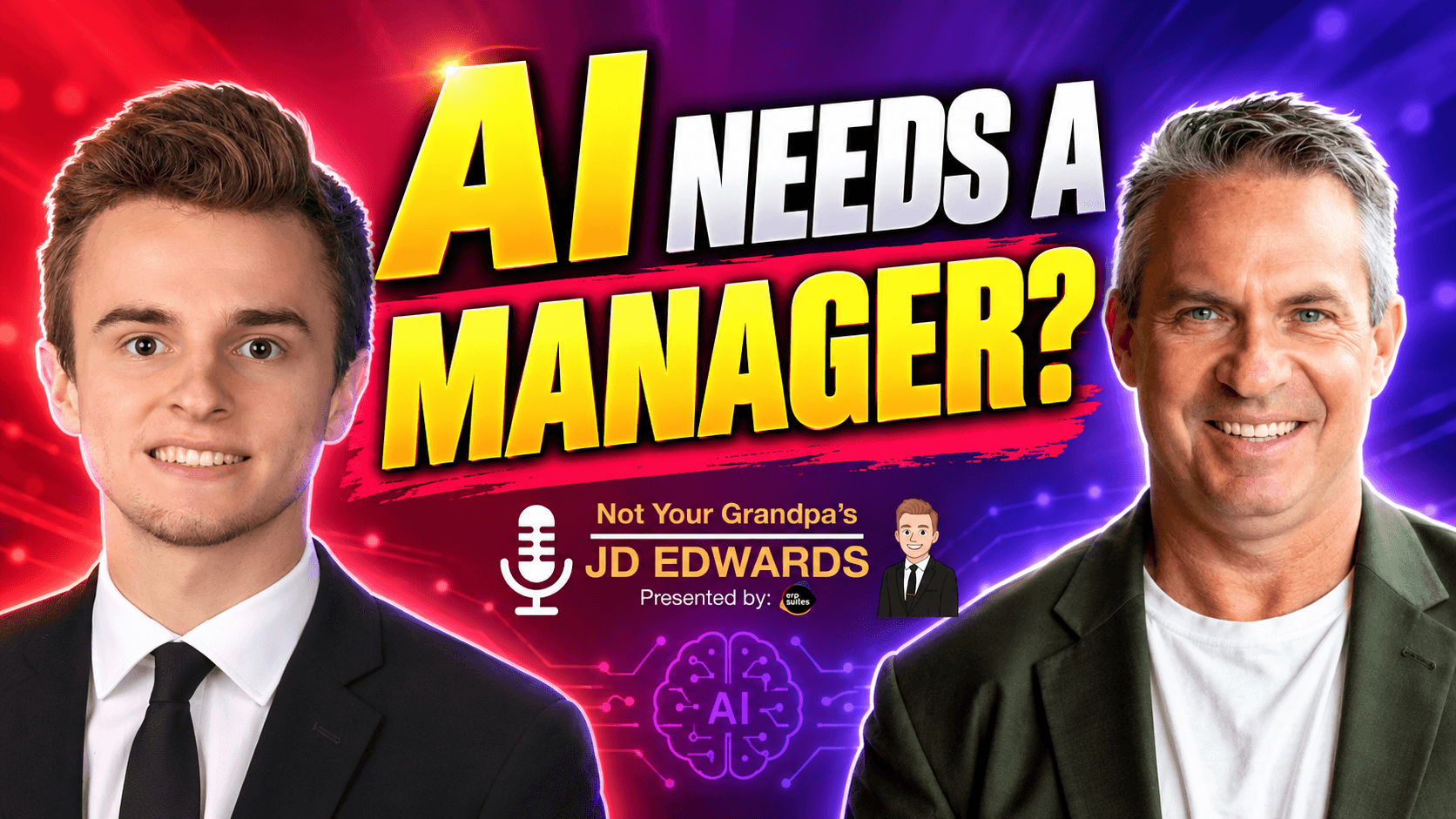
Does having a highly customized JD Edwards environment make adopting AI more complicated? Not necessarily. In this episode of Not Your Grandpa’s JD Edwards, Nate Bushfield and Manuel Neyra explore how AI Agents can work alongside existing customizations, integrate with your current systems, and automate business processes without requiring a complete overhaul. Discover why your unique JD Edwards environment doesn't have to stand in the way of AI innovation.
Table of Contents
- Introduction: Is a Highly Customized JD Edwards Environment a Barrier to AI?
- Business Processes vs. Technology: What Makes Customizations Challenging?
- How AI Agents Adapt to Unique Business Processes and Customizations
- Which JD Edwards Customizations Matter for AI Agents?
- Connecting AI Agents to JD Edwards, Third-Party Applications, and Orchestrator
- Getting Started with AI: Choosing the Right Processes and Building Trust
- Evaluating Customized Environments for AI Readiness
- Modernizing Customizations and Reducing Dependencies with AI
- The Importance of Documentation and Final Steps for AI Adoption
Introduction: Is a Highly Customized JD Edwards Environment a Barrier to AI?
Introduction: Why AI Agent ROI Matters in JD EdwardsDoes AI sound great in theory, but unrealistic for your highly customized JD Edwards environment?
And one of the bigger issues isn't custom code, but a business process that only makes sense inside your company.
Today, we're breaking down what customizations actually matter when it comes to AI agents.
And by the end, you'll know how to tell whether or not one of your unique processes is a good AI candidate.
Welcome back to Not Your Grandpa's JD Edwards.
I'm your host, Nate Bushfield.
One objection we hear all the time is AI sounds great, but you don't understand how customized our environment is.
Sometimes that means custom applications and integrations.
Other times that means the business process itself is unique.
So today, we're asking a simple question.
Does being highly customized actually make you a bad candidate for AI agents?
Joining me today is Manuel Neyra, VP of AI and Products here at ERP Suites, to help us break it down.
Manuel, welcome back to the show.
I know you're a recurring guest.
You probably have five or six episodes at this point, if not more.
But for the people out there that maybe haven't seen an episode with you, could you maybe give us a little bit of background?
Yes, first of all, Nate, always good to be here with you.
Always a good time and we always have interesting conversations so looking forward to today's session.
For folks that don't know me, you know, I, I come from a long history of product development all the way back into the mid-90s with the JD Edwards organization through the PeopleSoft acquisition and Oracle, of course, adding up to almost 27 years being there now.
I'm, I'm happy to be here at ERP Suites leading the, the AI team and the investments we're making, both from an agentic perspective as well as a platform perspective to allow customers to safely and functionally have agents that drive efficiencies for their business.
So really excited for today's topic.
Yeah, I know it's, it's something that we've danced around.
You know, we talked about customizations, we talked about how specific some customers can be, but we really haven't dove deep into this topic.
I mean, how we often hear AI sounds great, but our JD environment is highly customized.
Is that actually a barrier or is that just something that people like to say because they think they're different?
It's, it's definitely the latter, Nate.
It's, it's definitely because they think they're different and many companies are different, right?
What you know, you look at the different verticals of companies manufacturing chemicals, even med device companies, oil and gas are looking for a differentiator, right?
And those differentiations get implemented in JD Edwards and sometimes it's supported by base software that JD Edwards delivers in some cases and not, it's not, right?
It adds additional capabilities that doesn't prevent customers from using AI.
It adds additional considerations for sure.
And all the tenets that we've discussed maybe in prior podcasts, Nate, where identifying the right process and making sure that it's a defined process, it just puts a little bit higher premium on customizations to make sure that those special sauces or special business processes that make that company different are incorporated in AI.
Business Processes vs. Technology: What Makes Customizations Challenging?
Yeah. So that last point there of it being business process, would you say that this is more of a business process problem or could it also be like a technology problem?
That's a great question, right?
I think I would say 90%, 10%, right.
Most of it, it's, it's a business process challenge, right?
And making sure that it's documented, make sure that it's accurate in terms of what you know, that you know, whether it's that special sauce or the mainstream type of scenarios, exceptions as well are documented is going to be tantamount, right?
The 10%, you know, there, you know, as I reflected on, on this topic, the 10% could be made up of scenarios where companies become very, you know, ingenious in terms of how they implement particular customizations, right?
It's one thing to use orchestrations, it's one thing to use logic extensions or any of the constructs that JD Edwards has, right?
Even the, you know, the, the, the, the long legacy type of ways of adding a new application and so forth supported.
Then there's really creative other ways that then become very intricate and maybe have third-party type of technologies embedded in JD Edwards.
And it's a little bit of the beauty of JD Edwards, right?
You can, you can use different technologies.
Those don't necessarily make it prohibitive for you to implement AI.
It just becomes a little bit more complex in terms of how you're going to interface to a third-party technology with third-party data and how do you bring that in.
As we all know, there's different constructs for doing that, whether it's API calls or MCP, right, that everyone's talking about.
So there's, there's different levels, but it, it adds a little bit more layer of complexity into the process, but doesn't make it prohibitive.
Yeah. But even then, does every AI agent need to understand every customization in the environment or are there some exceptions there?
No, great point, great point.
It all goes back to what is the customer looking at trying to realize as a result or the benefits that they want and being able to identify that includes assessing the, the flow of the business process, right? And what is relevant and what is not perhaps for what they're looking to accomplish.
So that, that is extremely key to your point.
But, but it, but again, I, I go back, right.
Sometimes seeing an exception doesn't necessarily mean that, you know, you can't adopt AI.
Yeah, yeah.
So obviously we can talk about third parties and that type of complexity there.
And yes, I get how there are customizations.
Maybe there's some added security that you might need to add on here and there because of the different levels between each application.
But what if the business process, like the actual business process that they are trying to perform with this AI agent is completely unique?
Is there another level of complexity that an AI agent will have to go through or is it a teaching moment?
Can you maybe unpack that a little bit?
How AI Agents Adapt to Unique Business Processes and Customizations
That's a great question.
And there are some interesting things in my career, right, that I've seen of what customers have done in terms of needing to customize JD Edwards to make it work specifically for what they're trying to accomplish for the business process.
And sometimes, right, it was, it was above, you know, 60–70% kind of customization, some significant changes.
And from, from that perspective really it's understanding the functionality, right.
So our agents, for example, what we're building at ERP Suites, you know, we are building some agents that are off the shelf that are kind of catered to base JD Edwards functionality.
But our, but our architecture allows for and expects some specific type of processes that need to be implemented for a customer.
Now, if a customer is highly customized, we can still tackle that and we can still address the business process that they have, even if it's 60–70% customized, it, it takes a little bit more work.
But we're also anticipating that, Nate, in our architecture so that if the base model needs to reflect a customized JD Edwards application or process, we can do it efficiently rather than having to tear everything down and bring everything from the ground up.
And that's oftentimes when the question either comes up or where we're talking right now is, well, you can't use AI because it's impossible.
Well, you know, slowly we'll, we'll talk about that some more here, but the, the other point is, well, is it going to be costly?
Is it going to be cost prohibitive?
Am I going to invest more in the agent?
Am I getting the return?
And that's why, you know, I, I, I feel confident that what we're building allows for that balance so that you can still have your, your, your customized JD Edwards and still get the benefits of AI that everyone's looking for.
See, that's an interesting thing you bring up there of realizing the ROI because of how customized maybe your environment is.
Thing is there, like it's kind of like you already have to teach an AI agent your process anyways.
So if it is a little bit more customized, you're already going to have to teach them the process.
So what's a few more steps?
You know, I mean, obviously you're going to know that answer more than I do, but yeah, so like it.
Yeah, sorry, go ahead.
No, no, no, I think you hit the nail on the, on the head, right.
It's, it's about training the, the, the model, setting up the model for the agents so that it understands the process that it's going to be monitoring, assessing or leveraging to complete a set of tasks.
As long as you do that, you're, you're going to be in big, big shape.
There's nothing prohibitive from it, right?
There are some, you know, I'm not going to overblow it, right?
There are some things that will cost a little bit more time or effort to do, but prohibitive.
I think it's, you know, maybe what's prohibitive, right, is if someone doesn't have, like we've spoken in the past, clearly documented processes, clearly, you know, paths that people, humans today run, if there are exceptions and they're either tribal knowledge or even worse, right, that there's no tribal knowledge, right?
And it's been lost, obviously that's going to cause problems, not just with AI, but with the system itself.
So it's kind of a precursor, right?
You need to have some of the basics in your ERP, JD Edwards or any ERP before you start, you know, layering in AI.
So yeah, it's, it's the agents only, only need to understand part of your environment tied to its job.
That really narrows down the actual problem because, yeah, where you can talk about third-party applications that might be plugged in, but if your AI agent is never going to be a part of that process anyways, it doesn't really need to understand that.
It can just work on its side of it.
It's kind of like a, like a regular person in that way of, yeah, you can have all these customizations over on the finance side, but if someone on the marketing side is working in JD Edwards for whatever reason, they probably won't need to know exactly how to utilize those third-party features because they're never going to work with it.
So that makes sense.
Which JD Edwards Customizations Matter for AI Agents?
So what types of JDE customizations actually matter when implementing an AI agent?
I would say the ones that, that matter, right, are probably across the board in terms of the capabilities, right?
If they're contributing an additional step in a process that requires an approval or is capturing additional data or is aggregating data based on a selection or a decision that a human is making, those are going to be relevant, right?
Because now the agent needs to understand how to process that, how to augment it, how to analyze it differently with, if there's a new data element or a, the collection of data now that is being fed to enrich, let's say, for example, visibility on financial planning that, you know, company didn't have before.
It's going to be essential to have that.
So I, I think it really, you know, goes back to what is, what it, what is critical to the process and, and, and incorporating it in the model, training it and making sure it's, it's good.
If the back, it goes back to what you were talking about earlier, if the particular, you know, set of customization is not in scope and let's say they made a table change, it, you know, it's, it's, it's, you know, there may be some mapping that needs to happen, but that's a drop in the bucket.
And, and then within our model and how we're building agents to better update that, but tangible kind of relevant impact to, oh, now we need to make sure we consider this in terms of a customization, whether it's localization.
If we start talking about the international world where there's localizations that need to be accounted for, that's going to be very relevant, right?
So those types of customization maybe that JD Edwards does not deliver, but that, you know, either the customer has developed or partners developed localization for, you know, whatever, right, taxes in a certain part of Latin America.
It's, it's, it's going to need that and it will be, it will take some time.
But does that, is that prohibitive?
Again, I keep on beating that drum.
It's, it's not.
And you kind of touched on it right there.
But just so we're clear about this, can an AI agent work with custom JD applications, tables, business functions or even orchestrations?
Or do we have that issue anymore?
That's a great question.
No, we don't have that issue, right?
That's the beauty of what JD Edwards built, what we built back in the day, right?
It was at JD Edwards, is we built, we had a tool that we used to create applications, tables, business views, reports.
And now with the, with the, with the, you know, extension capabilities, right, of, of user-defined objects and all the feature sets that, that JD Edwards team has done a marvelous job of adding.
It gives you that expansion.
So of being able to leverage those capabilities.
So as a customer, if you're adding these components, right, as customizations to your base objects, or in some cases those are personalizations, it's still something that JD Edwards recognizes, right?
So it's, it's an object.
So when AI is laid on top of it, right, it knows, it will know about user-defined objects, it will know about tables, it will know about business views, etcetera, etcetera.
So in some sense it doesn't care, AI doesn't care whether it was something that was delivered by the JD Edwards team or if it was delivered by a partner or by the customer, right?
It's, it's, it's kind of like the same toss and in the same way in some ways it's indistinguishable for the agent.
Connecting AI Agents to JD Edwards, Third-Party Applications, and Orchestrator
And we had a podcast that came out not too long ago now with Mike Pilato.
We were talking about more of the finance side of how finances are really in three buckets these days, either three applications, I should say. It's JDE, EPM and Excel.
Now say you have a process that uses each one of those three applications, is that going to prohibit anything for an AI agent to potentially help out with or are there already built customizations within an AI agent or how will that really work out?
That's a great question.
And the other really we, we started looking at for those kind of scenarios where it's a PDF, it's a spreadsheet, it, it is a handwritten note, right?
Or some customers where we have, you know, field sales reps writing on paper, right, the quantity, the, the units of the quantity, the, the per unit price, the total kind of sale and then send it over to email, right.
And we can, you know, there are technologies that allow us to leverage in, in AI to be able to read those even handwritten type of documents.
So those are AI services, whether you probably heard about document, document understanding, computer vision and all different flavors of it, some of which they have Gen AI components, some that have RAG components to really make sure that the traditional stuff that they get, we talked about as an example is OCR, right?
It's technology that's been around for decades, but very, very sensitive in terms of, you know, real estate positioning on a sheet of paper, whether it's electronic or printed.
The new services are much more sophisticated in terms of being able to find the field, find the value and be able to extract it.
Whether it's up in the upper left-hand corner, bottom left-hand corner, one-third up from the bottom of the page, wherever it is, it will find it.
So yes, no problems.
It can be extracted from all those and other types of documents that, that, you know, content might reside in.
Now I will say it'll probably have some difficulty reading my handwriting, but I'm sure that it'll get advanced enough that it can read even my chicken scratch.
So I think we'll be OK.
I don't think that there is.
You might be surprised, Nate, right.
You haven't seen my handwriting.
It's bad and it can read mine, so we'll see.
You might be surprised.
That's impressive.
Awesome.
All right, so where this is always an interesting topic.
You know, obviously when we first started this podcast, we were talking about orchestrations.
How far we've come in the past year and a half is crazy to me.
But where does Orchestrator help in this AI agent world?
And when do you need other APIs or integrations?
No, great question, right?
And orchestrations and AIS are very strategic, right?
For, for, for us that we're implementing AI solutions, whether it's for a core set of functionality or as what we've been talking quite a bit about today, customizations, right, customizations that are built through some of the objects you talked about, business functions, named event rules, applications, etcetera, etcetera, not to mention UDOs as well, right?
Those, those things are like natural to AIS, so they get exposed to those, those, you know, for, to AI so that they can be used to either pull the data out and be able to send to an AI service to crunch it, to analyze it and, and perform whatever task it needs to perform.
So it's, it's, it's a fundamental component of AI solutions.
But there are exceptions, right?
There are exceptions in some cases.
And then in particular where we're looking at, you know, massive amounts of data that need to be crunched through at, you know, at once, if you will, if you know, kind of it's all relative, right, at once is, is kind of relative.
But being able to crunch all that data, right, you know, we work in, in, in environments where customers have their JD Edwards working on-premise.
In other cases, they're working on, you know, they're, they're JD Edwards is running in the cloud.
It may not be working, you know, you know, in the, in an OCI cloud, it may be AWS and still things can work, right?
In some cases they're right.
We need everything. We need everything where the processing power is being close.
So those are some of the considerations, but outside of that, Nate, you know, orchestrations is an invaluable tool as well as AIS to be able to get that data to where it needs to be and, and analyzed by AI or processed or aggregate whatever it needs to be done through AI.
It's always funny to me to think about that too, because Orchestrator, I feel like it's been around for a while now and yet everything that is really coming to fruition in terms of next steps in JD Edwards, I feel like Orchestrator truly is at the base there.
Am I wrong about that or is that kind of what you're seeing too?
Obviously there's stuff that's outside of the Orchestrator scope, not saying everything's coming from it, but at least some of the new cutting-edge stuff that we're seeing is coming from that.
Am I wrong?
No, no, you're not wrong.
You're, you're spot on, right.
And, and it's interesting, Nate, if we go back to when I was at JD Edwards and we, and we were building out that functionality.
And I, I say we because I was part of the team, but you know, there are other folks on the team that were spearheading that effort that they're still at, at Oracle, JD Edwards.
And we started off in the area of Orchestrator being an IoT, kind of, you know, Internet of Things type of tool to be able to facilitate, enable communications between machines and JD Edwards to be able to kind of enrich the process, whether it was for service management or, you know, equipment that, you know, maintenance, etcetera.
And then we realized, oh, this could be so, so much more.
And it continues to give dividends, right, for, for JD Edwards and more specifically for our customers, right, that, you know, they can leverage orchestrations to do amazing things.
And it's not just limited to what, you know, you may have within JD Edwards or with an Oracle, right?
It can, it can bring in data from a variety of different, different sources that have REST API kind of enablement.
It's so interesting that and again, like it's, it's crazy to me to see it.
But then I think about someone like you that was there in the room when they were actually creating the beginnings of what Orchestrator is now.
And it's just, it has come so far.
It's really cool.
Getting Started with AI: Choosing the Right Processes and Building Trust
But actually speaking of that, so what would be the easiest way for someone to implement an AI agent?
Would it be for them to build everything from scratch for a business process?
Or should they use it as is and see how that works?
What's probably the best way to go about it?
Although the first step I think follows still the general guidance, right, even for a non-customized customer or a lightly customized customer, right, is identify the process, identify the process that you're targeting. Probably at the equal level is, are you sure that you need AI for that process?
Because there, it still comes up regularly, customers that are eager to sink their teeth into AI and get the benefits that they need.
And inevitably we end up speaking to customers that have a, have an opportunity that they can address through Orchestrator and RPA, right.
And it's automating it, right.
So automation today sometimes gets obfuscated of like really what it, what it needs.
There's different ways to address automation needs, but if you're looking at automation with insights and crunching of information and having, you know, the, the ability to, to reason and, and assess things and give feedback to the, to the human, not just ask, OK, I did this, now what do you want me to do? Be able to suggest I can do task A, B and C?
That's where we still kind of hit some areas.
But outside of that, if, if, if customers are, look, OK, we figured out the RPA versus AI type of use cases, then that, the general case too is if this is your first foray as a customer into AI, find something that is manageable, right?
Don't go to the, like, the PhD type of, type of scenario right away, right?
It would be like start at, you know, maybe a, you know, college, you know, undergrad degree level and, and get some, some, some wins there, get some value.
The other thing it does is it also, you know, builds trust within the user base that an AI solution is driving value.
It can be, it can be successful, it can be safe.
It, you know, the hallucinations can be managed well so that they don't have the, the oddball kind of things that they are being suggested or, or recommended or performed.
Those, I think those are the most important things.
It's find something, get some experience, build trust.
Then you start biting off some more of that more intricate, comprehensive type of value.
But now you have some experience culturally as well.
It's important, right, because there is the little bit of a stigma about AI.
Oh my gosh, what is it going to do?
Is it going to eliminate all of us?
Is it going to be Skynet, right.
And, and it, and it's not and it's not, but you know, typically, right, you know, with, with, with humanity in general, we get used to what we do and, and, and we become very good at it.
And then when we, you know, our cheese is moved, then it's like, oh my gosh, what is going to happen, right?
Especially with some of the potential that we hear about AGI kind of recent announcements and whatnot.
It could be a little bit frightening.
And that, that could undermine a project on AI.
So that's why I say start small, get some wins and then, you know, go deeper and broader and, and then you'll have more people on board because they'll see the benefits, right?
They'll see the benefits of, you know, humans working together with agents is the way to go.
It's, it's not, you know, kind of the robots taking over 100%.
Yeah.
I mean, I don't know.
I don't know if you caught the Apple event or not, but talk about some steps in AI agents.
They're turning Siri into your own pocket AI agent.
And I am here for it.
I am very excited about that.
But enough about that tangent.
It's like you want to talk to me more about that.
Let me tell you, I got some, I got some things, but we can talk about that later.
Evaluating Customized Environments for AI Readiness
But to get back on topic, technically a customized environment may be more workable than people truly assume right now because again, everyone thinks they're different, which is true in many ways.
But when it comes to your processes, it's not all of it is as custom as you truly believe it is because an AI agent truly can learn all your customizations.
It might just take some more time like you said earlier.
So how do we evaluate whether a highly customized process is a good candidate for an AI agent?
So no, great question.
And it goes back to one, the business process itself.
So we just talked about that.
So I won't belabor that point, but that's, that's fundamental.
But beyond that is how has the, how has the customization been implemented, right?
There are ways that we've discussed here in the last few minutes that, you know, whether it's UDOs, orchestrations, right?
Those are very easy to incorporate and, and, and encompass within AI, even traditional ways of doing customizations, you know, meaning creating a new table or new business view, a business function, named event rules I was talking about earlier can be managed, right, can be called in and whatnot.
There are some very specific things that have been done in the past, though, being able to in some cases hard coding, you know, API calls through, through some embedded, you know, kind of techniques within JD Edwards.
And while functional, they, they may, they may pose some challenges to be able to implement with AI.
But I, I will stand on this for sure, Nate, there's still a way to do it, right?
There's still different ways to do it.
We talked about, I mentioned MCP.
We didn't talk about it, but I mentioned MCP.
That is one possibility that you have.
And we have that as part of our, of our architecture as well.
That will facilitate and that's the best way to be able to do that.
So there's, there's ways, it's just figuring out, understanding the architecture of the customization and then from there go, go forward.
Modernizing Customizations and Reducing Dependencies with AI
Yeah. So are you saying that they need to clean up some of their customizations here or are you saying that if it does get a little too complicated, if they do see a few too many blockers, should they just eliminate it altogether?
Good question.
There's always, you know, there's always refactoring, right?
And, and, and you know, the, the history of, of software development, refactoring is always something that needs to be done.
And at the same time, right, engineering teams cringe, but it's, it's necessary, right?
Things evolve and, and can be modernized and, and simplified, including what you just mentioned, right?
And I'm not going to claim that every single customization that, that is in JD Edwards can be or even a big portion of them can be replaced by AI. I think that would be, it was disingenuous, right?
I think more realistic is that there's some percentage of those customizations that could be replaced by AI, but they're going to be, they're going to need to be assessed, assessed not only technically, but functionally, right?
So, you know, business analysts will need to be in the play as well as the, the technology folks.
I wish I could give you, you know, you know, very specific, concrete kind of guidelines, but it's, it's going to take assessment to, to understand.
And like I said, some here, like it's actually, for example, you know, what I would say is a functional enhancement that is added to an application, be it you call it accounts payable or you call it, you know, work orders, right?
That's never been there.
And all of a sudden the customer needed to add that and it adds more fields and it adds more capabilities.
Well, that capability, right, whatever is processing could be incorporated in AI, but then we go back to like, could it just be done with an orchestration by adding a field as a UDO and being able to, you know, kind of automate that process?
It, it, it's, it comes full circle to what we were talking about earlier, right?
That is if, if it's adding a new field and it's tracking it and it's only for, you know, the intelligence of the human or ultimately the agent that may be interacting with it, it needs to be aware about it, but it's not necessarily replacing the need to have that new field and whatever that field or collection of fields needs to do.
Now, if there's a customization, on the other hand, that was designed very, you know, a while ago, let's call it that way, and it was aggregating and doing some basic analysis, not AI, but some basic analysis that might be at least interesting to, to assess and understand, say, could there be a better way to assess this and analyze it, you know, more in a more sophisticated manner that gives you more, you know, more value?
Yeah.
And the answer would be yes.
So it kind of depends on the, on the, on the enhancement, Nate.
Yeah.
So you're saying that, yes, customizations aren't different in this industry, but depending on when you made that customization, it can make your business different.
So that's, it's funny, we've been talking about, yeah, everyone goes through this.
You're not too different, but in a way you're also could be different, if that makes sense.
Yes, interesting.
I like that.
It's kind of confusing there, but I kind of like it.
All right.
So can agents sometimes reduce the dependence on some of these customizations, kind of like what you're saying right there of if you do change how you look at this old customization and maybe you retool it if you won't have to have such a dependency on that old customization?
Absolutely, absolutely.
It's, it's about reducing the, the dependency on customizations and, and you have three choices, right?
And maybe there's others, but I think there's a main one, right?
It's like, we look at the customization and we said, oh, it was written as a named event rule.
It requires retrofit all the time, every time you want to update your JD Edwards, should you do it as a, you know, a user-defined object, eliminates that whole mess, right.
But then that next level is like, well, wait a second, that customization does some analysis or man's version of analysis.
Oh, guess what?
We have AI that can do more sophisticated analysis and draw more insights.
Then you maybe have that, that next step where you could, where you could leverage, right, and then drive some additional value and at the same time eliminate the customization.
So it kind of depends on where the customer is.
Like you said a moment ago, what era were those customizations done?
Could, could be the influence, right?
Or there are still situations where customizations were done old school, where already UDOs were, were, you know, a better option.
So that could, that could also be a step forward, Nate, without needing AI.
If, if you don't, it's like, find the right solution for the issue at hand.
Yeah.
So if you look back far enough throughout your JD Edwards, you might be going on an Eras Tour.
Taylor Swift, don't sue me.
Don't sue me.
Oh, jeez.
Yeah.
You're, you're, you're getting a royalty invoice.
Might have to, might have to.
The Importance of Documentation and Final Steps for AI Adoption
All right, so this is a real question that I feel like we've been dancing around today.
Is there a point where a process is simply too inconsistent or even complex for an agent to understand or to utilize?
Complexity? No, it's pretty, pretty darn impressive.
What's, what's, what are the technologies that we have today and where technology is going.
So you know, complexity, no. Inconsistent, undefined, undocumented.
That is a recipe for, for, for, for, for, you know, implementing an AI solution that fails.
And it's not because it, because it fails, because it can't do what those, you know, special sauces that have been implemented, those customizations have been implemented, but if we don't know about them, well, we can't build them into the AI agent and it's going to ignore it and may in some cases create bigger problems.
So, and it's important to know, right?
This is a documentation awareness, understanding of what that piece of code does.
Not that the piece of code can be replaced by AI necessarily, right?
It's always knowing, you know, what you have, you know, in that little black box and understanding it.
That is the big, you know, answer ultimately whether AI is even relevant, not to mention, you know, how, how do you, how would you tackle it in the AI kind of schema?
Yeah, actually brings me back to a conversation I was having with Tim Cramer about, yeah, if the process is clearly defined in your system, someone could probably pick that up and learn it.
But if you have to call a specific person because that one person knows, oh yeah, when it breaks here, you actually have to do this.
And then if that works and you're good, but if it breaks again, then you have to do this.
That process isn't very clearly defined and it's going to be difficult for a regular person to learn it or an AI agent to learn it.
And that's just, it's more about the defining of the specific process.
Am I right in that?
That is absolutely correct.
And there's, there's lots of examples there.
We could give examples even in my career where I inherited other people's code and it, in, in some cases, it could be hieroglyphics and, and, and, and you struggle to try to figure out what was, what was, what was the purpose of what was being written.
And it took a lot of time.
In some cases we, we didn't.
So we had to re-engineer the process to understand, you know, what we needed to do. That, that kind of same scenario could happen, right, with some of these customizations that have been built and it doesn't have to be an age thing, right?
It could be something that was just built in an interesting way.
Let's call it that way.
Yeah, interesting way.
That's a nice way to put it.
All right.
So if a company is watching this right now, what would you say they should do first to be able to implement an AI agent as fast as they want to?
I think it goes back to, right, find, find an area that is a sore spot, right, that, that, you know, you've tried to address and improve and you haven't been successful.
Understand, right, you know, what is it that, what is the goal? Is the goal of kind of driving more efficiencies, being able to, to transform the process, get more insights, whatnot.
And then understand if this, you know, I would say you should check the box to see of like, can you do that with an RPA?
Is it a simple, what I would call a simple automation?
If that's a simple automation, go down that path, don't go any further, right?
That's all you need.
But if you need automation plus dynamic cognition, recommendations, enablement of action over time, then you probably have something that's an AI type of solution that you should be, should be evaluating.
Yeah.
So maybe the word too customized for AI isn't really the conclusion here.
It's the starting point for figuring out which processes are actually ready to implement an AI agent digital worker today.
But if your team is exploring AI agents but your JD Edwards environment feels too customized or complex, ERP Suites can help you evaluate which processes make sense and what you can reuse before you have to tear down and rebuild anything.
Visit erpsuites.com today to connect with our team like Manuel, Kevin, and a bunch of our stars that we have here.
But that's a wrap on today's episode of Not Your Grandpa's JD Edwards.
The big takeaway?
Simple customization does not automatically disqualify you using the AI agents.
What matters is whether the specific process can be understood, connected, controlled and measured.
Huge shout out to you, Manuel.
I know I have you on this podcast maybe a little too much, but our conversations are only getting better and better as we go throughout this.
Thank you.
Yeah, seriously, if this episode was helpful, subscribe, leave a like and share it with someone who's ever said that.
Sounds great, but you don't really understand our environment.
Until next time, keep modernizing, keep asking better questions, and remember this is Not Your Grandpa's JD Edwards.
Manuel Neyra has presented at 20 combined Collaborate and INFOCUS conferences, 10 Oracle OpenWorld events, and numerous regional user groups across the globe. Manuel brings wisdom and perspective gained over a 26-year career with Oracle. Today, he is Vice President of Products & Advisory Services at ERP Suites.
Topics: