

AI agents are becoming a bigger part of the conversation around enterprise automation. But for homebuilders, the important question isn't whether AI agents are gaining attention. It's where they could realistically make a difference in everyday operations.
Building a home involves much more than the physical construction itself. Before construction begins, communities have to be set up, lots have to be defined, and costs have to be established. Throughout the process, teams manage large amounts of pricing and operational data. At the other end, every completed home has to move through a closing process with important financial activities happening behind the scenes.
Much of that work is repetitive, data-heavy, and dependent on accurate information.
That's where AI agents could have an impact.
Rather than replacing the people making important business decisions, agents can take on defined pieces of repetitive work, organize information, identify exceptions, and help employees manage processes with less manual effort.
The question then is: Where could AI agents fit into homebuilding operations, and where could they create meaningful value?
Why Are Homebuilders Looking for AI Agents?
Homebuilding is a high-volume business. While every community and home may be different, many of the processes supporting them happen repeatedly.
At scale, that can mean significant administrative work, manual data entry, and large amounts of information that need to stay accurate as they move through the organization.
AI agents offer an opportunity to handle some of that repetitive, information-heavy work differently. They can help teams process and organize information, reduce manual effort, and identify what needs attention.
That doesn't mean AI agents make the physical construction of a home happen faster. Their potential value is in changing how some of the work surrounding the homebuilding process gets done.
Where Could AI Agents Fit into Homebuilding Operations?
There isn't one homebuilder AI agent that takes over an entire operation. Instead, agents can be designed around specific processes and responsibilities.
ERP Suites started with three AI agents—the Community Intelligence Agent, Bid Upload Agent, and Home Closing Agent—to address different stages of homebuilding operations. Together, they span from setting up a new community to managing bids and pricing to supporting the closing process.
These are three examples of where agents could fit, not the limit of what's possible. Each addresses a different type of work, which also means the potential value of AI can look different depending on where it's applied.
Community Intelligence Agent: Building a Better Foundation for Community Planning
Setting up a new community requires information from multiple sources.
Community plans, lot dimensions, street information, zoning requirements, setbacks, open-space information, wetlands references, and other planning documents can all contain information teams need to establish reliable lot-level data.
The Community Intelligence Agent is being designed to handle more of the research, extraction, and organization behind that process.
It can analyze planning and site documents and transform the information into structured lot data. That information can then be used to create a validated Lot Master, assess buildability, identify site constraints, and create an interactive digital site map.
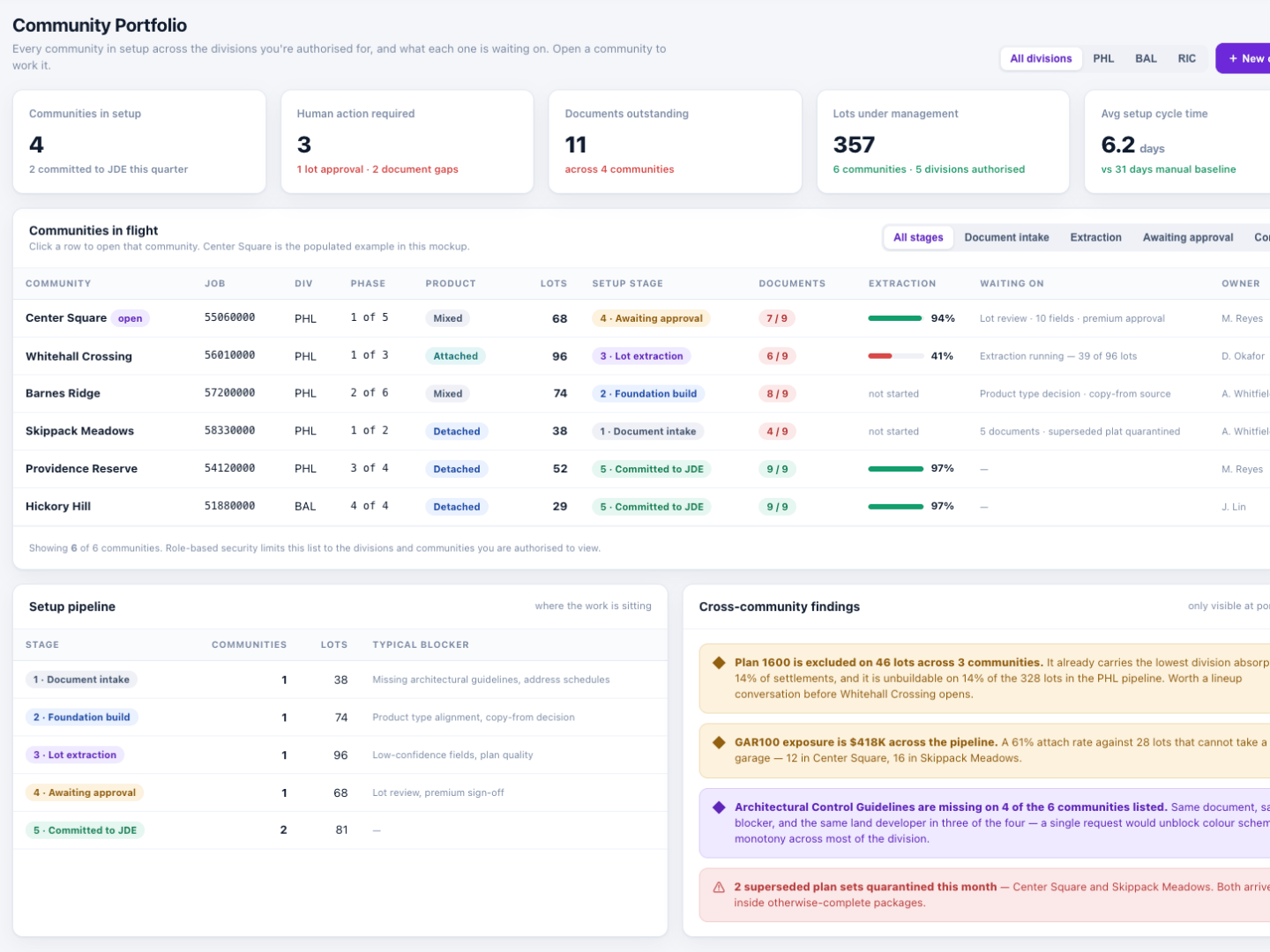
The immediate benefit is reduced manual set-up.
But there is another potential benefit, better data from the beginning.
When lot setup is labor intensive, teams may capture the information they need to keep the process moving without having enough time to enter every piece of data that could provide value down the road.
Automating more of the initial work could make it practical to create a more complete source of lot and community information from the start.
That doesn't mean the agent should independently decide what can or cannot be built on a lot. The agent can extract information, structure it, and surface potential constraints, while people review the results and remain responsible for decisions carrying financial, operational, or liability implications.
Bid Upload Agent: Reducing Manual Work and Improving Pricing Accuracy
Once a community is established, homebuilders have another data-intensive process to manage bids.
Trade vendors submit pricing that may need to be associated with specific communities, jobs, plans, elevations, options, cost codes, and cost types. As bids change, teams also have to manage new prices, effective dates, cancel dates, change orders, and expiring pricing.
The Bid Upload Agent is designed to act as a digital estimating and purchasing assistant throughout that process.
Instead of requiring employees to manually work through every bid line, the agent can extract vendor bid information and map pricing to the appropriate combinations. It can also recommend more efficient bid-line structures using wildcarding, helping avoid unnecessary duplicate lines when the same pricing applies across multiple plans, elevations, or options.
The agent's role doesn't end with the initial upload.
As pricing changes, it can help manage effective dates and change-order sequencing, monitor bids approaching expiration, and identify information that may require additional review. Maintaining an audit history of approvals, overrides, price updates, and other changes can also provide teams with greater visibility into what happened and why.
Accuracy matters because a small error in a large bid can have consequences later. Rather than expecting employees to manually identify every unusual value, an agent can help surface exceptions for review.
The important distinction is for review.
Estimating and purchasing teams still approve changes before they are applied. The agent performs the repetitive extraction, mapping, validation, and organization; people retain control over the pricing decisions.
Home Closing Agent: Bringing More Control to a Time-Sensitive Financial Process
Closing presents a different challenge.
Every home that is completed eventually has to move through a closing process, and that process includes financial activities that need to happen accurately and at the appropriate time.
The workload can become particularly demanding around period-end. A closing near the beginning of a month and a closing at the very end of a month can create very different time pressures for the employees responsible for completing the related financial work.
The Home Closing Agent is being designed to bring more of that workflow into one place.
Rather than requiring teams to coordinate closing activities across disconnected manual steps, the agent can support the administrative work involved in managing the process and provide greater visibility into what needs attention.
The goal isn't to hand financial control over to AI.
Closing can involve decisions about money, approvals, accounting, and judgment. Those responsibilities stay with the people accountable for them. The agent supports the workflow around those decisions so employees can spend less time coordinating repetitive work and more time reviewing what requires their attention.
Where Should People Stay Involved When AI Agents Take More Work?
As AI agents take on more work, defining where people remain involved becomes increasingly important.
An agent may be able to read a document, extract information, organize data, compare values, map information to the appropriate location, monitor dates, recommend an action, or identify an exception.
That doesn't automatically mean it should have the authority to make every decision that follows.
The appropriate level of human involvement depends on the process and the consequences of getting something wrong.
This is why successful AI adoption shouldn't be measured by how completely people can be removed from a process.
A better question is: Can the agent handle enough repetitive work that employees have more time to focus on the decisions, exceptions, and relationships that require human judgment?
That boundary should be intentionally defined when an agent is designed, not after it has already been put to work.
How Should Homebuilders Evaluate the Business Value of AI Agents?
The business case for an AI agent will look different for every homebuilder.
A process that creates significant value at one organization may have less impact at another depending on transaction volume, current labor requirements, process complexity, error rates, and the amount of human oversight required.
That's why ROI shouldn't start with a universal savings estimate. Instead, homebuilders can compare the cost of implementing and managing an agent against measurable improvements such as hours of manual work reduced, errors or rework avoided, additional employee capacity created, and improvements in process consistency or data quality.
Volume matters, too. Saving a few minutes on a task may seem insignificant until that task is repeated across hundreds of communities, thousands of lots, bid lines, or home closings.
Ultimately, the question isn't simply "How much can AI save?" It's "Does automating this particular work create enough measurable value to justify the investment?"
Final Thoughts: Could AI Agents Reshape Your Homebuilding Operations?
AI agents could change how homebuilders handle some of the repetitive, data-intensive work surrounding their operations. But that potential shouldn't be confused with a finished product or a guaranteed business outcome.
The Community Intelligence Agent, Bid Upload Agent, and Home Closing Agent capabilities may continue to evolve as they are developed, tested, and applied to homebuilding processes.

What they illustrate today is a practical way to think about AI agents.
Instead of asking where AI can be added simply because the technology is available, start with the work. Identify processes that require significant manual effort, depend on large amounts of information, or create bottlenecks and accuracy concerns at scale. Then determine which pieces an agent could reasonably handle and where people need to retain control.
At ERP Suites, we're exploring that approach with AI agents designed around the operational challenges homebuilders face, from community setup and bid management to the financial processes surrounding closing.
AI agents don't need to take over an entire process to create value. The opportunity is to find the right work for agents to handle while keeping people involved where their experience, approval, and judgment matter the most.
Topics: