
A trial balance issue does not have to be complicated to slow down your accounting team.
A batch may not have been posted correctly. An account may be carrying a balance it should not have. A recurring journal entry may be missing. The correction itself could be relatively straightforward once someone knows what happened.
Finding it is often the hardest part.
When something does not look right, accountants may have to work backward through companies, accounts, batches, journal entries, reports, and spreadsheets to determine where the problem originated. What ultimately turns out to be one small issue can require a much larger investigation.
Improving the process is not only about making errors easier to correct, but also about reducing the amount of searching required to find them.
Why Are Trial Balance Errors So Hard to Find?
A trial balance gives your accounting team a broad view of financial activity, but that breadth can also make investigating an issue difficult.
If you know exactly which account or transaction is causing the problem, you already have a significant head start. Often, however, the first thing you know is simply that something does not look right.
Now you have to determine where to look.
The issue could be isolated to one company or business unit. It could involve an account with an unexpected balance, a batch that never posted, or an entry that normally occurs but is missing this period.
Meanwhile, there may be thousands of accounts that are behaving exactly as expected.
That creates a search problem. Accountants are not necessarily spending their time correcting thousands of errors. They are reviewing large amounts of normal financial activity to identify the small number of items that require attention.
The more companies, accounts, and transactions involved, the larger that search becomes.
What Can You Look for When a Trial Balance Doesn't Look Right?
Not every trial balance issue will have the same cause. Knowing some of the common places to investigate can help narrow the search.
For example, an accountant may need to look for:
- Unposted batches: A transaction may be entered correctly but not yet reflected where expected because the batch has not been posted.
- Batches in error: An interface or other process may have created a batch that requires attention before it can be completed.
- Abnormal account balances: An account may carry a debit or credit balance that is inconsistent with what would normally be expected.
- Inactive accounts with balances: An old or inactive account may still be carrying an amount that needs to be reviewed or moved.
- Missing journal entries: A recurring accrual or other expected journal entry may not have been entered for the current period.
These problems can be very different, but they have something in common. The trial balance does not necessarily tell you immediately which one occurred.
The accounting team still has to connect the unusual result back to its cause.
Why Can a Small Error Create So Much Manual Work?
The amount of work required to investigate an issue is not always proportional to the size or complexity of the issue itself.
A relatively small discrepancy can still require someone to review multiple accounts, run reports, export data, build pivot tables, and trace activity until they find the transaction responsible
Once they find it, the correction may take only a few minutes.
That is why focusing only on the correction can give an incomplete picture of the effort involved. The expensive part of the process may be everything that happened before the correction.
There is also a timing problem.
If an issue occurred earlier in the period but was not identified until the accounting team began its review, the investigation starts after the fact. The team has to reconstruct what happened instead of addressing the issue when it occurred.
The question then becomes: How much of that searching is actually necessary?
How Can a Trial Balance Agent Help You Find Errors Faster?
A Trial Balance Agent can take that exception-based approach further by continuously analyzing financial activity and identifying items that may require attention.
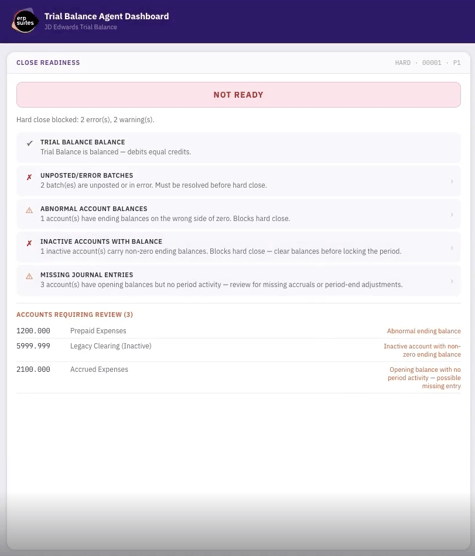
Rather than waiting for an accountant to discover that something looks wrong and then begin searching for the cause, the agent can monitor for conditions such as abnormal balances, unposted batches, inactive accounts carrying balances, and expected journal entries that appear to be missing.
It can also help prioritize what it finds.
An unposted batch that simply needs to be posted may not require the same attention as a batch in error or an account carrying an unexpected balance. Separating routine exceptions from potentially more significant issues helps accountants decide where to focus first.
The agent can then provide information about why an item was flagged and, when appropriate, recommend a potential correction.
For example, if an asset account has an unexpected credit balance, the value is not simply pointing out that the balance looks unusual. The agent can provide the account activity and context that led to the exception, giving the accountant a more focused starting point for determining what happened.
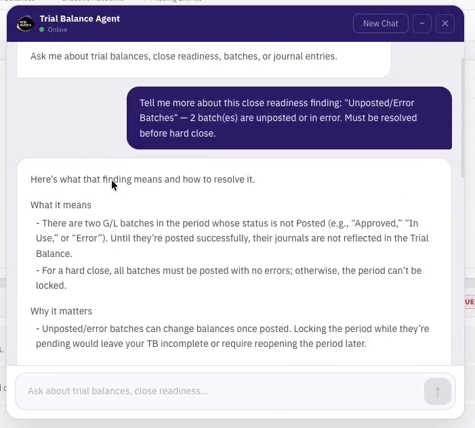
That changes the accountant’s role in the investigation.
Instead of starting with “Where is the problem?”, they can start with “Is this actually a problem, and what should we do about it?”
The search does not disappear entirely, but much of the manual work required to narrow thousands of possibilities down to a few relevant exceptions can.
What Should Still Require Human Review?
Finding an anomaly and deciding how it should be handled are not necessarily the same thing.
An unusual balance does not automatically mean an accounting error occurred. A transaction that looks different from previous periods may have a legitimate business explanation. And even when a correction is appropriate, the accounting team still needs confidence that the proposed entry reflects what actually happened.
That is why human review remains important.
A Trial Balance Agent can identify an exception, provide context, and recommend a potential journal entry. The accountant can then review that recommendation before it moves through the normal approval and posting process in JD Edwards.
That balance allows the technology to take on more of the searching without removing the controls surrounding financial decisions.
Over time, the agent can also become more familiar with the organization’s normal activity, including recurring entries, account behavior, and other patterns. But learning those patterns should make the accountant’s review more focused, not eliminate the need for appropriate oversight.
Final Thoughts
Trial balance problems can be frustrating because the amount of effort required to find an issue often has little to do with how difficult that issue is to correct.
Your accounting team may spend hours searching across accounts, batches, journal entries, and spreadsheets only to find a problem that takes minutes to resolve.
That is where changing the investigation process can make a meaningful difference.
Instead of asking accountants to search through everything until they find out what is wrong, a Trial Balance Agent can help identify unusual activity, prioritize exceptions, and provide the context needed to investigate them. The accountant can spend less time searching and more time deciding what actually requires action.
At ERP Suites, we see the Trial Balance Agent as one way to bring AI into the financial processes JD Edwards teams already rely on without removing the judgement and oversight those processes require. The opportunity is not simply to automate another accounting task. It is to make it easier for your team to find the few things that need their attention among everything that does not.
Topics: