
As businesses look for ways to use AI agents to automate processes, improve productivity, and reduce manual work, an important question comes up: Should you build your own AI agents or buy them from a provider?
Both approaches have advantages. Building internally gives organizations greater control over development and customization, while buying an AI agent can provide a faster path to implementation without requiring a business to develop everything itself.
But the decision isn’t always that simple. Costs, internal expertise, integration requirements, and long-term responsibilities can all influence which approach makes the most sense.
Before deciding whether to build or buy AI agents, it’s important to understand what each option involves and how it fits your business.
What Does It Take to Build AI Agents In-House?
Building an AI agent internally means your organization is responsible for developing, implementing, and supporting the agent using its own resources.
That doesn’t necessarily mean starting from scratch. Businesses can use existing AI models, development frameworks, and tools to create agents designed around their specific processes.
However, developing an agent that can perform meaningful work involves more than connecting to an AI model.
An organization may need to:
- Define the business process the agent will perform.
- Connect the agent to the applications and data it needs.
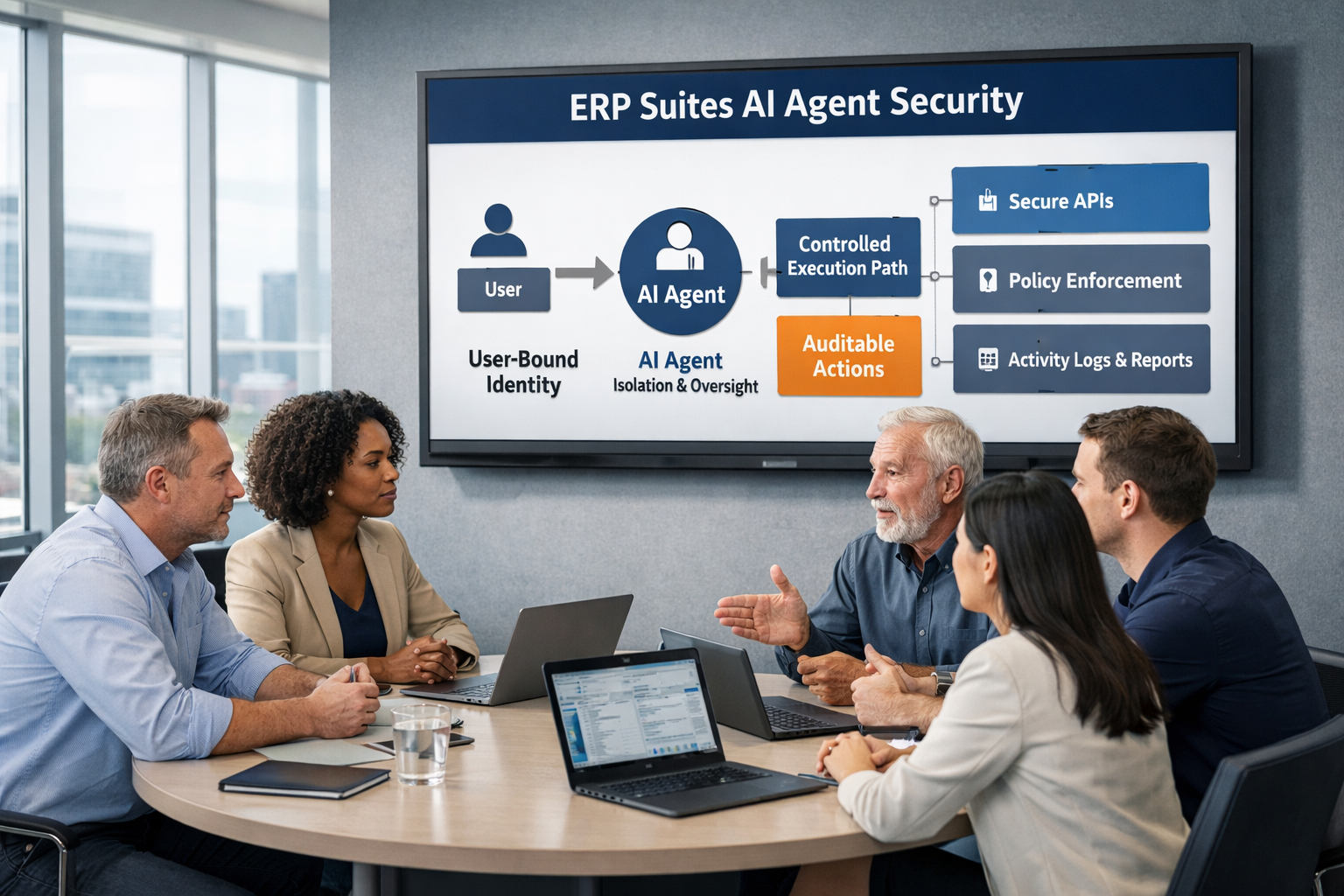
- Establish permissions, security controls, and approval requirements.
- Test how the agent handles different scenarios and exceptions.
- Monitor performance as business requirements change.
The complexity depends heavily on what the agent is expected to do.
For example, building an agent that summarizes internal documents may be relatively straightforward. Building one that retrieves information from JD Edwards, evaluates transactions, and initiates business processes introduces additional integration, security, and testing requirements.
When does building in-house make sense?
Internal development can be a good option for businesses that already have experienced technical teams and want direct control over how their agents are designed.
Building internally may also make sense when an organization has highly specialized processes and the technical expertise to develop solutions around those requirements.
What Does Buying an AI Agent Look Like?
Buying an AI agent doesn’t always mean purchasing a finished product that works the same way for every business.
Organizations generally have two options when working with an external provider: purchasing a prebuilt AI agent or partnering with a company to develop a customized solution.
Prebuilt AI agents are designed to address common business processes or use cases. For example, a provider might offer an agent that supports invoice processing, financial reconciliation, or customer service activities.
Because much of the development work has already been completed, these agents may require less implementation time than building an entirely new solution. However, they may still need configuration and testing to work within a particular business environment.
Custom AI agents developed with a partner offer another approach.
Rather than developing the agent internally, a business works with an external company to customize and implement an agent around its requirements. This can provide greater flexibility while allowing the organization to use the partner’s technical expertise.
There is also a middle ground between purchasing a finished agent and developing an entirely new one. Some providers offer an existing AI agent foundation that businesses can customize around their processes, integrations, business rules, and approval requirements. This allows organizations to build on established capabilities without starting development from the beginning.
When does buying make sense?
Buying or working with a partner can be particularly valuable when an organization wants to implement AI agents but lacks the internal resources or expertise to develop them independently.
It may also make sense when a provider already has experience solving the same business problem, allowing the organization to build on an existing solution rather than developing everything itself.
Working with an external partner can also be valuable for organizations with highly specialized processes or complex environments. Beyond technical expertise, a partner can bring both functional and technical perspectives that internal teams may not have considered. This outside perspective can help businesses rethink existing workflows, identify opportunities for improvement, and develop solutions that go beyond simply automating how things have always been done.
Build vs. Buy AI Agents: How Do the Costs Compare?
Cost is often one of the biggest factors in the build vs. buy AI agent decision. However, comparing the two approaches requires looking beyond the initial price of development or implementation.
AI Agent Development and Implementation Costs
Building internally may appear less expensive if an organization already has experienced developers. However, traditional development experience doesn't necessarily translate into AI agent expertise. Even with capable developers interested in taking on the project, there may be a learning curve that requires additional training, specialized knowledge, and development time.
Another potential expense is data preparation. If business information is scattered across multiple systems, stored in customized databases, or inconsistent, organizations may need to invest additional time and resources into making that data accessible and reliable before an agent can use it effectively.
Buying an agent or working with a partner typically involves licensing, implementation, or custom development fees. While these costs may be more visible upfront, working with an experienced provider could reduce the time and resources required to develop the solution.
Ongoing Support and Infrastructure Costs
Whether you build or buy, AI agents require ongoing support to remain effective.
Organizations developing internally must account for infrastructure, model usage, monitoring, and maintenance costs. These responsibilities typically fall on internal teams, adding to their existing workload.
When working with a provider, some of these responsibilities may be included in the agreement. However, businesses should understand what support is covered and whether additional fees apply.
AI Agent Updates and Scalability
The cost of an AI agent doesn't end with its initial implementation. Business processes change, new requirements emerge, and agents may need to be updated or expanded.
Another consideration is whether agents operate independently or within a shared AI platform. Some platforms allow businesses to deploy multiple agents within the same environment, making it easier to introduce new agents, modify existing ones, or retire agents that aren't delivering the expected return.
Rather than treating every new agent as a separate implementation, businesses may be able to build on existing infrastructure and investments. However, they should evaluate whether additional agents introduce new licensing, usage, or support costs.
Time to Value and AI Agent ROI
An important financial consideration is how quickly an AI agent can begin delivering measurable value.
Building internally may offer greater control over development, but the time required to acquire expertise, develop integrations, and test the agent can delay implementation.
Buying a prebuilt agent or working with an experienced partner may shorten that timeline, particularly when the provider has already developed solutions for similar processes.
However, faster implementation doesn't automatically mean a better return on investment. Employee training and adoption also play a role. Even a well-developed agent may fail to deliver its expected value if employees don't understand how to use it or aren't incorporating it into their daily workflows.
Businesses should evaluate the total cost of ownership alongside the time it takes for an agent to begin generating measurable benefits. A lower upfront investment may not be the most economical option if implementation takes significantly longer or ongoing expenses are higher than expected.
What Should You Consider Before Deciding?
Before choosing whether to build or buy an AI agent, start by identifying the specific business problem you're trying to solve.
Not every process requires AI. In some cases, existing automation tools or functionality within your enterprise applications may accomplish the same task more efficiently and at a lower cost. Understanding the problem first can help determine whether an AI agent is necessary and what capabilities it actually needs.
The decision also doesn't have to be the same for every AI initiative. A business might build smaller agents internally, purchase prebuilt solutions for common processes, and work with a partner on more complex projects.
If you're evaluating an external provider, ask what customization is available, which systems the agent can integrate with, what ongoing support includes, and who retains control over the solution. It's also worth understanding whether you're dependent on a particular AI model or platform, how your data is handled, and what options you have if you eventually want to change providers.
For organizations running enterprise applications like JD Edwards, it's especially important to understand whether a potential partner has experience integrating AI agents with those systems. General AI development expertise doesn't necessarily translate into an understanding of your existing ERP processes.
Ultimately, the best approach is the one that delivers the capabilities your business needs at a cost and level of responsibility it can sustain.
Final Thoughts
Whether you're building AI agents internally or working with a provider, the decision should reflect your business's requirements and long-term capabilities.
ERP Suites offers prebuilt and custom AI agents designed to work with JD Edwards and existing enterprise processes. Its AI platform is designed to support multiple agents within a shared environment, allowing organizations to introduce new capabilities, adjust existing agents, or retire those that aren't delivering value.
Whether you're evaluating your first agent or expanding automation across your business, working with a partner who understands your ERP environment can help you determine which approach makes the most sense.
Topics: