
As AI agents begin performing real work across the enterprise, organizations have to answer a question that may not have mattered during early AI experimentation: Who actually owns them?
Is it IT because agents connect to enterprise systems, access company data, and require security controls? Or is it the business because agents perform processes that traditionally belong to finance, operations, sales, procurement, or other departments?
The answer is usually both, but that does not mean ownership should be unclear.
AI agents require different types of ownership. The business needs to own what the agent does, what a successful outcome looks like, and where human judgment is required. IT needs to own the technical environment that allows the agent to operate securely and reliably.
Without that distinction, organizations can end up with agents that technically work but do not meet the needs of the business—or agents that solve a valuable business problem without the controls needed to operate safely at scale.
Understanding who owns what can help organizations avoid that gap.
Why AI Agent Ownership Is Different from Traditional Software Ownership
Traditional enterprise software often has relatively clear ownership.
IT manages the technology, while individual departments use the applications and processes that support their work. A finance team might own its month-end close process, for example, even though IT supports the ERP system behind it.
AI agents blur that line.
An agent may connect to several systems, retrieve information, make decisions based on defined rules, complete multiple steps, and escalate exceptions to an employee. That means its performance depends on both technical decisions and business decisions.
Consider an agent that helps process customer orders.
IT may be responsible for how the agent connects to the ERP system, what information it can access, and how its activity is monitored. But IT should not independently decide which orders require additional review, what qualifies as an acceptable exception, or how the business wants unusual customer requests handled.
Those are business decisions.
At the same time, a business team should not independently decide that an agent needs unrestricted access to several enterprise applications simply because doing so would make the process easier.
That is where IT needs to be involved.
The point is not to choose a single owner for every aspect of an AI agent. It is to establish clear responsibilities before the agent begins performing meaningful work.
What Should IT Own When Managing AI Agents?
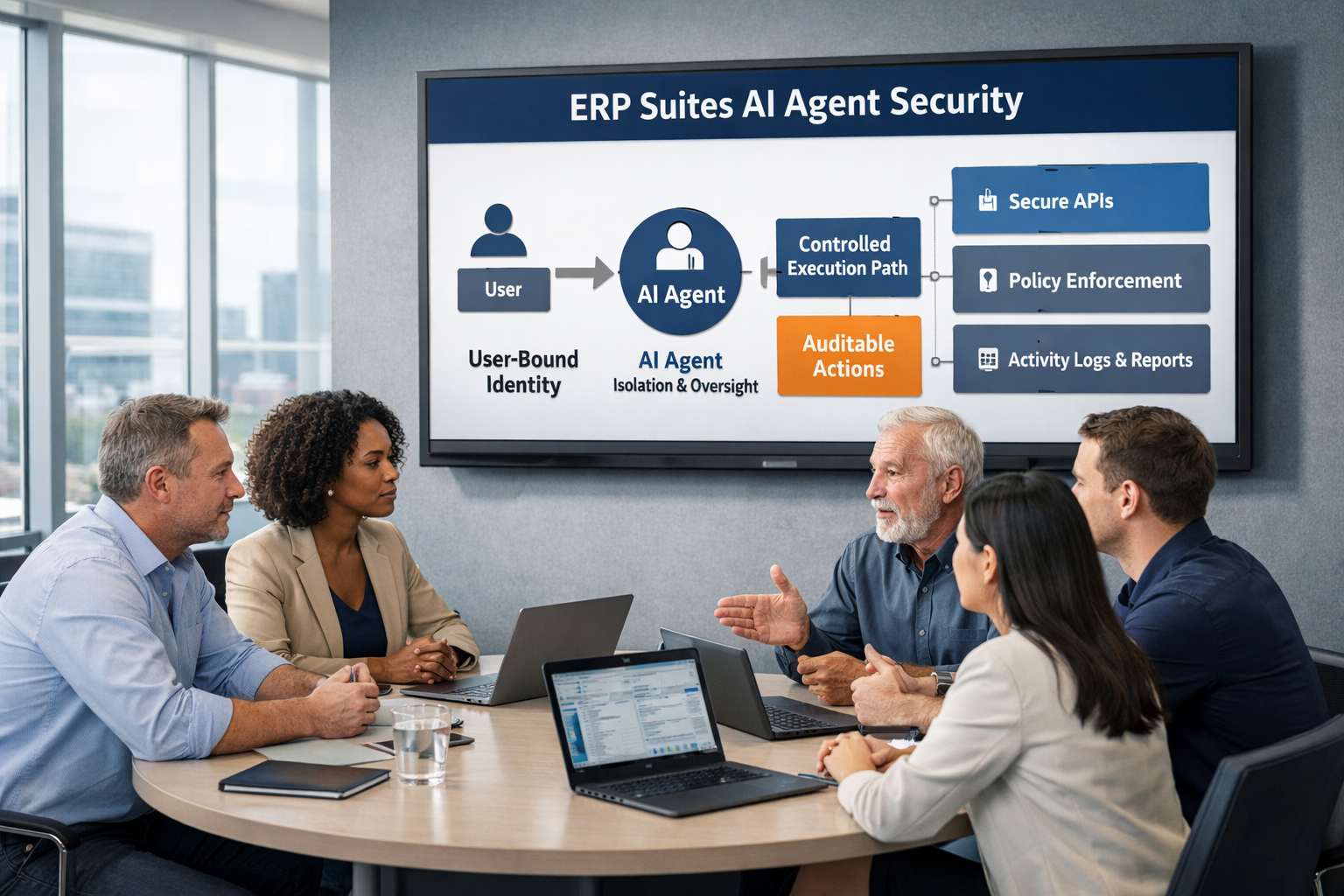
IT’s responsibility should generally center on the environment in which an AI agent operates.
That can include:
- System integrations
- Authentication and access
- Data security
- Technical permissions
- Infrastructure
- Logging and monitoring
- Technical standards
- Reliability and availability
- Changes that could affect other systems
This becomes especially important as an agent connects to ERP, CRM, document management, data platforms, or other enterprise applications.
An AI agent should not automatically receive access to everything an employee or system can access. Its permissions should reflect the work it actually needs to perform.
An agent designed to retrieve invoice information may need permission to read certain financial records. An agent responsible for creating or updating transactions may require a different level of access because its actions can directly change business data.
IT helps make sure those connections and permissions are intentional rather than simply granting an agent whatever access makes implementation easiest.
That does not mean IT decides how the business process should work. IT creates and manages the technical boundaries within which the agent can operate.
What Should the Business Own When Managing AI Agents?
If IT owns the technical environment, the business should own the work.
The people responsible for a process understand what needs to happen, what a good outcome looks like, where exceptions occur, and when human judgment is necessary.
For example, if an AI agent supports accounts payable, the finance team should help determine questions such as:
- What should the agent be responsible for?
- Which exceptions should be escalated?
- What information should employees receive when something requires review?
- How should success be measured?
Those questions cannot be answered by technology alone.
Business owners should also be involved in evaluating whether the agent is improving the process after implementation.
An agent can technically function exactly as designed and still fail to create meaningful value. Perhaps employees are still doing too much manual work. Maybe the agent escalates so many exceptions that it creates a new bottleneck. Or the original business rules no longer reflect how the process operates.
The business team is in the best position to recognize those issues.
That makes ownership ongoing. The business is not simply responsible for providing requirements before implementation and then handing the agent over to IT. As processes change, the agent may need to change with them.
Where Does AI Agent Ownership Usually Get Complicated?
Ownership can become less clear when an AI agent works across departments.
An agent might begin a process in sales, retrieve information from finance, update an ERP system, and then trigger another action for operations.
Which department owns the agent when several teams depend on the work it performs?
In those situations, organizations may need a primary business owner while still involving other process owners in decisions that affect their areas. The primary owner can remain accountable for the overall process without making decisions on behalf of every department the agent touches.
The more systems and departments an agent works across, the more important it becomes to define those responsibilities instead of assuming everyone understands who owns what.
Who Should Approve What an AI Agent Is Allowed to Do?
Not every AI agent needs the same level of autonomy.
Some agents may retrieve information, organize it, and present it to an employee. Others may create records, update transactions, communicate with customers or vendors, or initiate additional workflows.
As the potential impact of an action increases, so does the importance of defining who can authorize it.
This is another area where IT and the business need to work together.
The business should determine which actions make sense within the process and which decisions still require human approval. IT should help enforce those boundaries through permissions, integrations, and technical controls.
An organization might allow an agent to complete routine work automatically while requiring human approval when a transaction exceeds a certain threshold, falls outside established rules, or presents an unusual exception.
The idea is not necessarily to give an agent as much autonomy as possible. It is to give it the appropriate level of autonomy for the work it is performing.
That level can also change over time as the organization learns how the agent performs.
Who Is Responsible When an AI Agent Makes a Mistake?
Clear ownership becomes especially important when an agent does something incorrectly.
The first question should not simply be, “Was this an IT problem or a business problem?”
Instead, the organization needs to understand what happened.

Was there a technical failure? Was the agent given incorrect or outdated business rules? Did it have access it should not have had? Was an exception not accounted for? Should human approval have been required?
The answer determines who needs to be involved in correcting the problem.
IT may need to address an integration, permission, or technical control. The business may need to adjust a rule, process, or exception. In some cases, both may need to make changes.
This is why assigning ownership before something goes wrong matters. Teams should already know who investigates issues, who evaluates the business impact, and who approves changes to the agent.
Accountability should not have to be figured out after an error occurs.
How Should IT and the Business Govern AI Agents Together?
Shared ownership works best when responsibilities are specific.
With those responsibilities defined, IT and the business also need a shared process for decisions involving autonomy, permissions, monitoring, risk, and major changes.
There should also be a clear process for making changes after go-live.
AI agents are not necessarily something organizations configure once and leave untouched. Business processes change. Systems change. Policies change. New exceptions appear. Organizations may also become comfortable allowing an agent to handle additional responsibilities after seeing how it performs.
Clear ownership makes those changes easier to manage because everyone knows who needs to be involved.
Final Thoughts: Who Should Own Your AI Agents?
AI agent ownership does not need to come down to IT versus the business.
A more useful distinction is between ownership of the technology and ownership of the work.
IT should manage the environment, integrations, security, access, and technical controls that allow an agent to operate. The business should own the process, desired outcomes, business rules, exceptions, and expectations for how the work should be performed.
Where those responsibilities overlap, ownership should be shared rather than assumed.
As organizations move from experimenting with AI to using agents for real business processes, defining those responsibilities becomes an important part of building an AI program that can scale.
ERP Suites builds AI agents and helps organizations connect them to enterprise systems and processes while establishing the integrations, controls, and business workflows needed for those agents to perform real work. The technology matters, but successful AI adoption also depends on making sure the right people remain responsible for the right decisions.
Topics: