
AI Agents in JD Edwards: What They Do That Digital Assistants Don’t
May 18th, 2026
15 min read
By Manuel Neyra
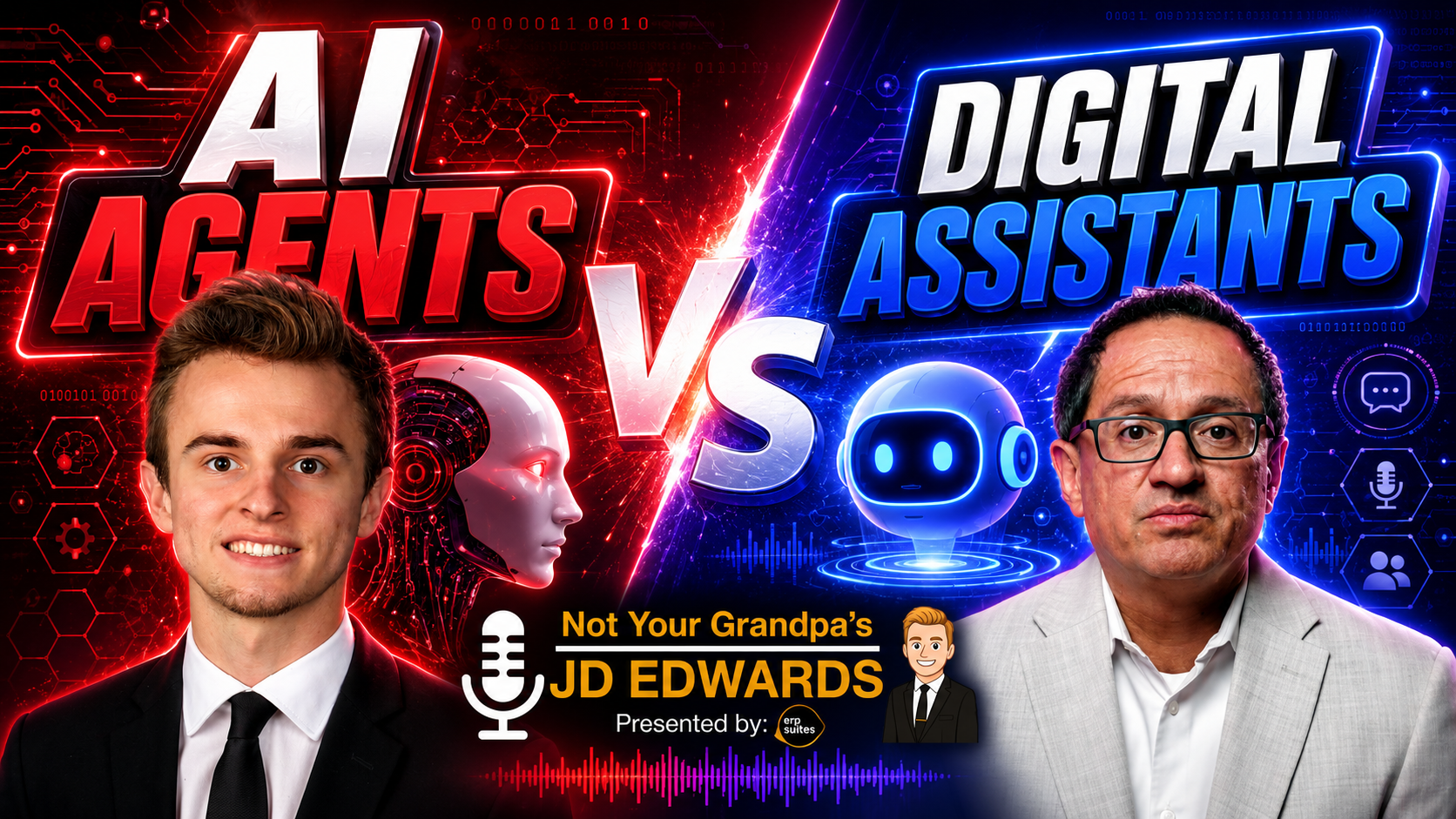
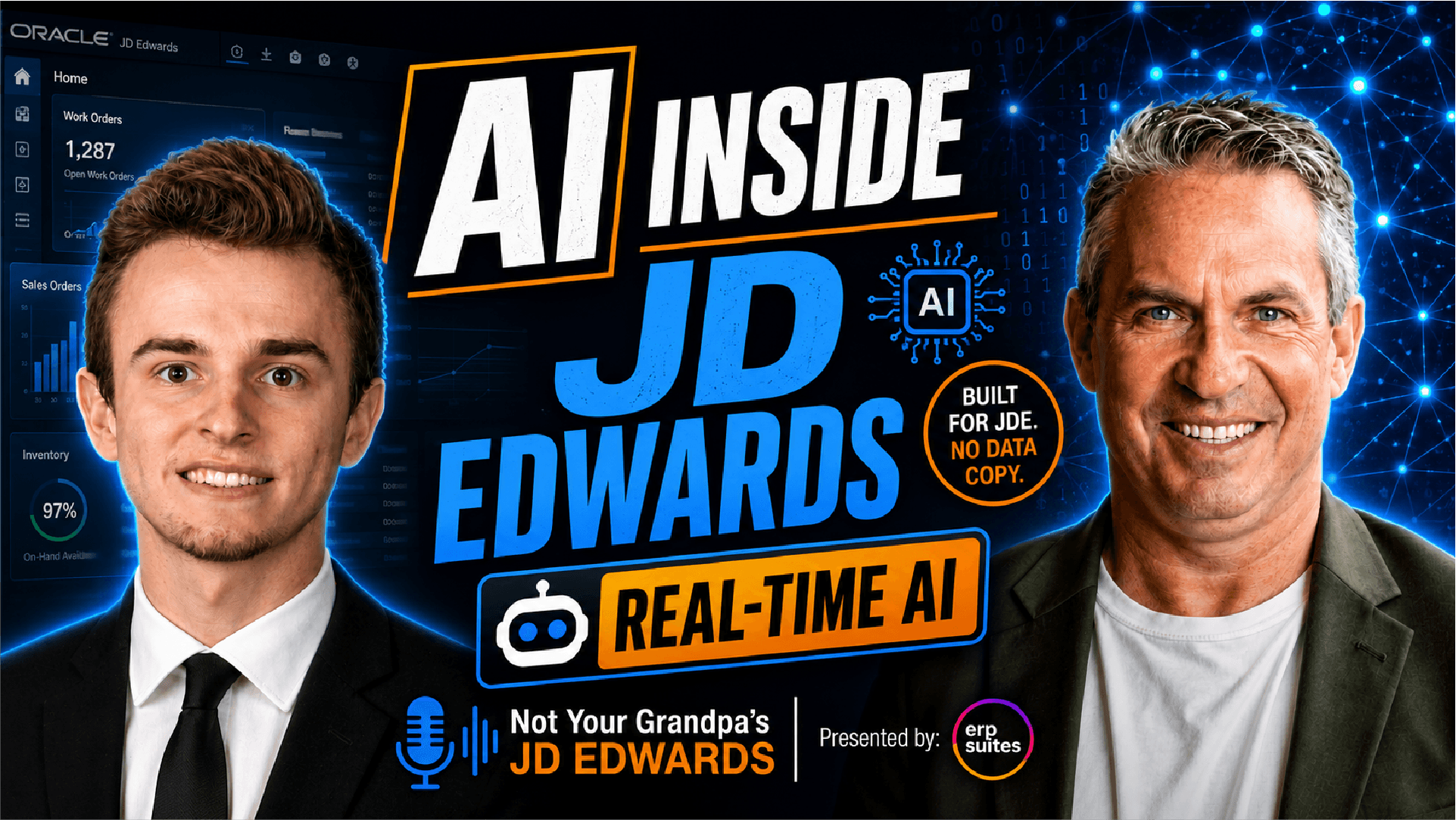
This episode of Not Your Grandpa’s JD Edwards explores the growing conversation around AI agents versus digital assistants and the real business value behind each technology. Manuel Neyra, VP of Artificial Intelligence and Products at ERP Suites, explains how digital assistants primarily provide insights and improve access to information, while AI agents are designed to execute business processes, automate repetitive work, and drive operational efficiencies. The discussion covers practical JD Edwards use cases, customer adoption trends, digital co-workers, human-in-the-loop AI, and why organizations are increasingly investing in AI agents to achieve measurable ROI and scalable business transformation.
Table of Contents
- Introduction to AI Agents vs Digital Assistants
- The Core Difference Between Digital Assistants and AI Agents
- Why Customers See More Value in AI Agents
- Why AI Agents Are Becoming the Focus
- Where Digital Assistants Fall Short in Practice
- AI Adoption, Digital Co-Workers, and the Future of Digital Assistants
- Where Digital Assistants Still Make Sense
Introduction
AI agents versus digital assistants, what's the real difference? And more importantly, which one actually delivers real value for your business?
In this episode, we're going to break down what we're seeing in the real world, from customer conversations to actual ROI and where each of these technologies fit. If you're evaluating AI and JD Edwards, this will help you avoid investing in the wrong place. Welcome back to Not Your Grandpa's JD Edwards, where we help you make smarter ERP decisions without the fluff. Today's topic is one we're seeing come up constantly, AI agents versus digital assistants. And candidly, we've had a lot of conversations with customers where expectations don't match reality, especially when it comes to digital assistants. So today we're going to unpack that, what each one actually does, where the value is and how to think about them moving forward.
But joining us today is Manuel Neyra, VP of artificial intelligence and products at ERP Suites. Manuel, welcome back. Reoccurring guests for. But for those out there that haven't seen you on the podcast before, can you give us a little bit of your background in the space? Yes, absolutely. And thank you for having me, Nate. It's always a pleasure to sit down here and we have fun talking about all the, all the intricacies around AI. Yes, I'm pleased to say that it's almost going to be 5 years that I'm, I'm part of ERP suites.
Prior to that. My background is JD Edwards started off as a software engineer back in the mid 90s and grew through the ranks in a variety of different roles and on product management, product strategy and variety of different roles they took there, you know, working on on what was one world, now enterprise one and how it's grown. So yeah, a lot of long history. Based in Denver and excited to talk about AI today. Yeah, a lot of people in our companies are actually having their anniversaries of X amount of years. I know mine's in July and I'll be hidden three years. So there's a lot of people that have been around here for a while. I know three years and five years doesn't sound like a lot, but there are a lot that have been here since the beginning 20 years and we're about to celebrate our 20th anniversary on June 13th, which this very exciting.
But let's start with the big picture. What's the difference between digital assistants and AI agents?
The Core Difference Between Digital Assistants and AI Agents
That's a great question, right? And it's digital assistance was one of the early stages of AI as as it was starting to get momentum in the enterprise space. Digital assistant is, is really transactional, right? You ask a question, it responds and it and it provides insights, right, compared to a agent, right. We're looking at a Agentic AI really looking at a solution that can run a process end to end, whether it's an A business process or a workflow, it can manage it end to end. It has an objective, it knows about business goals and and it it can pull data, it can inquiry what not. But the key thing here with an agent is that it will perform the actions, right? And one of the key differences between the two is 1 digital system will give you information, but there's still work to be done by the human to take action on it.
Right, on that, that data point here with an agent, the agent can have a varying degree of autonomy based on, you know, what, what it's being performed. And even if a human is in the loop, right, it will suggest what it's going to do. And the human can then approve for those human in the loop type of interactions. So rarely transformational is kind of the, the, the operative word, right, if you will, for agents versus a digital assistant is more kind of getting singular insights. You know, and some people would think that it's like agent is the next step of a digital assistant, but that's not really the case. The digital assistant is now built in to so many of these AI agents. And that's what is one of the most interesting things about it. I know we've talked offline about that of how I really like and that's where I was where I thought the digital assistants were a great product and the AI agents for just a little spin off of it. That's not the case at all. It's basically reinventing what we thought AI can be in this space.
And specifically for JD Edwards, how would you really define what in digital assistant is for JD Edwards?
Digital assistant in JD Edwards would be, you know, inquiring on an account balance, right, or looking at a specific data point and procurement. Do you have some insights or you want to ask, you know, particular status of your, you know, set up in MRP, right? That's what you're going, you're going to be inquiring on that and it will return singular status versus an agent, right? You can have an agent that's running your MRP operations head to toe and, and through a digital assistant that is part of that agent, you can inquire on it. You couldn't, you know, kind of ask it specific questions beyond what the agent is exposing and showing you. Because every agent, one thing that's important when we talk to customers about is the agent is going to track everything it does. It's going to be logged so you can see everything it does and and it traced back to it and it also give you why it's doing the things that it does. So very, very, two very transformational things into your point though. Digital assistants now are part of a of our agent offerings.
Yeah. And so on paper digital assistants, they do sound helpful, but why are customers having their at least struggling to see the value in digital assistants versus an agent?
Why Customers See More Value in AI Agents
That's a great question. And really that the fundamental common denominator as I was thinking about our podcast today is, is what what is it? Was it provide, right? And was it provide and what's providing? It's providing insights, right? So it is providing insights and is valuable for certain customers to get those insights. But generally that insight then drives something more right? And saying is that does, is that a representation that the business is healthy or the business process is running optimally? Or are we leaving business on the table or there's some inefficiencies in our business processes? An agent will surface that a digital assistant will not, right? And that's where we start getting the the difference between value on those two right. You, you know what, how do you place a value on getting information, singular information back? It's there's, there's some value, but being able to quantify that becomes a challenge versus an agent that could be working 24 by 7 gives you scale and gives you insights, right? And allows you to have your team, you know, take the next level in terms of operations without having to add head count.
Now you really start getting something that can be measured. I think that's, that's what we've encountered across a multiple sales cycles with customers. Don't, don't get me wrong, right there, there's, there are some places where a digital assistant may make sense for a customer, but it's important to to have those conversations with the customer and understand what is it that they're going to get as a result, right? It may be a facilitation type of use case. And if that's what the customer wants, if facilitating access to data, right, the traditional requiring ADBA to run a query over JD Edwards to pull a certain data set of data, well you a digital assistant can do that right? Now again, is that valuable enough? Is that's valuable for a customer then perhaps yes. But our experience is the vast majority of customers are are able to more quantify the return on investment on an agent versus a digital system.
Yeah. So the digital assistant doesn't eliminate work. It more assists you in actually completing that goal where an AI agents, yes, it'll still keep you in the loop. There are so many dashboards and ways that you can view exactly what an agent is doing, but it will be doing that manual task or repeatable task or something that at, with a digital assistant, you still have to do and it's still taking up a lot of your time where an agent will eliminate that. Am I right in the difference there in terms of the value?
You're, you're absolutely right. It's different and it's definitely gone in that way. And, and one thing that I wanted to share is as you look at the industry, right, you will see some is what I would call exceptional type of digital systems that are being built in, in, in the marketplace that have some capabilities to do something. But then the question is, if you're, if you have that the chat interface, right, the digital interface, right? And it's doing things, how do you know how, how do you get visibility, right? And that was one thing that as we looked at architecting our agents, we thought that the dashboard, right, the the, the, the dynamic dashboard that gives you, you know, KPIs and trending data and what not of what the agents doing would be the optimal kind of example, right. So as the agent is doing things, you're getting real time updates of what's going on versus a digital system it kind of just, you know, is processing. It may say, OK, I did it. Well, guess what now the human now needs to go into Judy Edwards or to another application to see, OK, what exactly did it do? Did it do what I expected it to do etcetera, etcetera.
Why AI Agents Are Becoming the Focus
So is that, would you say is that the reason why we're seeing more interest shift to AI agents instead of visual systems?
Yes, I think it is definitely the the case, right. With a, with a, an agent, we are really transforming how the process is being executed, right? And really enabling scale and operational efficiencies for, for companies, right? And whether it's reallocating people to high, you know, to tasks that are higher on the value chain and then having what we call Co work, digital Co workers, they're working in conjunction with those members, but they're, those members are working on other different tasks, right? It, it is really transforming how, how, how operations can be executed. And it's, it's making a difference.
So yeah, that's why the interest is is heavy on agents because it's not only surfacing information, it's doing, it's resolving and it's doing it continuously, right? Because agents have goals. And that's why when I was talking about earlier about a digital assistant, it is you ask, it answers, you ask, it answers, this one has a goal and it performs that continuously, right? And yes, you can still ask it introspective type of questions in terms of and it will answer to you, right? Much like if you and I are colleagues, right? And you have some responsibilities in, in a, in a payables function. And I have slightly different responsibilities and we need to speak to interact. You can do the same with a digital system. That's that the digital worker. You know, it really does take that, that terminology, we should say, and really embodies it because it is its own entity in a way. I mean, I'm not saying that we're at the time of Terminator yet, yet. And you know, you know, on this podcast, I'm very serious about that, but we're not there yet. And it is great to see how it can make your life easier. It can make a lot of these tasks a lot quicker and you can spend your time on more impactful work instead of having to do these for people tasks over and over and over again.
But digital assistants, yes, they're still great. They make it easier to interact with your system, but they don't fundamentally change how work gets done. AI agents, on the other hand, they're focused on actually executing and driving business processes. And that's where customers are seeing the real value because you don't really get that with a digital assistant. But what does this really look like in practice? Where do digital assistants tend to fall short compared to AI agents?
Where Digital Assistants Fall Short in Practice
No great question, right? And it's, it's really in the in the action portion of, of, of what you know what, what the business is encountering, right, whether you're inquiring on, on information, basically the model that that happens or that is being executed with a digital system is feeding the human information.
So the human can take action, can analyse it and then determine what needs to be done right to close that business process, be it a step or two or be able to execute that entire business process. So really you're providing an assistance to the human, but it's it, but it's a sliver usually of the overall business process. Now you look at an agent, it is looking at the business process or the workflow holistically and it will run through and even and I have to had these kind of conversations with customers. Even if there's a human in the loop where a customer is not ready to go fully autonomous on some of these processes. It's one thing for a human to see a recommendation, have it provide, you know, agent provides substantiation as to why it's recommending it. And in some cases they might offer alternatives. But the one thing is you're talking about a Click to say, yes, I want to do this right. Or if there's some feedback, you can do that very quickly.
You look at the digital assistant type of model. You're doing all that work that the agents doing right. So the the the load shifting is significant from human to digital Co worker or an agent. And that is really the crux right of of what the weather. It's a game changer for many comments. So maybe get a little bit more specific. What's like a common use case where a digital system would actually make sense for some of these users?
Great question. And one of one of the common ones that comes up in our conversations is a help desk, kind of help desk. And you have business analysts many times or some technical folks that are picking up the phone or reviewing tickets, right? Yeah, online, right. A digital system could help with that, right? And being able to report an issue and be able to enter a ticket in ServiceNow system, if that's what the customers doing, whatever equivalent system they're using to track issues, that could be a, a, a simple kind of entry point to use. Now remember now there's still someone on the back end who have to address that issue, right?
If there's something that is, let's say is going wrong with JD Edwards and you know, call object Colonel has fallen down, someone needs to analyze that. Then you need to get ACNC on it on the back end. An agent, you know, theoretically if it was agent, it would all not only receive the ticket, it would review it and then it would hand it off to another agent to figure it out that an agent that is trained on CNC and that agent could theoretically fix the issue. So you really have a loop as complete, you know, kind of fully managed by digital Co workers. Yeah. So in yours. Yeah, of course. In your experience, though, would people be happier or are they looking for more of a digital assistant in that scenario or would it be better for them to just go full agent at this point?
AI Adoption, Digital Co-Workers, and the Future of Digital Assistants
Yes, I think you know for it, it it that there, there is a component here and at Blueprint, right? We've had some conversations around that. There's, there's elements in terms of AI adoption that need to be considered, right? Part of it is company culture, part of his involvement, right, of customers. It's part of the business process, right? And, and and data's part of it. So all those things need to be considered to adopt and some customers are not ready necessarily to take the plunge for an agent, right? They their first step into AI may be, you know, more comfortable for them and may more make more sense for a digital assistant, right.
And like I said earlier, that that the the vast number of customers that we've spoken to, right, there's been some customers that look like they were going to go digital assistant, but you know, ultimately they decided to go agents, you know, to be honest, right, most of them have gone that direction so that the possibility exists, Nate. But then if they go to agents, they need to realize, right, that the value prop of an agent, even if if it's a human in the loop and component is being able to seed some of that responsibility of the process execution to a digital Co worker and being able to gain those operational efficiencies. Right now, we we do, you know, my team does a fantastic job and, and, and my colleague, right, Mo Shujaat does a fantastic job as well as we work together on these agents to make sure that they're doing the right thing, right the in their operating efficiency. So, and for any customer, right, that's one thing that we show where we demonstrate how do we do that to make sure that an agent actually does what it's supposed to do and it doesn't hallucinate.
Yeah. And it's actually a perfect point there. Like so agents, right? We use the term agents, AI agents and digital workers kind of hand in hand here. But would you say to make people more comfortable? Is that why we kind of change that terminology to a digital worker or is there a little bit more to it? Well, it's it's not just to make people comfortable. One is to help them understand that the digital Co worker, you know, even in an agent and an agentic AI world that we Live Today. And you mentioned it earlier, right, with Skynet reference, right, AGI, right. If we ever get to that phase, that's a different level, right? And the reality is even for autonomous AI, identity AI that we have today, the systems are designed to still interact with humans. They are not designed to be completely running on their own and defining the scope of where they're playing. It's, it's, it's, it's not there yet to, to be honest. So you know, from from that perspective, there's, there's the capability of.
Leveraging the the the functionality of agentic AI and gaining the benefits, but customers need to realize that there's adjustments, right. There's adjustments in business processes and displacement wasn't always mean getting rid of your human talent. It is allocating them to those job tasks that you haven't been able to get to that are valuable now, then, now you may be free up their time to be able to do. And the Co worker engagement back to your point is they're working alongside humans. So that's why we coined the term of digital Co workers. So what we're really seeing is digital assistants help more at the edges, but they don't really own the process.
Yeah. Agents, on the other hand, they step in actually run parts of the business process, which is why they're being viewed more like digital workers. Exactly, the big question becomes, does that mean digital assistants really have a role at all? Like do you like where do you see digital assistants fitting in going forward? Are they being replaced or they still playing a role? Kind of like what I said earlier in this episode, they, they play a role absolutely right. Whether it's additional introspections, right? If like you, you're, you're on a, on a dashboard for an agent, right, where there's manufacturing, inventory management, reconciliations, you want more information, right? You can introspect it through that. That will be the interface through our dashboards, through our agent dashboards to be able to ask it questions, to be able to give it feedback. Is, is, is part of it as well as being able to incorporate new things as we expand new things, new scope. You can you can talk to it and recommend that it do. And what some of the dynamic AI capabilities that exist today, we're starting to explore those kind of capabilities. So the digital system will always be a component in my mind, at least for the foreseeable future because that's the way you interact with the agent, you know, for either even with autonomous type of processes. Yeah. So instead of being the solution, right, they're more part of the experience. Is that kind of how you phrase it?
Absolutely. Yeah, It, it does complement it with, without the digital assistant right there, there would be a potential vacuum in terms of how do you give a feedback, how do you interact, how do you request it to do something again, right, Because you're giving it feedback because it got it about 90% right and needs to tweak some things. That's how you, you know, that's how we are enabling interaction with the agent as well as enhancing it.
Where Digital Assistants Still Make Sense
So we, we talked a little bit earlier about maybe a scenario where a digital assistant could be, but we kind of debunked that an AI agent would probably make more sense in that space. Are there any places where digital assistant on its own would still make sense outside of the ones that we talked earlier?
It may be, you know, for situations where where it's there is a premium on being able to facilitate access to data, might being able to query without having to do it. Like I was saying earlier, the, the SQL type of statements, that's where you know, whether it's, you know, pulling up an account balance, looking at quickly, you know, the, the, the average profitability for in a particular line of business or what not. That's where, you know, do you need an agent for that? And if, if that's become a very sore point and I, I've given a very basic example, right? But you know, they could be in different parts of the business. That's where a digital system would be the, you know, the way to go to deploy as a, as an entry point. Otherwise, if it's more, you know, kind of in terms of operational efficiencies and scale, they're definitely looking more at a agent.
Yeah, makes a lot of sense. So digital systems really aren't going away per SE, but they're shifting to be a part of the solution and a part of a broader AI strategy, so to speak, led by agents. And that's really where companies need guidance, understanding where they are and where to really invest.
But if you're evaluating AI and trying to figure out where to focus, ERP suites can help you navigate it. Whether it's understanding where digital assistants fit or exploring AI agents as part of your business processes will help you make the right investment.
So you take one thing away from this episode is this. Digital assistants improve access, but AI agents Dr. outcomes and right now the real momentum and the real value is happening with AI agents. So it's until next time, don't just automate transform catch you next time.
Manuel Neyra has presented at 20 combined Collaborate and INFOCUS conferences, 10 Oracle OpenWorld events, and numerous regional user groups across the globe. Manuel brings wisdom and perspective gained over a 26-year career with Oracle. Today, he is Vice President of Products & Advisory Services at ERP Suites.
Topics: