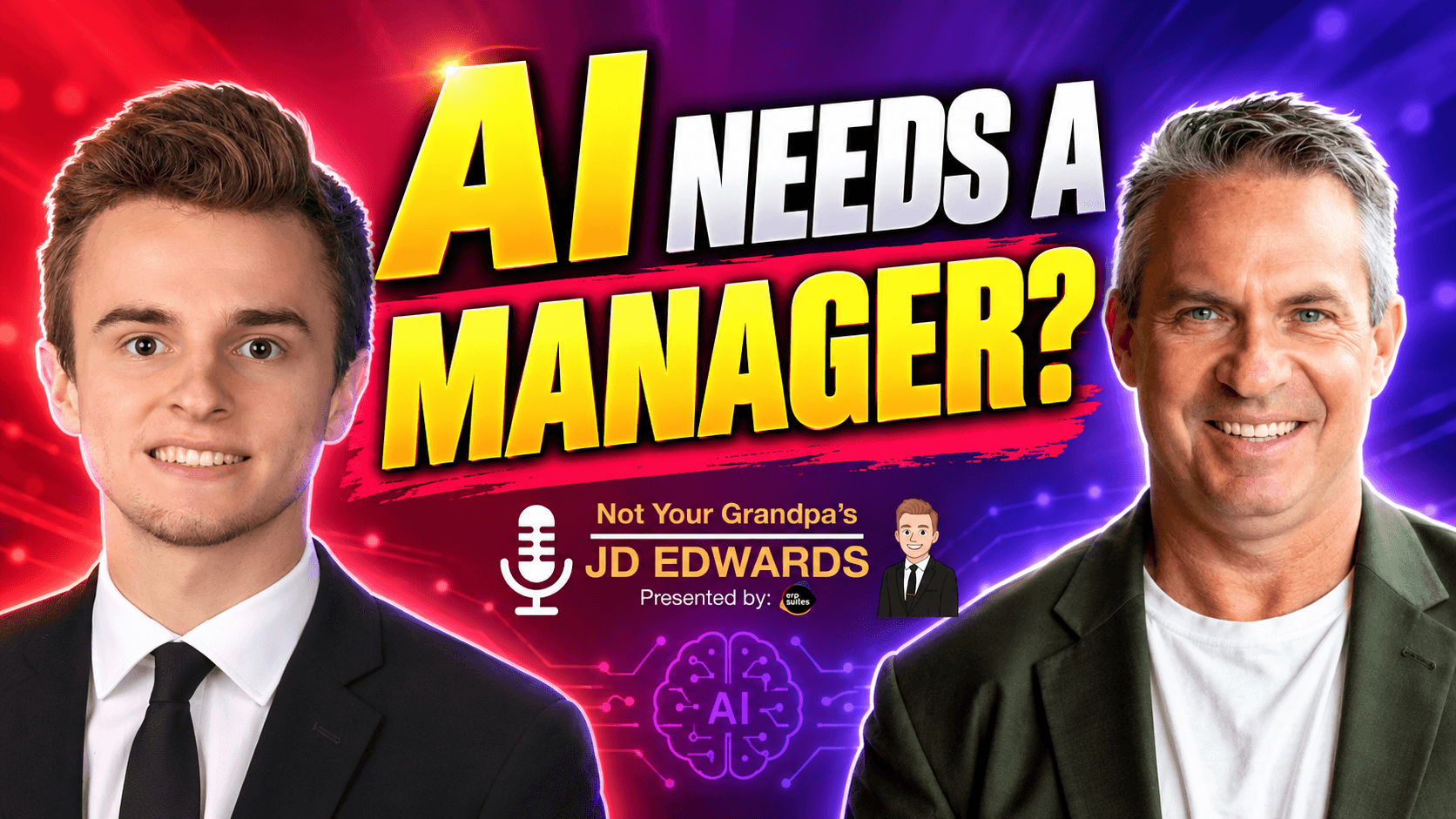


This episode of Not Your Grandpa’s JD Edwards explores how AI agents are transforming JD Edwards without requiring a platform replacement. Manuel Neyra, VP of AI and Products at ERP Suites, breaks down what AI agents are, how they differ from digital assistants and traditional automation, and where they deliver real business value. From finance and inventory use cases to adoption challenges, data readiness, and human impact, the conversation provides a practical, grounded look at how organizations can use AI agents to reduce manual effort, improve ROI, and enable teams to focus on higher-value work, today, not in some distant future.
Table of Contents
- Introduction
-
From AI Services to Digital Assistants to Agents: The Evolution and “Where to Start”
-
How AI Agents Work: Goals, Planning, Execution, Observation, and Learning
-
Agents vs Orchestrations, RPA, and Bots: Dynamic Reasoning and When to Use What
- Can AI Agents Create Orchestrations? Code Assist, Automation, and Realistic Limits
- Agentic Reasoning Explained: Cognitive Capabilities, Learning, and Action
- Why the Shift From Digital Assistants to Agents Happened and the ROI Pressure Behind It
-
From Digital Assistant to Digital Worker: What Agents Unlock Next
- Why AI Agents Are a Smart Investment for JD Edwards (Beyond Intern Work)
- Embedded AI Use Cases, Agent Labeling, and Avoiding Customization Risk
-
Quick Wins with AI Agents: Reconciliations, Email, and Immediate Business Impact
-
Long-Term Value of AI Agents: Continuous Learning, Scaling, and the Future of ERP Work
- Risks, Drawbacks, and Real-World Concerns When Adopting AI Agents
- Setting Expectations: ROI Timelines, Unrealistic Hype, and Why Starting Small Matters
- Adoption Readiness: Data Quality, Culture, Training, and Lessons from Early AI Efforts
- Expectations, Hype vs Reality, and Closing Thoughts on AI Agents in JD Edwards
Transcript
Introduction
Today's episode breaks down exactly what AI agents are, why they matter, and how you can start using them to modernize JD Edwards without switching platforms. Stick around to learn how AI agents are reshaping JD Edwards as we know it.
Welcome back to not your grandpa's JD Edwards. I'm Nate Bushfield. And today we're asking, what exactly is an AI agent? Why is everyone from Oracle to startups talking about them? And what do they mean for JD Edwards users?
Joining me today is Manuel Neyra, VP of AI and Products of ERP Suites, who's helping bring intelligent automation directly into JD Edwards. Manuel, it's great to have you back on the podcast, a great reoccurring guest, some would say. But for those of you that haven't seen you on the podcast before, can you give us a little bit of background of your time in the JD space? Yes, absolutely. But first off, Nate, I'd like to thank you for giving me this opportunity. As always, you do a great job with this podcast and happy to be joining you here today. My background is, and as I was thinking about this, is like over 30 years now of being in the JD Edwards ecosystem, 26 plus of those being with the JD Edwards organization across, you know, when JD Edwards was independent, the PeopleSoft tenure, and certainly the Oracle tenure. And now, like you said, I handle products and AI at ERP Suites and still work closely with the JD Edwards team, looking at how we can drive additional benefits and value for our customers through the technologies that we'll be talking about today.
From AI Services to Digital Assistants to Agents: The Evolution and “Where to Start”
And actually specifically you went to what was it Oracle AI world recently? Yes, yes, in this past fall. Yeah, yeah. And AI agents, they were such a big part of that. Could you maybe dive into a little bit of what you learned there? Yes, absolutely. You're right and certainly right as if we've seen AI being introduced in our lives, right, both business and many of us use a personal right to, to make ourselves more efficient. And the, the, the, the transition from AI services that we've talked about, right, whether it was document understanding, vision, you know, voice, but then it's shifting slowly. You mentioned it just a moment ago, a digital assistant, right? You know, some a, a, a feature that can answer your questions for you. And now we've transitioned over to agents, which makes it very interesting. It's it's the next step of evolution and really it's, it's going to drive the next level value, right, for, for companies as well As for individuals. So that's, it's very exciting and it is, you know, going very quickly, though, in terms of the, the, the change that, that rate of change. But we learned at AI world and they talked about all this, right? Was it, you know, kind of leveraging agents to be able to make yourself more efficient, but finding the right place to start was a key component, right? And in the right place to start may not be the same for every customers because of culture challenges that are companies facing, objectives that they might have etcetera. So, but certainly right, I think everyone should look at agents. We'll talk a little bit more about in in today's session, right, You know, where there might be some other considerations, customers may may not be ready to adopt agents and this transformative capabilities. But at least I think awareness and understanding right is always a good thing. And then companies can make their own decision on when and if ever is for them to adopt.
How AI Agents Work: Goals, Planning, Execution, Observation, and Learning
But to maybe backtrack a little bit, how do AI agents work? What makes them different compared to maybe like an orchestrations or even like bots that we have out there already? That's a great question, certainly. And, and here's the thing, right, when we talk about evolution to agents, and in particular a gentic AI agents, right, we're really talking about a system, a complicated system that can take a goal and, and you can give it a goal. It's pretty broad and it can analyze it, it can think about it, observe and then start planning and start breaking it down into, OK, this goal, I'm going to need to do ABCD tasks and it breaks it down. It's almost like it creates a project plan for itself and then it starts executing. So it starts doing right, starts doing those tasks and starts going through there. And then the other important thing, it's observing how the results turn out. How does it kind of play out with it in comparison to the goal that was set for it. And if if it doesn't hit the goal or it's not the expected result, it will learn. It will try to learn and adapt and evolve to 10 next time it will do better. So similar to a human being, right? How we go when we were a young child and we still learn at this age, especially I still learned in my age and I know you're still learning it. It goes through a similar process. That's the dynamic nature of of a digital assistant compared to some of the other assistance, which I can compare if you like, like me to where there you would ask him one thing and it would come back with the result. This the major paradigm shift with agents is you give it a goal and then it goes off and does things either semi autonomously or completely autonomously and then alerts the human at the end.
Agents vs Orchestrations, RPA, and Bots: Dynamic Reasoning and When to Use What
Yeah, that's so it takes us a step further right than what a digital assistant orchestration or even a bot. It's more of a self thinking in a way, right? Correct. No, no, absolutely. And that's, that's one thing sometimes you'll hear about this and, and, and, and some folks may take objection to this and it kind of depends how you're looking at it, right? Orchestrations are extremely valuable. They have been and they will continue to be, right. And you can look, you can classify orchestrations under the RPA, you know, robotic process automation category. But you know, when we started looking and comparing to to an agent, it can be dynamic. So like if it encounters something that it didn't plan for, it didn't identify, it will use cognitive, cognitive reasoning, right? And we'll get into some of those capabilities a little bit further down in in today's session. But to be able to analyze, distill it down and sort out what other tasks it needs to do to be able to address it completely. And that is certainly something that any RPA tool, including orchestrations, cannot do, right? It's, it's some, some people will call it a static, you know, robotic process automation and, and it's static. But don't get me wrong, it has its place, right? And just because AI is, is available here today and agents are here today to, to be leveraged, Nate, it doesn't mean you have to use agents for everything. That's the one real truth that we need to make sure we keep in mind is that an orchestration for a process that is predictable. And then you could be able to, you know, automate with orchestration, do it with orchestration. But if something is more dynamic and you need, you know, the process to be automated, but also have an agent like a digital worker to be able to think on its own and be able to do things for the human right versus, you know, a digital system or even an RPA, right? It it performs a task to inform the the human to do the action, the the agent will do the action as well.
Can AI Agents Create Orchestrations? Code Assist, Automation, and Realistic Limits
And could you potentially, maybe not right now, but maybe in the future, could you utilize an agent to maybe create some of these orchestrations that we're talking about? Absolutely, absolutely. So one of the things that was discussed at AI world. In fact, I'll go back a little even further, Nate, at the the AI Week event that we did earlier this, I was almost said this year, last year in the 1st and the second quarter of last year, we did AI Week and we had Oracle folks presenting at the event. And one of the sessions was about code assist and be able to write code right and generate code. And we've had some preliminary conversations with Oracle about how we could use code assist or code generation type of tools to be able to automate the creation of orchestrations or other RPA tools. So yes, that, that certainly is the process. Now, one thing that some people might think is, Oh my gosh, well, are we talking Skynet right then? And we joke around this with one of our, you know, friends, Nate, right? MO and I always joke about Skynet. And there's, there's, there's parameters right there. It's this is not Skynet right, where you just get completed either slammers. There's certain tools, there's certain limits, but you could you could automate the the creation through AI if it is a process right and thing and dynamic automation sit scenarios need to be, you know, repeated. The AI agent may be able to do that, but in other circumstances it may make more sense to create an orchestration.
Agentic Reasoning Explained: Cognitive Capabilities, Learning, and Action
So earlier you kind of hinted at this of agentic reasoning. What does that really mean in practice? Great question. So agentic reasoning is, is really the, the intelligence or the cognitive capabilities that have been developed into AI primarily around the large language models. So I won't get too geeky in there, but but it, it, it developed or they're like to develop the capabilities to be able to like we're saying there, it's like take a goal and break it down into tasks. It, it developed the, the capabilities to observe the, the observation of the perception of what's going on as it's interacting with systems, right? That's just the other thing that's part of that cognitive reasoning is that it can enter. It's not just you feed a data and that's it, right? It can certainly do that and it certainly will interact and analyze and learn from it. But now it can call other systems, ERPCRM systems, it can look at spreadsheets, it can look at audio files and whatnot. And it can and can analyse that and learn, right, not just look at patterns, which is one of the traditional AI services that we've seen as being able. And don't get me wrong, that still will have its place is if you need an analytics type of solution, you could do that. But now what it can do is it the cognitive reasoning will not only understand, analyze, think, but it will also be able to create actions from that and it can identify subpar kind of scenarios to be able to take action. That combination of all those tasks is what cognitive reasoning has has has turned into or it what it is and allows these agents to be so dynamic.
Why the Shift From Digital Assistants to Agents Happened and the ROI Pressure Behind It
I mean, so obviously AI agents, they're on the tip of everyone's tongue these days. And it used to be digital assistants. What really inspired this shift in how did AI world really highlight the need of agents? Great questions. There's there's two things, right? There's and and and it could be a chicken and an egg type of situation. Nate Right, one as we had digital assistants and we spoke to customers, customers adopted it. Customers in the J DS ecosystem have adopted digital assistants, right? It's it is a fact and the digital assistants serve the purpose, right? It it was more of the model of helping the human be informed. So the human would ask it a question and the digital assistant would answer and it was done. Then the then the humor would ask a different question and get an answer done. And then on and on and on, right? That that's that was the paradigm for interactions. And while that drove value for business, it certainly drove value. It wasn't necessary transformation. So, and that's another thing as we think about adoption of AI, right? It's not just adopting tech, right? Yes, we we have, there are customers out there that are very forward thinking and, and want to be on the leading or sometimes bleeding edge of technology, but others want to wait and really understand what's the ROI right there? Was ROI, was it massive? I think you could make a very strong case. I could make it there wouldn't be massive, but it was a way to dip your toe into the technology, AI technology space. Now we shift over to agents and then one of the things I talked about the technology that evolved, but you know, that was being done and, but it was being fed also, or the, the drive to develop that technology of cognitive reasoning was fed by the need of business saying I need more, I need more value before I adopt, before I, I, you know, I, I implement this across the board.
From Digital Assistant to Digital Worker: What Agents Unlock Next
And when we get into process automation, and I really mean right head to toe from, you know, from some processes, that's where we start looking at significant ROI, right? And value for the, for the customer. And that's where now it's for customers like, well, we need that, right? And it's driven these additional features that I talked about, whether it's the multi modality capabilities in it, but the, the reasoning, the breaking down a task to be able to do things. Now you have what I mentioned earlier, a digital worker that, you know, in the past, we could look at a digital assistant as an intern. Let's talk about his intern, right? A college intern, right. And I think a lot of us were, you know, we were in college, we worked as interns and I, I surely did many more blue moons before you. But I, you know, I would get a task and I would do a task, complete it and go back and then I get my next task. That was the model that was, well, that is the model with digital assistants and it could have its place. But now the next generation is that, you know, when you have a digital worker that's almost a peer of yours of a human doing those tasks and, and, and, and the thing to think about is, OK, well, what does that mean? Or that means that an agent can work 365 days, 24 by 7. We as human, we need time, we need downtime, right?
Why AI Agents Are a Smart Investment for JD Edwards (Beyond Intern Work)
Yeah, and maybe taking it a step further here, is there any other way that would make an AI agent a smart investment for JD Edwards users maybe looking to modernize their ERP other than the other stuff that you've said before of taking a process from point A to all the way to the end, or maybe even taking away the need for interns myself, I loved being an intern, but I could tell that maybe some of the higher ups weren't too happy about having interns in general. So, so are you talking about different, different types of AI solutions that could, that could drive value or just AI agents in general? What would make that a smart investment for the people out here that maybe they haven't even gone into digital systems yet, right, right there, there there is a variety of different, different solutions that could do that, that can help, right. And one, one of the areas that we've seen a lot of traction in is the analytics kind of side of the house, right? And it's not just harvesting data what not and, and and taking it through an analytics engine, but it's the dynamic nature of being able to do it on the fly and being able to do what if analysis very simply with what we're calling smarter analytics type of solutions is, is a way to dip in the toe of AI and leverage machine learning and statistical modelling type of algorithms that can can predict and can suggest as well. It's not just predicting, but suggesting improvements and processes that will yield X number of percent of of benefit. So those type of solutions are certainly valuable.
Embedded AI Use Cases, Agent Labeling, and Avoiding Customization Risk
There are other solutions as well that customers have looked at and increasingly the on some of these solutions. Nate, this is where it's getting a little tricky to be honest. So it's I'm glad you brought this topic up because when we look at solutions like automating the reading of invoices or purchase orders and and be it over convert those right into transactions and JD Edwards and maybe and sometimes maybe do matching of purchase orders with vouchers and two and three-way match etcetera. Those were solutions that that we have, right. We've embedded within JD Edwards without customizing that we've used you those to do that, that those solutions we were, we were calling them, you know, we had their own names. As the agentic wave continues to roll, we'll start seeing that those will be called agents as well, right? But they're variants, right. So as, as there's normalization in the marketplace in terms of the terminology, I, I, I predict that, you know, we'll call everything agents, but sometimes you'll see embedded AI, right. If if customers hear about embedded AI, it's AI that's delivered within the JD Edwards application, then we can't. But the key thing is if it's coming from partner X us or another partner, right? It's, it's not the customizing the app, which is obviously a big no, no, right, because it drives a total cost of ownership for a customer significantly.
Quick Wins with AI Agents: Reconciliations, Email, and Immediate Business Impact
Yeah, exactly. And when it comes to maybe where to get started, what would you consider to be the quickest win? I know we talked about quick wins on this podcast, but also at ERP Suites. But what would you say would like a situation where a customer would actually see the quickest win from from a business process right perspective? The one that comes up quite a bit as reconciliations, it comes up pretty pretty often as I've looked it up and looked at patterns, talk to customers, reconciliations, being able to automate the, you know, I'm creating an agent for reconciliations to help automate the process. And, and, and Jade Ewarts of course, has a workbench for reconciliations. They've, they've, they've the team has enhanced it over the years and it, and it's pretty nice. But then automating the whole process where it can analyze, it can find it can find results and if there's reconciliation to be had, actually execute on those. And they even suggest better ways to mitigate some of the reconciliation situations, you know, the drivers that have that have resulted in those kind of situations. That is 1 area that is pretty easy to implement and get value. And you know, in the past, you and I have talked about in terms of the change management component of adoption of AI, right? For some people, it's it's very exciting for other people, they're very driven for it. For other people that there's a little bit of concern, right? This is 11 innocuous way where you can drive some value reconciliate and Dr. some value in the in the process. And you think bigger picture and reconciliation is, is a key component in the financial year close or the period year close. So then you start compressing time there, which I know is, is something that every customer would like to do is compress the the fiscal year close as much as possible. So that's one example. There are other examples in terms of emails, right? You get a few emails. Do you get just a few emails? Just a few. You should see my inbox, yes. So there are agents in that that can handle that and you can and and then you train it for the types of things. I know that we've had filters for ages, right decades, but it's, it's, it's like, you know, filters on, on significantly bigger capabilities where it can learn. It can also auto respond for you based on, based on a basis that you that you define. But that's one thing, right? With these kind of solutions, you need to give it a basis for it to learn and understand so that it can do things accurately. Because the reality is, if you, if you don't set it up with the right set of sources, let's call it that, right? Because I talked about data ERP, other systems, AP is this is the beauty of agents, right? We start getting into agents, being able to talk to other systems and harvest that, that information, that knowledge. But then you can start interlacing groups of agents as well, right? So it could get, it could get very fancy and it could be that's where the autonomous type of scenarios commit to play, but but not to digress the the e-mail scenarios one as well or that that might be a good way to do it there at all.
Long-Term Value of AI Agents: Continuous Learning, Scaling, and the Future of ERP Work
Well, if it can fix the search function for Outlook, then I am all in on HS because that thing has never worked ever. It might have worked at one point, but I can never find anything if I've searched for it. I understand exactly what you mean, but we talked about the quick wins. Let's talk about long term. How does the continuous learning ability of agents improve maybe a long term system performance even yes, so and it's and this is interesting as as we look at expanding our offering and then other other, you know, providers of AI start expanding their offering. You know, it's, it's these the collection of the agents that you build out and how you interlace them to be able to, you know, automate processes. So I talked about it just a moment ago, the financial year close, right, reconciliations is one of them. Your journal entries is another component and the list goes on and on, right. You can create agents across those and then or the fiscal year close. And this was discussed at AI World this past fall, right? We look at, you know, accompanies the size of Oracle that is taking their fiscal year close and able to close it in a few days, right, Not weeks, less than a week right. Now you can talk about the other companies. We have a lot of large companies in the GDR space that are always scrambling to to close the books as fast as possible. Now you get something that it really powers that right turbocharges the close of the fiscal year. So that is, that is the, the, the next evolution of, of, of adoption of AI and agents and where it's going to go. There'll be other processes too where you can, you know, kind of, you know, create the agentic AI solutions, a collection of agents that will allow you to do that. So to answer your question a little bit slightly differently now is we talked about reconciliations. These agents, these are like you can look at agents and you start in specific areas as building blocks. But the way we're building our our agents too is with a broader kind of objective, right? We talked about the goal, right, for agents that they use goals and then they break it down. The idea with that is that there would be a goal is close my financial year, close my fiscal books. And then you'd have a collection of agents that are doing the annual analysis, breaking it down. So it's not just one agent, 1 monolithic agent that's doing it. One is doing reconciliation, others doing ledgers, others doing out of balance accounts, trial balance analysis, etcetera, etcetera. It can go, you know, through whatever phases that your business needs in theoretically as well as creating the, you know, if you're, you're a public company, creating the, the, the declarations for the, for the government, right and, and those type of things. So it can go across the board. So think of any business process, I don't know where it can go, but the fiscal year close is a common one because it is a sore point for everybody. And it's it's, it becomes a, you know, almost a student body, right to do it at the end of the fiscal year close. And it's a scramble and whatnot. So why not use agents to turbocharge that? Yes, there's the likelihood of still humans being involved in it, but you could significantly reduce the effort by using a
Yeah, yeah, that's something that, yeah, digital assistants can't really do that right now, like without somebody holding its hand the entire time. And yeah, I might take it down from a month to three weeks and change. Like, it'll help a little bit for sure. But is that the, like, if you were to say, all right, this is a real world example that only AI agents can really perform, would you say that that's like the biggest one? Or is there maybe one other one that's in out there? No, I think that's a key one, but there's other ones and it's still in the finance area, you know, so you can tell, but looking at finance, but there's certainly, you know, in, in the area of inventory management and, and the distribution area you look at across the board and there's processes. But I'll, I'll give you another one right now is at the top of my head is in the finance area. We look at cash management, right? Cash management. It's still very important for whatever company, whether you're small, medium or mega company like Oracle, right? So being able to, you know, analyze AR aging, you know, being able to identify, you know, any customer accounts that are overdue. That never happens, right? Sending reminders to customers and then juggling right, non critical AP that now you have to pay because you have customers that are not paying and it's affecting cash flows. And then recomputing the, the forecast and then notifying the CFO with, with the revised plan, those series of what is it 5-6 steps there that I just rattled off that would take a period of time and it's time for the CFO that is like he or she is like, I wanted this now and it takes sometimes a couple weeks. This could be done instantly every week, every day, every year. So is crystal would be insanely happy if that was the thing right now thinks you would be smiling for sure.
Human Impact, Time Constraints, and Why AI Agents Are About Enablement (Not Displacement)
But think of the similar things with inventory and optimization in that space. You know, the, the, the manual tasks and, and one thing that you and I have talked about as well, right and I've talked about with other customers is yes, you know, there may be some concerns around AI, right, because of like, OK, did, did you set it up? Did we expose it to the right systems, the right data so that it can be knowledgeable enough right to be able to do the right things and and do the inferences that it needs. But at the at the same time, you need to, you know, you need to look at what is your objective, what you're looking at. And when we look at that, some people may have concerns around human displacement, right? And, and, and the way I look at it, I don't think that's the right objective. That's unfortunately, some companies may look at it that they're just going to look at savings, right? And, but how many customers have you spoken to, Nate? I know I've spoken to a ton and I know I have these conversations with my colleagues. They're like, we don't have enough time. We don't have enough time. It's it's a common challenge that we face today, right as his competition is, is fierce as ever for whatever industry. So you know, the, the, the way I, you know, speak to customers is like Leia is going to help you in these areas. And we've talked about someone in finance, but it could be in just every module. Well, now you have extra time for your folks to get to those tasks that maybe are more human centric. And you can have agents taking care of these other things that either through supervision, right? Or they're semi autonomous or completely autonomous. If that, if that suits your, your, your desire and your goals and that helps you meet the ROI, then you have something that will really drive value or do it well and at the same time gives your, your human capital team, right, to be able to do a task that they've never been able to get to.
Risks, Drawbacks, and Real-World Concerns When Adopting AI Agents
Yeah. And obviously, AI agents, they sound very powerful. You know, we've been talking them up this entire episode so far. And yeah, you mentioned a little bit of the concerns, maybe some of the drawbacks, but are there any, any other ones in terms of real world examples that people should be on the lookout for when they're trying to adopt AI agents? Yeah, yeah, no, there's this, you know what one that we talked about before I go in and kind of more the humanistic side, right? Because it's it's real. But before I go into that, right, certainly we've talked about giving access to the agents rather than your data, your ERP data, your CRM data to other systems are is the data in all those systems and all the sources clean, accurate, complete exactly. Sometimes not. And that may drive bad decisions by an agent. So it's, it's similar to, and I know you don't have kids yet. I have a couple. I know a lot of us folks have kids, right? And as we teach our children and we expose them to stuff, they go to school, right? They get pieces of information and they make inferences. And sometimes those inferences are right. Sometimes they're wrong because they don't have all the information yet. Similar analogy with AI agents. So if you're feeding an agent and you give it all the sources, you have to make sure that your data is clean, complete, and correct. That is the right source and that it's not biased. Otherwise, it may produce unexpected results. That is a fact. The other thing is it's extremely important for customers to define what is your objective. What is the goal? What is the ROI, the value that you're looking at? We're working hard with customers on defining that. Is it efficiency? Is it cost savings? What is the objective? Because that will drive not only what type of agent you build, it will drive whether agents are even the right tool for you. Because as we were talking about at the beginning, you could address it with RPA or orchestrations. If you need a Honda Civic, get a Honda Civic, not a Bugatti.
Setting Expectations: ROI Timelines, Unrealistic Hype, and Why Starting Small Matters
And you're kind of hinting that maybe my next question here of what are like some of the unrealistic expectations people have when they first hear about AI agents? You know, like, you know, that's a great question. And it's like the ROI, right? The ROI that you target may not be immediate. It kind of depends on the use case again. So this is what we have in-depth conversations with our customers about, the use case and what is it. Some of these use cases are pretty intricate and those will drive different ways that we design agents and that will dictate sometimes what your ROI is. It may not be an immediate ROI where you say, OK, we've hit 54 percent savings or whatever it is in terms of time to completion. It may be a ramp-up type of equation. So those are things that customers need to keep in mind. And if it's something where someone's shooting big, I will generally not advise companies to do a major project with their first one. Start small, get buy-in, prove out the technology, then step up. There are always exceptions, but there are customers that have already done some of their own legwork and they're ready to run. That's fine. But customers should have some experience with it to be able to drive that. Otherwise, they could be disappointed with the results because it may be more of a progression to the objective. And if a customer knows that, they'll understand and that will be the goal. But if not, it could turn into, this didn't give me what we wanted. And many of us have heard reports about failed AI implementations. A large portion of those failed implementations, when you look deeper, are due to overly high expectations around ROI, how it's going to impact human talent, and whether users actually adopt the solution.
Adoption Readiness: Data Quality, Culture, Training, and Lessons from Early AI Efforts
And we're kind of talking about the types of groundwork that they have to do before adopting some of these AI agents. Are we just talking about data quality, maybe process clarity, or even cultural readiness, or is there a deeper side of it here where people have to be ready for it before they actually adopt an AI agent? You know, that's a great question. On the last point, people certainly need to be ready for it and understand it, because with the digital assistant, the interaction is pretty straightforward. You're asking one thing, it does A through Z, and it comes back. With an agent, it gets trained and then starts learning on its own. So how has it been trained? How is it going to work? Are there exceptions? There could be exceptions. In semi-autonomous scenarios, those may come back to the user, and if the human isn’t ready to answer because they assumed they wouldn’t be involved, there’s going to be a break in the process. That will cause failures. So those things are important to hash out. What is the expectation in the pivot of responsibilities between the human and the agent, and making sure there’s training. We talk about training in tech all the time. There are upgrades, installations, and so on. This is similar. It’s not flipping a switch and walking away. You need to train your people so they interact with the agent in the most optimal way. When we look at lessons from early adopters, it typically starts from above. Sometimes it’s executive-driven, sometimes middle management, but having everyone on the same page is critical. If not, projects can implode. This is no different than major ERP upgrades where customers who didn’t define objectives upfront ran into issues. Data quality is also key. Data, data, data. And finally, picking the right use case matters. If you’re early in your AI journey, start with a small pilot, deploy quickly, see value, and then expand. That builds trust not just in the system, but with your user base as well.
Expectations, Hype vs Reality, and Closing Thoughts on AI Agents in JD Edwards
AI agents seem like everyone should be using them. Is this maybe a little overhyped or too good to be true, or is this the real deal? Great question. It depends on the use case. There are things we talked about earlier that can be addressed by other tools like RPA and orchestrations. We get asked, can we do AI here, and the answer is yes, but you could also do that with RPA and do it quickly. There are also some agent capabilities Oracle is still working on. There are betas out now and more coming soon, and because the technology is evolving at a blinding speed, it’s important to make sure it’s solid before deploying. It’s not just Oracle either, you see Anthropic, Google, and others moving fast. So part of our job is making sure the technology we position actually works effectively. If you’re exploring ways to modernize JD Edwards without ripping and replacing your ERP, AI agents might be your fastest path forward. These tools don’t just improve automation, they transform how work gets done. Head to erpsuites.com/AI to book a free discovery call and see how AI agents can start driving impact in your JD Edwards environment. Get your questions answered, see use cases in action, and take the step toward intelligent ERP. But that’s a wrap for this episode of Not Your Grandpa’s JD Edwards. Manuel, huge shout out to you as always. Thank you for jumping on and diving into a topic that a lot of people don’t really understand yet because it really is cutting edge. I enjoyed it as always. Thank you for inviting me, and thanks to everyone for listening. Today’s conversation is a reminder that you don’t need to wait for the future of ERP. It’s already here, and it starts with AI agents. If this episode helped you reimagine what’s possible in JD Edwards, give us a like, subscribe, and share it with your team. Until next time, deploy smart, automate with agents, and transform how JD Edwards can work for you. Catch you next time.
Manuel Neyra has presented at 20 combined Collaborate and INFOCUS conferences, 10 Oracle OpenWorld events, and numerous regional user groups across the globe. Manuel brings wisdom and perspective gained over a 26-year career with Oracle. Today, he is Vice President of Products & Advisory Services at ERP Suites.
Topics: