
Are JD Edwards AI Agents Secure? A Technical Review for Security Teams
April 3rd, 2026
12 min read
When companies evaluate AI agents in the enterprise, the first question is rarely about features. It is about control.
That is especially true in an ERP environment. A chatbot that summarizes information presents one kind of risk. An AI agent that can validate inputs, trigger workflows, or initiate actions in JD Edwards presents another. Once an agent moves from observation to execution, security is no longer a supporting concern. It becomes part of the architecture itself.
For enterprise security teams, the review criteria are straightforward but unforgiving. Who is the agent acting for? What permissions does it actually have? Can a natural-language request turn into an unauthorized system action? Where does data go during processing? What is stored, and what is deliberately not stored? If something goes wrong, can the organization reconstruct who initiated the request, what the system was allowed to do, and what happened next?
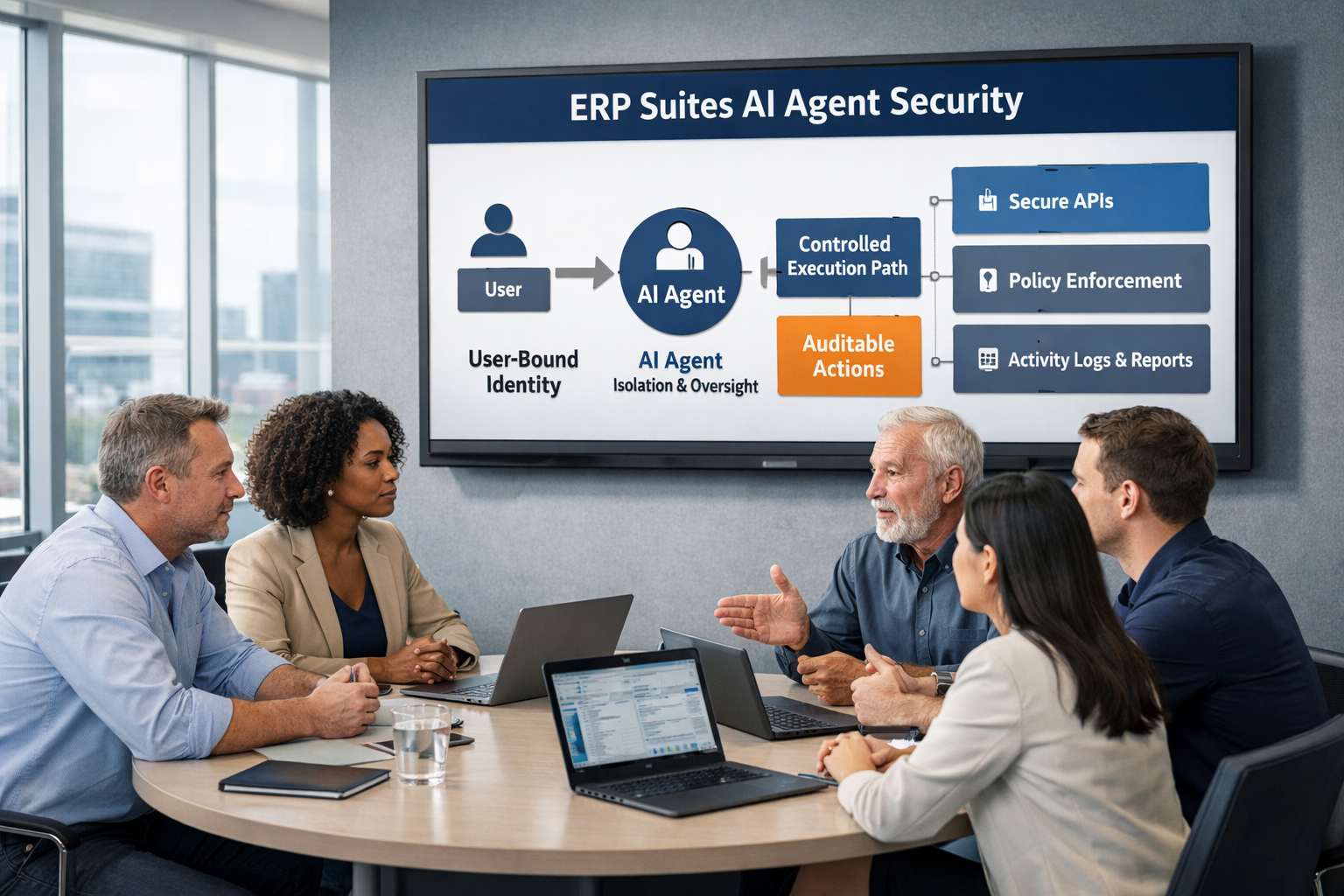
This article addresses those questions directly. It explains how JD Edwards AI Agents are designed to operate within a controlled security model: user-bound identity, constrained execution through approved functions and Orchestrations, limited credential persistence, protected data boundaries, and auditable actions. The goal is not to make broad claims about AI security in general. It is to show, in concrete terms, how this architecture preserves control inside an enterprise ERP environment.
Executive summary
JD Edwards AI Agents are designed around a simple principle: the agent is not trusted by default. It does not operate as an invisible superuser, and it does not create its own authority at runtime. Instead, it works within the context of an authenticated user session and within execution paths that have already been approved.
At a high level, the security model rests on five core controls:
1. Identity remains user-bound
The agent acts on behalf of an authenticated user rather than as a standalone privileged identity. JD Edwards authorization continues to depend on the mapped JDE user and existing enterprise roles. This helps preserve established role-based controls instead of bypassing them.
2. Human credentials are not persistently stored
User authority is session-scoped and represented by short-lived tokens rather than stored human credentials. Durable secrets in OCI Vault are limited to service and agent credentials used for platform-to-platform communication.
3. Execution is constrained by approved paths
The agent does not perform arbitrary actions in JD Edwards. It operates through approved OCI Functions, using AIS DataService API queries for most read operations and JD Edwards Orchestrations for select write operations. If a request does not map to an approved path, it is denied.
4. Data boundaries are intentionally narrow
JD Edwards remains the transactional system of record. Transaction data is not stored in OCI by default unless explicitly authorized, and customer data is not used to train public models. The design intent is to reduce unnecessary data movement and avoid the creation of an ungoverned secondary store of ERP data.
5. Actions remain auditable
The platform is designed so organizations can trace requests and outcomes without turning the AI layer into a black box. This supports governance, investigation, and operational accountability in environments where traceability matters as much as functionality.
For security stakeholders, the central takeaway is this: the architecture is intended to make the AI layer a controlled execution boundary, not a backdoor into ERP. The sections that follow examine how that principle is applied across identity, access control, data protection, execution constraints, auditability, and infrastructure security.
Why AI Agents Require a Different Security Model
Enterprise teams already know how to secure users, APIs, and application integrations. AI agents introduce a different challenge because they sit between human intent and business execution. They do not just retrieve information. They interpret requests, select approved tools, and initiate actions. In an ERP environment, that means the security model has to account not only for access, but also for how language is translated into controlled system behavior.
That means a secure agent architecture has to answer a more demanding set of questions. Those concerns shape the security architecture described below.
Why JD Edwards AI Agents Should Never Be Trusted by Default
At the core of the architecture is a zero-trust model. In plain terms, that means the agent is not treated as inherently safe just because it is running inside the environment. Every interaction still has to be authenticated. Every action still has to be authorized. Every downstream system still has to enforce its own controls.
That principle matters because AI systems can otherwise become a kind of privileged middle layer. It is easy to imagine an architecture where the agent is given broad system credentials and allowed to operate as a technical superuser. That may be expedient in a prototype, but it creates exactly the kind of invisible access path most enterprise security teams are trying to avoid.
The design here takes the opposite approach. The agent is not a backdoor into JD Edwards. It is a controlled execution layer that operates within the boundaries of an authenticated user session and the permissions attached to that session.
How JD Edwards AI Agents Handle Identity and Access Control
One of the first questions enterprise security teams ask about any AI agent is whether it operates within the organization’s existing access model or creates a new privileged layer around it. That question matters even more in an ERP environment, where the consequences of unauthorized actions are operational, financial, and auditable.
Does the Agent Act as the User or as Its Own Privileged Identity?
One of the most important security properties of the system is that the agent does not operate as an all-powerful platform identity inside JD Edwards. Instead, it acts on behalf of a real user whose identity has already been established.
The identity flow follows a defined chain:
- The user authenticates through OIDC with single sign-on and multi-factor authentication.
- A session token is established for the application session.
- A per-user JWT is used to represent that authenticated context downstream.
- JD Edwards authorization still depends on the mapped JDE user and existing enterprise roles.
This matters because it preserves the security model that already exists inside JD Edwards rather than bypassing it. If a user has permission to initiate a certain action, the agent can assist with that action. If the user does not have that permission, the agent does not magically acquire it.
That keeps the AI layer accountable to the same role-based controls the business already understands. EnterpriseOne roles, RBAC patterns, and related controls remain the deciding factor for what can actually happen.
Scenario: A user requests an action they are not authorized to perform
Suppose a user asks the agent to initiate a JD Edwards action that falls outside the permissions already assigned to that user. In a weak design, the agent might still complete the action through a broad backend identity, effectively bypassing the ERP’s access controls.
That is not the intended model here. Because the agent operates within the context of the authenticated user session, and because JD Edwards authorization still depends on the mapped JDE user and existing enterprise roles, the user’s permissions should remain the governing boundary. If the user is not authorized to perform the action directly, the agent should not be able to perform it on the user’s behalf. In that sense, the agent helps execute permitted work; it does not expand the user’s authority.
Are Human Credentials Stored by the Platform?
A second important point is what the platform does not retain.
User authority is session-scoped. Human credentials are not stored in the platform and are not retained in the vault; instead, the user context is represented by a short-lived JWT that exists only for the life of the session. OCI Vault stores service and agent secrets only, separating durable platform credentials from temporary user delegation.
That design reduces several categories of risk at once. It avoids the creation of a long-lived credential store for human users. It reduces the chance of credential reuse across sessions. It also makes the agent’s authority inherently time-bounded because the user context is session-scoped.
The credentials that are stored in OCI Vault are agent and service credentials: the secrets, keys, and service-level materials needed for secure platform-to-platform communication. That is a very different class of secret than a human username and password, and it is managed accordingly.
Why Per-User Authorization Is Safer Than Broad Service-Account Access
In many insecure integration patterns, the system behind the scenes ends up calling into the ERP using a broad service account. That makes initial development easier, but it weakens traceability and over-centralizes privilege. Actions may be technically logged, but they are no longer meaningfully attributable to the user who initiated them.
The safer pattern is per-user authority. In this model, the system can still use services and orchestration layers to carry out the work, but the decision to allow or deny that work remains anchored to the user identity and the roles attached to it. That is the difference between an agent helping a user perform work and an agent quietly becoming its own privileged actor.
Where JD Edwards Data Goes During AI Processing
Does JD Edwards Remain the System of Record When AI Agents Are Used?
A secure architecture is not only about who can act. It is also about where the data lives and how much of it is moved around.
A key boundary in this design is that JD Edwards remains the transactional system of record. The AI layer may interpret requests, validate extracted data, or coordinate approved actions around the ERP, but that does not mean ERP transaction data is being copied into OCI by default.
In fact, JDE transaction data is not stored in OCI unless there is explicit authorization to do so. That is an important point because many teams assume AI initiatives automatically require data replication into a separate analytics or model-serving environment. That is not the operating assumption here. The intent is to minimize unnecessary data movement and avoid creating a second ungoverned store of transactional business records.
Is Customer Data Used to Train Public or Shared AI Models?
Another common concern is whether customer data ends up training public or shared models. The answer here is no. The environment is designed so that customer information remains within controlled OCI boundaries rather than becoming part of a public training pipeline.
That distinction is fundamental for enterprise adoption. Many organizations are less concerned about AI in the abstract than they are about loss of control over proprietary operational data. Security architecture has to answer that concern directly, not with general assurances but with explicit isolation boundaries.
How Private Networking Reduces Exposure in the AI Agent Architecture
The architecture also assumes that network placement matters. Core services are not designed around unnecessary public exposure. Instead, the environment uses private networking controls such as private subnets and network security groups to reduce the attack surface and to constrain east-west traffic between services.
This is important because the most meaningful question is not whether a cloud platform offers security features. Most do. The real question is whether those features are being used to narrow access in a deliberate way. A private deployment model, paired with segmentation and policy enforcement, is part of how the system reduces the chance that sensitive processing paths become broadly reachable.
How the Architecture Minimizes Plaintext Data Exposure Across AI Workflows
The architecture is also built around minimizing plaintext exposure. Data is encrypted in transit, and the platform avoids treating raw business content as something that should casually move from component to component without protection.
That may sound obvious, but it becomes more important in AI systems because AI workflows often involve multiple hops: front end to agent runtime, agent runtime to orchestration, orchestration to API gateway, gateway to ERP or supporting services. The more components involved, the more disciplined the design has to be about how information is transmitted and protected across those boundaries.
How JD Edwards AI Agents Restrict Actions
The agent is limited to approved read and write paths
At runtime, the agent does not invent its own way of interacting with JD Edwards. It operates through approved OCI Functions that use two controlled execution paths depending on the task being performed.
For read activity, those functions query JD Edwards through the AIS DataService API. For select write activity, they invoke approved JD Edwards Orchestrations. This means Orchestrations are used where a governed write path is required.
This keeps the execution model narrow and intentional. The agent is not given broad, open-ended access to JD Edwards. It is limited to approved function-level paths for reads and approved Orchestrations for specific write actions. If a request does not map to one of those approved paths, it should not be executed.
Scenario: A prompt asks the agent to perform an unapproved workflow
A common concern with AI systems is that flexible natural-language input could create flexible system behavior. For example, a user or malicious prompt might attempt to get the agent to perform a task that was never intentionally exposed through the platform.
The control model described here is designed to prevent that outcome. The agent is limited to approved OCI Functions, approved AIS DataService query patterns for reads, and approved JD Edwards Orchestrations for select write operations. If a request does not map to one of those predefined paths, it is denied rather than improvised at runtime. This turns the execution model into an allowlist, not a general interpretation engine. The model may interpret language, but it is not supposed to invent new operational paths from it.
How Prompt Boundaries and Approved Tools Prevent Unauthorized Behavior
One of the easiest ways to misunderstand AI agents is to assume that because the input is flexible, the execution path is flexible too. That is not how a secure system should work. The user may express intent in natural language, but the agent does not get to invent arbitrary system behavior from that input. It works within a defined set of approved tools, AIS query paths, Orchestrations, validation checks, and controlled execution paths.
The agent has no direct database access and does not bypass JD Edwards business logic. All business actions flow through approved application-layer controls rather than unrestricted access to underlying data stores.
That means the agent’s role is not “do anything the user asks.” Its role is closer to “interpret the request, map it to an allowed capability, validate that the request is appropriate, and then execute through controlled channels if authorization and validation both succeed.”
This is where prompt safety becomes a practical engineering matter rather than a marketing phrase. The system is not depending on the model to be well behaved in the abstract. It is depending on the surrounding architecture to limit what model output can actually cause.
How Requests Move from Query to Validation to Execution
A useful way to understand the control flow is as a gated sequence. The agent does not jump from prompt to transaction in a single step. The path is more deliberate:
- the request is interpreted,
- the intended action is matched to a known capability,
- the inputs are validated,
- and only then is execution allowed to proceed.
That sequence matters because it inserts checkpoints between language interpretation and system action. Each checkpoint is an opportunity to reject malformed inputs, deny unauthorized behavior, or require the request to fit within a known business process rather than a model-generated improvisation.
Scenario: A request is ambiguous, malformed, or incomplete
Not every user request should proceed to execution. In enterprise systems, ambiguity is itself a risk, especially when an action could affect operational or financial data.
That is why the control path should not be described as simply “user asks, agent acts.” The more accurate model is query, match, validate, then execute. A request must first align to an approved capability, then pass whatever validation logic governs that path, before any downstream action occurs. That sequence is what keeps interpretation from collapsing directly into execution.
How OCI Infrastructure Secures AI Agents
Which OCI Infrastructure Controls Actually Enforce the Security Model?
It is easy to say a platform is “built on OCI” and leave it at that. But using OCI is not, by itself, a security explanation. The real security story comes from how the environment is assembled.
In this case, infrastructure controls include private subnets, NSGs, API-level mediation, encrypted communication, and secret management through OCI Vault. These are not peripheral add-ons. They shape how the agent runtime, functions, gateways, and integration points communicate with one another.
The objective is defense in depth. No single control is treated as sufficient. Network isolation, identity validation, secret management, and transport encryption each cover different parts of the problem.
As noted earlier, OCI Vault stores service and agent secrets, not human credentials.
How API Mediation Reduces Direct Exposure to JD Edwards and Other Services
Another meaningful security decision is that integrations are not simply opened up end to end. API gateways and controlled functions create a mediated path between the agent layer and enterprise services. That reduces the likelihood that internal systems become directly exposed to every component or caller in the environment.
In practice, mediated integration allows teams to enforce policy, logging, and validation at well-defined control points instead of scattering trust assumptions throughout the stack.
How the Platform Supports Auditability Without Creating a Shadow ERP
Can Every Meaningful Agent Action Be Traced Back to a Real User?
For enterprise security teams, prevention is only half the story. The other half is being able to reconstruct what happened.
That is why the architecture includes a complete audit trail around agent activity. The goal is to retain visibility into who initiated a request, what action was attempted, when it happened, and what the result was. Without that, even a well-protected system becomes difficult to govern.
Auditability is particularly important for AI because intent and execution are not always the same thing. A user may ask for one thing, the system may interpret it in a particular way, and downstream controls may allow or deny some portion of that request. Good logging makes that chain understandable after the fact.
The audit trail captures the requesting user, the requested action, the selected function or Orchestration, the time of execution, and the outcome. That provides accountability and reviewability without reproducing full JD Edwards transaction payloads in a secondary system.
Scenario: An auditor needs to reconstruct a request and its outcome
If an action is initiated through an AI layer, one of the most important governance questions is whether the organization can reconstruct what happened afterward. Who made the request? What was the agent allowed to invoke? What did the system actually do?
The platform is intended to preserve that traceability by keeping actions attributable and auditable. The emphasis is on logging the request and the controlled execution path rather than creating a duplicate store of full JD Edwards transactions. That gives reviewers a way to investigate activity without turning the AI layer into a shadow ERP or a second source of record.
What Does the Platform Log?
At the same time, observability does not mean copying everything.
The platform logs the JD Edwards transaction request, not the complete transaction. It is not trying to function as a shadow debugging tool for JD Edwards, nor is it attempting to trace and replicate ERP internals in a separate environment. That boundary is important both for privacy and for operational clarity.
In other words, the logging model is designed to support accountability and review without turning the AI platform into an unnecessary store of full transactional replicas or a second source of truth about what happened inside the ERP.
How Logging Supports Governance Without Creating Unnecessary Data Retention
A good audit trail serves governance, compliance, and troubleshooting. A bad one creates excess retention and a new data-management problem. The balance here is to capture enough information to understand actions and outcomes while avoiding unnecessary accumulation of sensitive transactional detail.
That is the difference between logging for control and logging for indiscriminate collection.
Compliance, Data Residency, and Governance
Security is not only about blocking unauthorized access. In many organizations, it is also about demonstrating appropriate control to auditors, regulators, and internal governance teams.
Because the platform can be deployed within OCI regional boundaries, it supports organizations that have data residency or jurisdictional requirements. That does not automatically satisfy every compliance obligation, of course, but it gives the architecture an important degree of control over where processing occurs.
Just as important, the combination of identity-bound actions, limited credential persistence, private infrastructure, and auditable request logging makes the environment easier to explain to governance stakeholders. That matters in regulated industries, but it also matters in any enterprise where new systems must fit into existing review and risk frameworks.
What “Secure” Should Actually Mean for AI Agents in JD Edwards
It is easy to use the word secure too loosely when talking about AI. In practice, a secure AI agent environment should mean something more precise.
It should mean the agent does not act as a hidden superuser. It should mean human credentials are not being silently warehoused. It should mean data is not being copied or retained beyond what the workflow actually requires. It should mean natural-language input cannot bypass system controls. It should mean actions remain attributable to real users and reviewable after the fact.
That is the standard worth holding these systems to, especially when they are operating around financial, operational, or transactional workflows.
Conclusion
AI agents become much more useful when they can do real work inside enterprise systems. That usefulness is exactly why the security model matters so much. The more capable the agent becomes, the more discipline the architecture needs around identity, authorization, data boundaries, execution controls, and auditability.
In this design, security is not a wrapper around the agent. It is part of how the agent is allowed to exist in the first place.
The result is an architecture where the agent remains constrained, attributable, and aligned to the same enterprise controls that govern human users. That is the right foundation for any organization that wants the benefits of AI automation without surrendering control of its ERP environment.
Topics: