
JD Edwards AI Agents: Hype vs. Real ROI
June 15th, 2026
25 min read
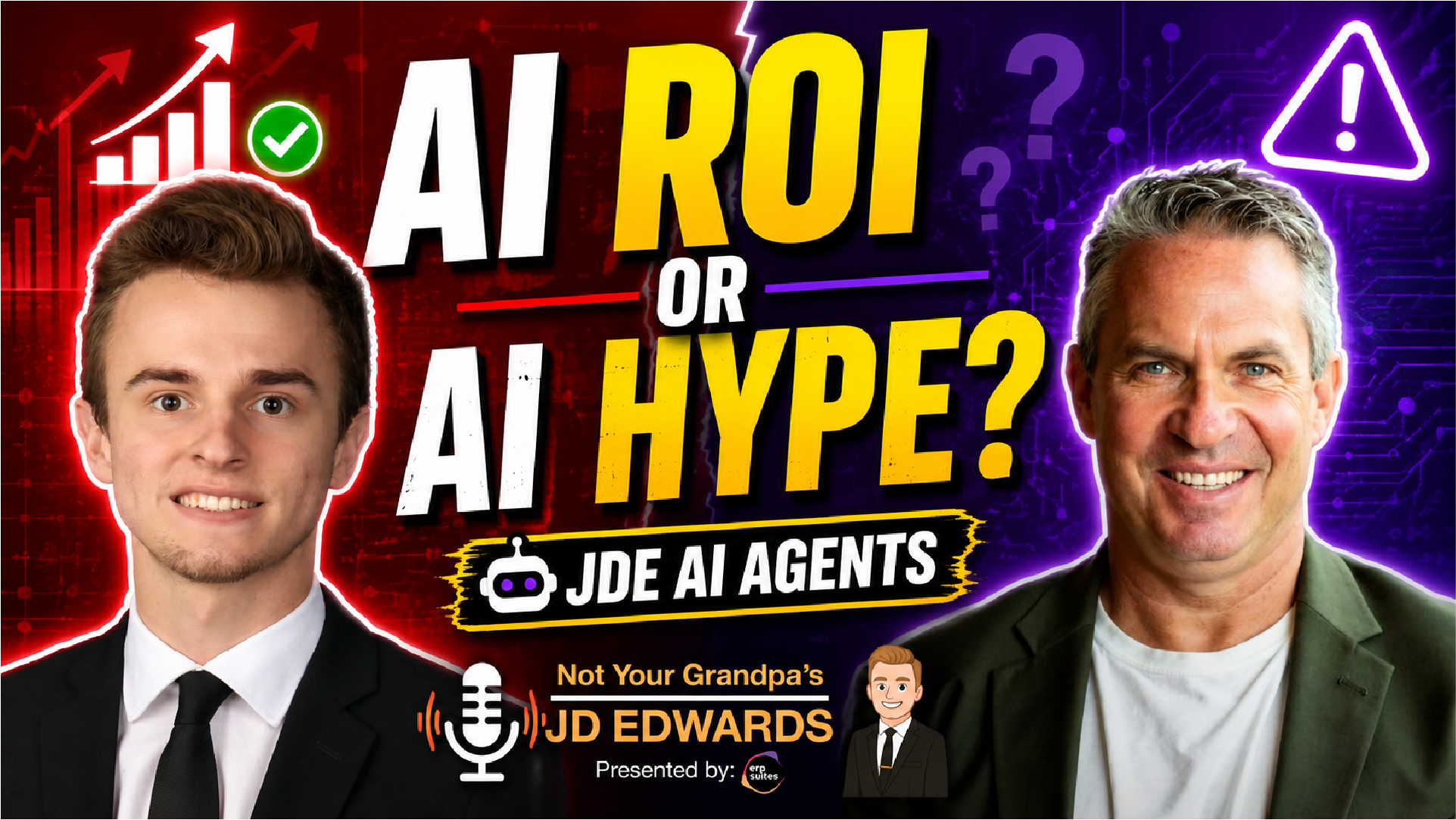
This episode explores how JD Edwards organizations can achieve measurable ROI from AI agents by focusing on business processes rather than technology alone. Kevin Van Horn discusses why successful AI initiatives start with identifying repetitive, rules-based, high-volume processes and establishing clear performance metrics before deployment. The conversation highlights practical JD Edwards use cases including accounts payable, order entry, procurement, and financial close, demonstrating how AI-powered digital workers can reduce manual effort, improve accuracy, increase scalability, and enhance employee satisfaction.
Table of Contents
- Introduction: Why AI Agent ROI Matters in JD Edwards
- The Shift from AI Curiosity to Business Value
- Building the Right AI Business Case
- Choosing Processes That Deliver Measurable ROI
- Accounts Payable as a High-Impact Starting Point
- Order Entry and Procurement Automation Opportunities
- Finance Close and Other Digital Worker Use Cases
- Measuring ROI: Baselines, Metrics, and Success Indicators
- Avoiding ROI Mistakes and Creating Sustainable Business Value
Introduction: Why AI Agent ROI Matters in JD Edwards
Introduction: Why AI Agent ROI Matters in JD EdwardsAI agents sound promising, but how do you prove that they're actually worth the investment? And if you're running JD Edwards, how do you know whether an AI agent is creating real business value or just becoming another AI experiment?
In today's episode, we'll breakdown where ROI comes from, which JD Edwards processes make strong first use cases, and what leaders should measure before and after deploying an AI agent. By the end, you'll know why. AI agent ROI starts with a measurable business process, not with the technology itself.
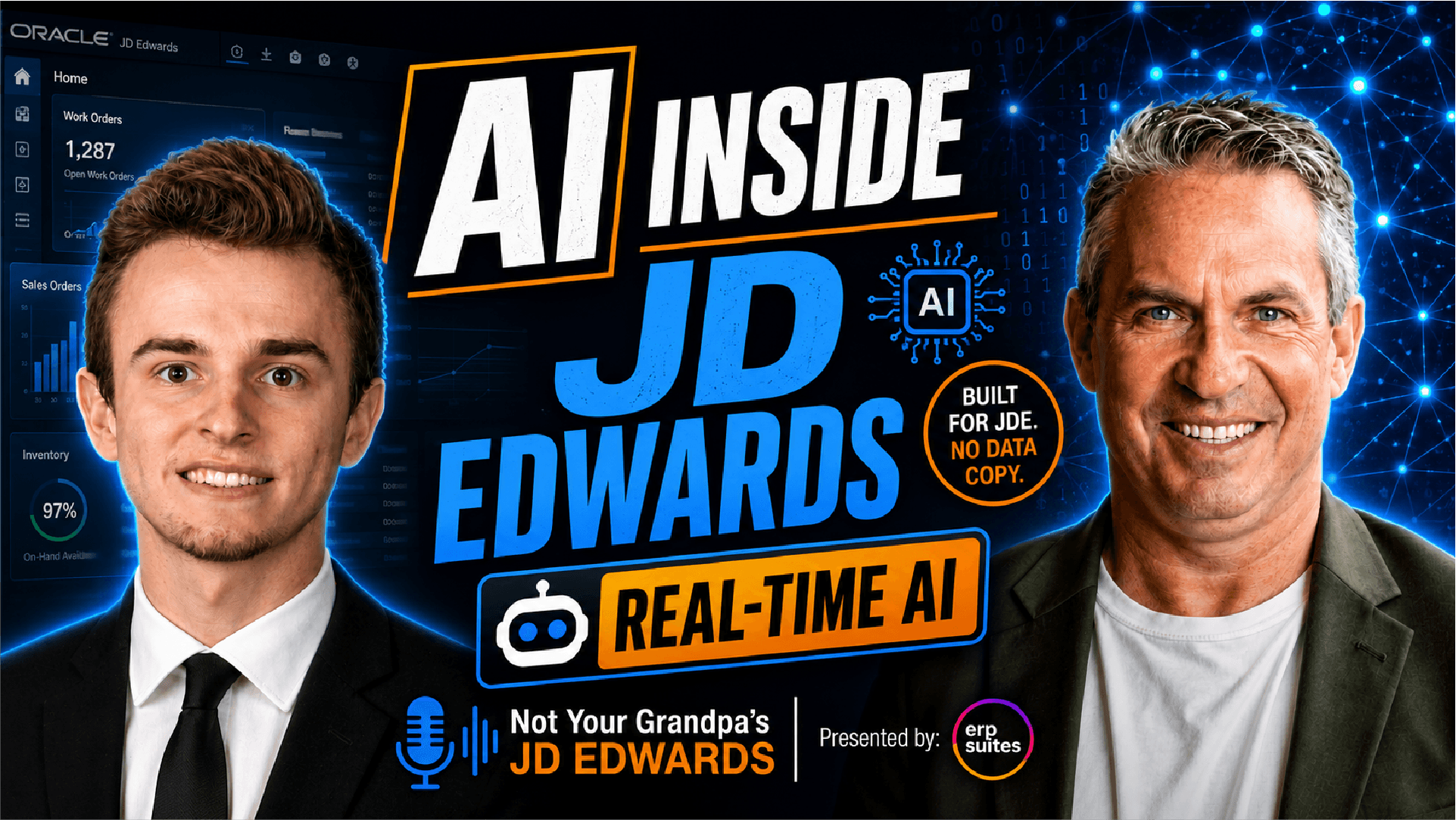
Welcome back to Not Your Grandpa's JD Edwards, the podcast for JD Edwards users who are modernizing, optimizing, and finding new ways to get more value out of their ERP investment. I'm your host, Nate Bushfield, and today we are talking about one of the biggest AI questions for JD Edwards leaders: How do you actually get ROI from an AI agent in JDE?
Many organizations are past the curiosity stage. CFOSCIOS and JD leaders are now asking what value are we getting? Can we measure it? Can we justify the investment?
And the key point for this today is AI agents do not automatically create ROI. They create ROI when they are attached to a measurable business process.
The Shift from AI Curiosity to Business Value
But joining me today is the first time guest Kevin Van Horn from ERP Suites. Kevin, welcome to the show. And for those that are out there right now that are like, oh, who's this guy? Could you give him a little bit of background?
Sure, sure. Thank you, Nate, and, and thank you for having me. It's a I'm super excited to be here. It's it's, I'm equal parts excited and, and nervous because you know, when you've, when you've reached that career level where you're on not your grandpa's JD Edwards podcast, it's that you've reached that, that, that pinnacle. And I want to do a good job.
So I am a recurring guest. But yeah, I, you know, I'm a long time old time JD Edwards professional. I started as a customer back in 1990 with Waste Management and it was so much fun working with JD Edwards at that point. I joined JD Edwards back in 1994 and stayed with that organization through the acquisitions of of PeopleSoft and Oracle and spent 27 years helping lead the JD Edwards organization for Oracle.
And you know, and over the last couple years I've been working with AI particularly related to JD Edwards in and just have had a wonderful time working with the RP suites and and their leadership in this space. So thank you for having me.
Yeah, of course. Yeah, we are the number 2 podcasts for JD Edwards in the nation right now. So it's very high, high praise that we get, but I'm sure you'll do great.
So before we get into ROI, what are you hearing from JD Edwards customers right now when it comes to AI agents?
Yeah, yeah, that's, it's very, very interesting because the the conversation has definitely shifted. We've gone from curiosity to tell me about that to I need it now. I want this, right?
So, you know, but but the point is the leaders now are, are wanting more than just demo air, right? They're wanting more than just kind of vaporware. They they want real time solutions that solve real time problems, right? And and to get that, they're asking those hard questions, right? What is it's going to do for me? How is it going to make my business better, right? You know how the how is it moving the needle for the organizations?
And it's just with JD Edwards, it's such AAI ready ERP, right? It's such a transaction heavy software that it lends itself so well to to AI, right. But the leaders are now that they're more than curious. They want to know what's in it for them.
Building the Right AI Business Case
Why do some of these AI projects struggle to show that ROI?
Yeah, yeah. And that the, you raise a really good point to, you know, how much this has changed just in the last year, right? And, and, and digital assistants, you know, that was that, that, that was compelling 2 years ago, right? You know, how do you help JD Edwards users use the solution better, right? But it was more about that kind of training and interaction where agents are actually doing something, right?
They're actually doing something, they're actually performing those manual processes that users typically were doing. They weren't just helping, they were doing right. So the case that the, the, the whole kind of paradigm is shifted towards that.
So you know, what's the problem is I need AI isn't a business case. It isn't a use case, right? The, the business case is, is a process that needs to be fixed and improved, right? And, and you know, as I mentioned before, it's gone from curiosity to tell me about it to I need it now. But still, even with that needed now it's, well, I need it now because the board is asking me to use AI, right?
That that's great, you're, you're on that journey. But using AI isn't the business case, right? The business case is what is the business process that you're trying to fix, trying to improve? Where are your bottlenecks? Where are too many hands on the keyboard? Where are exception requests that require too many people in the process, right? What are those rule based business processes that can be improved really?
And that's that's where it is, right? If, if, if you've created a a use case around AI that where you don't know the process, you don't know the owner and you don't know the metric, you're probably trying to improve. You're not, you haven't created a use case, right.
But the cool part is if you know all three of those, that's where the magic happens, right? That's where AI could really start driving ROI into your business.
Yeah, exactly. And some of these people, they don't know the specific use case. They do not know their specific pain points before. Maybe they have a conversation with one of the many AI teams that are out there in this world.
Sure. But how, how would you say that some of these JD leaders should narrow their scope before they even start?
Yeah, Yeah, that's another great question. It's, it's, and you've kind of brought you raised a really good point in that question is that, you know, oftentimes business processes change, right? Oh, you know, based upon business requirements changing, right? And they've done so for years upon years, right? And oftentimes those changes are incorporating manual processes into it, right? And they become kind of a tribal norm to the process and leaders.
You know, maybe it's a new leader who's come into the organization, or maybe it's somebody who's been promoted through the process or, you know, through their organization, but they don't even necessarily know that there's a problem in the process because it's just become the process, right?
But you know, I, I think, you know, as you mentioned before, it's, it's not AI isn't a magic, you know, but you know, it's not, it's not magic, right? We, you have to work with your organization or, or you know, or work with a company like ERP suites where we can go in and talk to the business universe and help determine a process that needs to be improved.
And the key then is to is to pick a process that has some volume, that has some complexity, that is rules based, that is repetitive, right? And then we can start understanding those metrics that you're trying to track against, right? Create the baseline, right.
You know, we can help you figure out those processes. I mean, you know, we that, you know, that's one of the things we do. But you've got to start with the process, right? You, you, you can't start with using AI.
Choosing Processes That Deliver Measurable ROI
So let's unpack that a little bit deeper there. What is the difference between a useful AI pilot and just another science project?
Yeah, right. Yeah. You know, science projects are about exploring the unknown, right? You know what I mean? It's, it's about, you know, the theoretical, right, where AI pilot should be about improving a specific business use case, Right, right.
A science project always starts with technology, right? Whether that's, you know, you know, pharmaceutical companies, you know, with R&D, with new, you know, drugs, whether it's NASA, they know, you know, creating a, a, a project to Mars, what you know, whatever it is, you know, science projects start with technology, right?
AI problems AI a pilot start with use cases right? You know a useful like I said before, a useful pilot will have a you know, a process, an owner and a metric to improve right? The output shouldn't be well, the AI did its job, right? You know the AI function right? It's about how did it improve your process in a measurable sort of way, right?
You know, if, if you if you can't point to that specific process that's slowing you down and say, you know, this is what we're fixing. You're not really running a pilot. Like you said, you're running a science project, right? And you know, that's where ROI is going to be difficult to ascertain at that point, right? I mean, because, I mean, you're not trying to fix something specifically. You're just trying to use AI.
Yeah. And that's a great distinction. The AI agent itself is not the business case. The process is the true business case.
So is the first step is choosing the right process? The next question truly is where do AI agents create measurable value inside of JD Edwards?
Yeah. So which JD Edwards processes are most likely to produce ROI from an AI age?
Yeah, that's a great, another great point. I want to take one step back though, because I before I answer that question, I want to try to reframe how people are thinking about AI ages, right?
We need to stop thinking about AI agents as a piece of software or code, right? We need to start thinking about AI agents as digital workers, right? Like somebody who is actually performing action for your organization, within your organization to improve your measurable results, right?
JD Edwards is your system of record, right? That's software, right? I mean, it truly is that's, it's, it's software that's tried and true, right? A digital worker, and I'm going to start calling it that, right? A digital worker interacts with JD Edwards the same way your, your actual workers do, right?
They research problems, right? They process transactions, they make decisions, they follow rules, right? They they escalate exceptions. Same thing your people are doing today, right? The difference is these digital workers work 24 hours a day, seven days a week. They scale much greater than an actual worker, right?
So will you ask me, you know, what kind of processes in JD Edwards help produce those kind of ROI? Well, obviously high volume, right, repetitive, right, rules based, right, where there is actual vision, you know, pain within your organization, right, where people are chasing data, where they're chasing approvals, where they're checking status is, where they're handling exceptions, you know, things of that nature.
Those are the areas that digital workers can really excel and help your actual workers, you know, become more value added workers.
So, you know, I think that common thread is, is, you know, the the higher the volume, the more predictable the rules are, the more measurable the outcomes are. That's those are great places for digital workers start.
Accounts Payable as a High-Impact Starting Point
Yeah, couldn't have said it better myself, but let's maybe talk about a specific place where they can start. Let's start with accounts payable.
Sure. Where can an AI agent create measurable value in AP?
Yeah, I mean, if you think about it, AP is the perfect place to start, right? AP automation has created an entire sub industry just to just to try to do things that our, our current AP agents are excelling at now, right?
We have companies all over the place have created AP automation, right and used old technologies to try to get, you know, invoices into the system without having to manual key punch, right? You know, a digital worker can handle all that front end work, right?
It doesn't use OCR, which at its best was 50 to 60%, you know, accurate, right? We can have intelligent documents that are 9899% successful at scanning documents and understanding the data, right?
So our AP agents can pick up invoices from almost anywhere, from e-mail, mailboxes, from portals, from, you know, file store, cloud storage areas. It can grab invoices anywhere, validate the data, you know, give you kind of the results of that and actually load those into JD Edwards automatically like it had fingers on the keyboard.
So, I mean, again, it's, it's it's an excellent place to start, particularly if you have high volumes of high volumes of invoices it yeah, it reduces the time per invoice and even the amount of manual touches, right. I mean, could be there, right.
And that's a great, that's kind of a great measurement. I mean, you, you can think of all the, you know, kind of the, the historical kind of days payables outstanding, right, or discounts taken or things of that nature, which are, are, are still really important goals for these digital workers to achieve, right?
But some of the other goals that you that that these digital workers allow us to track is that thing about human intervention, right, or first time success rates or how do we, you know how, you know, time per invoice, right? Things of that nature that allow us, that allow the digital worker to and actually allow your actual workers to spend more time, you know, managing, you know, vendors and suppliers and, and, and, and truly critical problems like cash management and all of that.
Whereas the digital workers can truly start improving those metrics that you're looking at. But yeah, that, I mean, AP is the one that could, I mean, if you just think about it, you know that this is the next evolution of AP automation.
Order Entry and Procurement Automation Opportunities
Yeah, yeah, couldn't have said it better myself. So maybe switching gears here a little bit, what about like a order entry, you know, like how can an AI agent, digital Co worker work like help out there?
Yeah, it's interesting because you know, sales orders are, you know, personally to me they're they're more complex than AP invoices, right. There's, there's a lot more to them, but you know, EDI is actually helped that quite a bit, right? It has, has helped automate sales orders, it, you know, into systems and, and have built that integration between, you know, your, your customers and your sales order systems.
But you know, EDI doesn't do everything right. And, and it's funny because I'm working with a customer right now who they have up to 50,000 sales orders a month, but 5000 of them are manual entered. So I mean, if you think about that and say, well, 50,000 a month, 45,000 or through EDI, fantastic. How do you enter 5000 sales orders manually every month, right? And that's the problem they're really trying to solve, right?
And it's very similar to the AP agent, right? How do I take some communication from my customers, you know, whether that's APDF, whether that's an Excel spreadsheet that into JD Edwards much, much faster than any human could actually type that into the system, right. Particularly thinking that, you know, a sales order could contain a multitude of line items with it right.
So so it it it can get all of those in instantaneously and. Then it can read the customers and the items and the pricing and the quantity and the freight instructions and all of that information and make suggestions it has to how to best create that sales order, you know, working with the rules that the customer has for their customers and how they want to act.
So yeah, Sales Order is another great place because each of those are just incredibly high volume, competitive, a incredibly repetitive, but also incredibly, incredibly important. I mean, sales orders are mission critical to organizations, right? The, the quicker they can get into the system, the more responsive you can be to your customers.
And I think that that is critical, right, that we get sales orders into the system as fast as possible. So you can understand, you know the the interaction then with your customers, right is is that order back ordered? You know what does the freight we know when do I need to ship this? When is this going to be available?
All those decisions can be made faster, quicker and more accurately. You know if we can utilize digital workers to get these into the system.
Yeah, exactly. And maybe again, maybe switching a little bit here, how could like procurement needs to last.
AI procurement is, is incredible because it's, it's, you know, you can use our digital procurement workers, you know, from the very beginning of procurement through the entire life cycle. And I'm talking the very beginning, it's they can support supplier onboarding, right, Which is a in, in, in a lot of organizations is, is an incredibly cumbersome, time consuming task that that requires people to go to multiple screens and multiple applications just to get a supplier into the system in order to buy something from that, from that.
You know, you've got procurement professionals and buyers who are spending an enormous amount of time kind of chasing down exceptions, you know, trying to look at supplier risk management, certificates of insurance and things of that nature. Where is the system should and could be tracking that in real time for you, right?
You know, it needs to understand, you know, where the digital worker can understand what POS, you know, when POS are created, what's their status, what's their projected delivery date, when is, you know, where is it in the process they are.
You know, I talked about it before when I, we were talking about digital workers that they can actually research and reason, right? I mean, our digital workers can look at APO that has a delivery date of next week and if it understands how it's being shipped, it can actually go out to the shipment or company, FedEx or UPS or whatever and see where that shipping is in real time for us, right, To help monitor that process, right.
So, so, yeah, it's, you know, all the way through, you know, execution and, and, you know, with my background, you know, there's a thing called, you know, retainage, you know, that that that needs to be held on certain POS and it AI agents can look at that and understand, you know, when to release those and automatically release those retainage payments.
So procurement again is another sweet spot, right? It really is. It's, it's procurement is one of those ones that there's a lot of manual processes, there's a lot of exceptions. There's a lot of, you know, there's a lot of key data points to track.
And the cool part about our digital workers is they they track them. They track everything all the time, 24 hours a day, seven days a week, so that you have all of that information real time, all the time.
Visibility truly matters when it comes to procurement.
Finance Close and Other Digital Worker Use Cases
Absolutely. But but it also matters in maybe a different Department of Finance.
Sure. Where could an AI agent help them during clothes?
Yeah, clothes is it is such an interesting one to me because it's it's one, you know, obviously it's repetitive. It happens every month, you know, year after year, month after month, year after year. It always happens, right.
And you can argue about, you know, the volume, particularly if you're, you know, an an organization that has tremendously high sales orders or invoices or whatnot. But the thing about closing to me is a, and why digital workers for closing are so important. It's because of the time, right?
You know, closing the books is a, you know, is all about timing, how much time it's about timing coordination, right? So, you know, it's, it's maybe it's not the, you know, the 50,000 sales orders in a month, but you, you have to do something in minutes, hours and days and have to coordinate all those activities with a number of different people within the team to be able to, to execute a close Florida State the way you want to as an organization.
And the great part about these digital workers is that that collaboration, they collaborate, right? They, they share information, right? They can track, they can track the statuses of different operations and different tasks within that closing process and understand where they are, you know, how much time to completion, what do they need to do? You know, who needs to be involved in that exception processes just to make all of that run smoother, right?
You know, I mean, obviously there's components to a close, right? You know, is, is to we have an agent that can look at our trial balance and, and, and look for and look for exceptions and, and problems in our trial balance. So that instead of somebody looking at an enormously big trial balance where 98% of the accounts are correct, they're focused, the digital worker could focus on the 2% that are, that is incorrect, right?
Accounts reconciliations, right? It's the same, the same idea, right? It, it's, you know, the problem with some of these processes is that each month you kind of start a new right and, and quote and, and they are closing. Our financial professionals are going through the systems looking at 98% of accounts that are perfect, trying to find the 2% that are incorrect.
Digital worker could find those immediately, you know, without having to spend all the time looking and allow the financial professional professional to solve those problems immediately without having to do that research that the digital worker have to do.
So I mean, it, it's, it, it's, you know, when you have a team trying to close the books and they're stretched thin and they're under a lot of pressure, it's nice to have these digital workers working all the time giving you that information you need.
So you're, you're saying that the strongest AI agent or usual worker use case, they're specific, they're measurable, they're repetitive, and they're tied to a recognizable business plan.
For GDE customers, that often means AP invoices, order entry, procurement, follow up and close tasks, ticket triage. Well, maybe not that and also system monitoring.
So you're saying the strongest AI agent use cases are specific, they're measurable, they're repetitive, and they're tied to recognizable business pains. For JDE customers, that often means AP invoices or entry, procurement, follow up and even system monitor.
Measuring ROI: Baselines, Metrics, and Success Indicators
So now let's say a company has picked one of those processes. How do they calculate the true business case?
Yeah. I mean, what, like what should they measure before deploying an AI agent?
Yeah, yeah. I mean, you know, and I this might sound intuitive, but you know, in speaking with customers, it's, it's often not right. It's, but they've got to document the baseline, right? That you've got to understand where you are today, right?
And, you know, obviously people understand problems, you know what I mean? They, they understand, Hey, you know, our, our, you know, we've got so many invoices and it takes so long for our people to enter those. And it's like you were our days payables outstanding is growing and we're not taking discounts and all of these things are happening.
And so that's where, you know, documenting that baseline and that's why that's so important, right? I'd argue that, you know, you look at so many JD Edwards customers, right? And when they created these processes, whatever it might be like and and you mentioned it, I mean, JD Edwards is full of these type of processes, right?
We've talked about financials, we talked about payables, we talked about, you know, sales, sales and distribution. We talked about, you know, there's inventory allocation, there's reconciliations, there's procurement, there's projects or service, There's so many different areas that any one of these problems can occur, right?
But you know, they've created these processes years ago and they're often their business has changed, right? So they understand the process, right? But they don't, they understand that there's a pain in the process, but they haven't necessarily documented that that process as where is my Bayside? Where is my stake in the ground, right?
They've acquired companies, they've started new business lines, you know, the things like that. And you know, so the first thing is, is understand your process volume, right? Whatever it might be, you know, like, like how many transactions, you know, and, and, and what's the repetition of those transactions, right?
I mean, we talked about invoices, you know there every day, all the time, right, sales orders every day all the time or financial close. Well, this is monthly, but it's this, right? So the volume, what is the volume?
How much time are you spending on that volume, right? What is the time of the transaction? How long does it take for somebody to actually do that, right? How many manual touches does it take to support that, right?
So I mean, they kind of go together, right, for the time. But you know, we, we have, you know, I mentioned it before, you know, you go just to try to do supplier onboarding and there's four or five different screens it takes to be able to get them a supplier up and running, right? So there's 5 or 6 different manual touches. It might take 15 minutes and there's 5 or 6 manual touches, right?
You know, another big one is what's the exception rate? What are the error rate? You know, the more manual it is, the higher the error rates going to be, right? You know, how much rework needs to be be done.
But you know, ultimately you're going to be able to find out all those things by talking to people, right? You know, actually working with them because they tell you things that your documentation doesn't, right? They tell you the they tell you the truth where you and, and it was that thing we talked about before. It's that, you know, they're sometimes people, companies that put in manual steps to solve a business problem at a given time and they, they just become part of the process, right? And then ultimately, as the business change, they become part of the problem, right?
So by talking to the, your people and, and trying to work through that process, what is the volume? How much time does it take? How many keystrokes does it take? How, what's the exception and error rates? You're going to find that from talking to people. And that then helps, gives us, gives us the metrics to build upon, right?
And yeah, so we have the metrics now to build upon.
Yeah. What should leaders then measure after an agent is deployed?
Yeah, Yeah. So the future state, you know that we talked about the current state, right? So what is the future state, Right.
So, you know, I'm always going to go back to the most important thing, which is time, right? And how much, you know, So the first thing is how much time are we saving in the organization, right? You know, how much manual work is reduced, right? How many, how much exceptions or errors are reduced, right?
So, you know, understanding time, you know, is, is going to be a huge component to track in the future, right?
Human intervention is another key one, right? Whereas, you know, if we've created these digital workers correctly, and I realize this can be something that happens and evolves over time, but they can, they can perform these tasks autonomously, right? So the lower the human intervention rate, the better, right? That means the the digital worker is doing a, a better job, a good job, right?
So, and, and I think we all realize and, and that when companies are deploying their first digital worker, they might want to have that human in the loop, right? They, they might want to have, you know, those humans, you know, that human intervention to ensure that, that digital workers doing things the right way.
But over time, what we really want to see is that human intervention, intervention rate go down because that really means your people are able to focus on more value added processes and not this manual process that we, that we're solving with our digital worker, right.
Adoption is a big one, you know, and, and, and that really goes, I mean, and when you talked about it in the very beginning, you know, digital assistants were great back when they started, but the adoption wasn't really what we hoped it would be, right? It was an extra step in the process for people to go and ask the, the digital worker, you know, what to do, right? So the adoption wasn't what we wanted it to be, right?
What we hope now is that the adoption, you know, and, and if you think about it, there are different types of agents, right? You know, they're different types of digital workers. There are transactional, which the adoption should be 100% right. But there's other digital workers that are more analytical, right? That they're, they're more suggestive, they're helping you do research, they're making recommendations as opposed to performing autonomous tasks, right?
We want to see those adopted, right? We want to see those recommendations being, you know, being agreed upon and executed automatically because that's going to help all those other things.
Now, the last piece that I'll say is, and this is one that I would think is often overlooked, is don't overlook employee satisfaction.
Yeah, you know, you know, people were everybody is hesitant about AI, right? It's going to take my job, it's going to do this. And simultaneously, they're also complaining about doing mind numbing repetitive work, right.
So if we can get a digital worker to do that repetitive work, how much does that help the satisfaction of the employees that they're doing more value add work? They're they're helping make business decisions that are helping the custom the company be successful, right.
And just that, you know, that ability has truly have to improve, you know, the employee morale and, and the employee engagement, right? And, and really kind of foster that organizational cultural type improvement that that these digital workers can right.
I mean, we, we get the fact, I mean, everybody's nervous about what AI is going to do to workers, right? What we hope they do is we hope, we hope they make workers more valuable, right? They that they can do we, they can do all the things we want them to do if they didn't have to do all the manual stuff that we don't want them to do.
So the ROI categories, they usually fall under a few buckets, yeah, like labor capacity, cycle time reduction, error reduction, exception reduction, scalability, visibility, the risk reduction and even the avoided hiring or overtime, which is what you were just talking about.
And you're right, that has such a big role into employee satisfaction for many reasons, but it also helps out the business. But one of those places companies can overstate ROI and goes with that customer, customer satisfaction. They can oversafe the ROI in labor savings. It's not really what that does.
It allows your labor to not work that overtime. So yes, there's some savings there, but All in all, it's about giving them meaningful work. So how, how should leaders think about labor savings without overstating this ROI?
Avoiding ROI Mistakes and Creating Sustainable Business Value
Yeah. I mean, that's a, that's the tricky, that's the tricky part, right? That's often this is where the ROI conversation can go sideways if we're not careful, right?
I mean, you, you raised a great point, right? If if you deploy a digital worker, let's just say we deploy our AP digital worker and you currently have a staff of five people that are doing this full time, right? And it saves them two hours a day, right?
OK, well, so it saved US 10 hours a week, right? That's that's not a person or you're not, you're not, you're not necessarily getting rid of a person, right? You freed up capacity, right?
You know, and you know, this, This is why we talked about earlier that going back to thinking that that you're, instead of having to go through the recruitment and onboarding and, and you know, the perpetual, you know, the whole, you know, higher to retire process, you know, we can help go through the onboarding process of a digital worker, right?
And what that allows to your point is it helps free up capacity for higher value work now in the future. Well, I know, I mean, to your point too, it's like there are some hard savings, right? I mean, there's hard savings of reducing overtime, right? There's hard savings, but the other hard savings will be your, your headcount planning, right?
You know what I mean? Like, like, you know, I'm working with a company now that's trying that, that's, that's going through an acquisition phase, right? And they literally can't hire enough people, right, to take on the new volume, right? So it's going to limit or inhibit them from achieving their results, right?
But the digital worker can help that, right, without having to grow headcount. So it's, it's, it's not about headcount reduction, it's about having a new model for headcount planning in the future. And what's the balance of people, human people, right, versus digital theme, right? And, and it's all that.
So, yeah, that's something that, you know, we really, you really have to consider, right? And not be about this is about labor reduction, right? This is about labor efficiency, right? And that that's going to help you create a more real realistic ROI model than saying, oh, this is going to let me get rid of five people because that's not going to happen, right.
You know?
Yeah. And I mean, there's also that that side of it of there's a reduced turnover, a lot of your a lot of your employees. And if we're talking about cost, that means you have to spend the money to go in a completely new hiring process. And then you have to take the time to train that employee, right?
And it's just gets to the point where you're spending so much money just to fully transform what your business looks like right now for these like few people that are working on your team.
Yeah. Yeah, you're absolutely right. I mean, you know, you're not trying to replace people, you're trying to build an environment where people want to stay, right? And the more you know, and that's a great, you know, we talked a little bit a few questions ago about the metrics and we, we did talk about employee satisfaction, but employee turnover, right?
Those are, that's real money, right? That's real dollars and that's and those are significant dollars, right? They're hard to they're hard to quantify on day one, right? They, they truly are. I mean, we all get that right.
But I think if you take that step back and stop thinking about this as software and code and start thinking about these as digital workers to that, that help support your, your people, then it becomes, you know, it, it, it becomes a, a different conversation and you frame it differently as you're talking, thinking about ROI, because digital workers are here to help our people, right?
They're here to increase their, you know, not just the intangibles as we talked about if increase, you know, increasing all the key business operating metrics, but also to make your current employees jobs more satisfying and to reduce their turnover.
Nobody wants people leaving it. It causes disruption that in many cases takes weeks, months, years to replace. The the more we the more we can stop, the, the more we can slow that, the better the organization is.
Exactly. So what would you say are some of the most common mistakes that create fake or even inflated ROI in an AI project?
Yeah. You know, it's, it's funny you, you say that because it's it's, you know, one of the things that that I've been seeing is that because of all the things that we were just talking about, right.
Most ROI estimates for digital workers are underestimated, not overestimated. I mean, and, and we're perfectly OK with that, right? You know, when you were when we're looking to build these ROI cases, I mean, I think everyone is more comfortable with conservative is better, right?
But you know, we don't have to go with those extreme numbers, right? But what I've also seen is we can see some really incredible extreme result improvements but with these digital learnings, right? So, but it's better to be pleasantly surprised then come in, you know, disappointed with the with the ROI, right?
So don't base your ROI on the demo, right? Demos are, are running on sample datas and things happen fast and you know, you're and, and, and you're running on real data that you know that. And the system, if the system is trying to do research and trying to look up stuff, you know that that time is going to count, right?
Use a, use an average baseline, not your best case, right. So you know, when we talked about that baseline before, you know that baseline is over a period of time, you know, don't pick your best week, don't pick your worst week, right? You know, pick the pick the average.
You know, obviously there there are real hard costs associated with kind of development and implementation of these, these these agents, right, these digital workers just like you had before when you're trying to hire somebody and on board and train and all that, you know. So there are those costs.
But you know when we talked about that labor savings, that the labor savings really comes from two things, right? It comes from scale, right? To be able to grow your business without having to grow headcount, right? And it also comes from not having to hire new people, right, you know, and, and having a more engaged workforce, right?
So, you know, again, be conservative. And, you know, I can almost promise you the results are going to exceed your expectations. And that's a good thing, right?
Yeah, exactly. So if your organization is exploring AI or JD Edwards, the best place to start is not just for technology. Start with the process.
Sure. Where's your team doing repetitive manual work? Where are expectations slowing things down? Where are people re keying data, chasing approvals, checking statuses, or relying too heavily on scarce JD Edwards experience?
ERP Suites helps JD Edwards customers evaluate AI opportunities, identify measurable use cases, and connect automation to real business outcomes across finance, operations, managed services, consulting, and especially modernization.
To learn more, connect with ERP Suites at erpsuites.com or reach out to Kevin directly.
That's a wrap, though, for today's episode of Not Your Grandpa's JD Edwards. The biggest take away is this. AI agents create ROI when they are attached to measurable business processes, not when they're treated like generic AI experiments.
For JD Edwards customers, strong first opportunities often live in AP automation, order entry, procurement, follow up, finance close and even CNC operations.
Thanks again to Kevin for joining us and sharing your perspective. Seriously, this has been fantastic. You're one of the best guest we had on so far.
Thank you for asking. I hope I get invited back. Right.
So, oh, I'm sure you will. I don't know if it's an invite or you must come back. So we'll figure that out, but if you found this episode helpful, make sure to subscribe, leave a review, and share it with another JD Edwards leader who is trying to separate AI hype from real business value.
Until next time, keep modernizing, keep optimizing, and keep getting more value from JD Edwards.
Catch you next time.
Kevin Van Horn brings more than 35 years of JD Edwards experience spanning implementation, product development, industry solutions, presales leadership, and enterprise transformation. Since joining ERP Suites, Kevin has focused on helping organizations leverage emerging technologies, including artificial intelligence, to maximize the value of their JD Edwards investments and drive business innovation. Kevin's JD Edwards journey began in 1991 as a customer, where he led the selection and implementation of JD Edwards software for Wheelabrator Technologies. Serving as project manager, he implemented Financial Management, Project Management, and Enterprise Asset Management (EAM) solutions, gaining firsthand experience with the operational challenges and opportunities organizations face when adopting enterprise software. In 1994, Kevin joined JD Edwards as an implementation consultant and played a key role in developing the JD Edwards Homebuilder solution (System 44H). He worked with numerous homebuilding organizations to implement industry-specific ERP solutions and later expanded his expertise into construction, homebuilding, and facilities management. Following Oracle's acquisition of JD Edwards, Kevin advanced into presales leadership, helping organizations evaluate, design, and optimize ERP strategies while remaining a trusted advisor within the JD Edwards ecosystem for nearly two decades. Kevin holds an MBA and a Master of Science in Organizational Leadership, combining deep technical expertise with a strong foundation in business strategy, leadership, and organizational development. His unique blend of industry knowledge and enterprise software experience allows him to bridge the gap between business objectives and technology solutions. Outside of work, Kevin enjoys spending time on the beaches of Cape Cod, and is a proud dad of his son, Jack.
Topics: