
JD Edwards Upgrade: Security Risks to Fix Before Go-Live
November 9th, 2026
15 min read
By Brian Connor
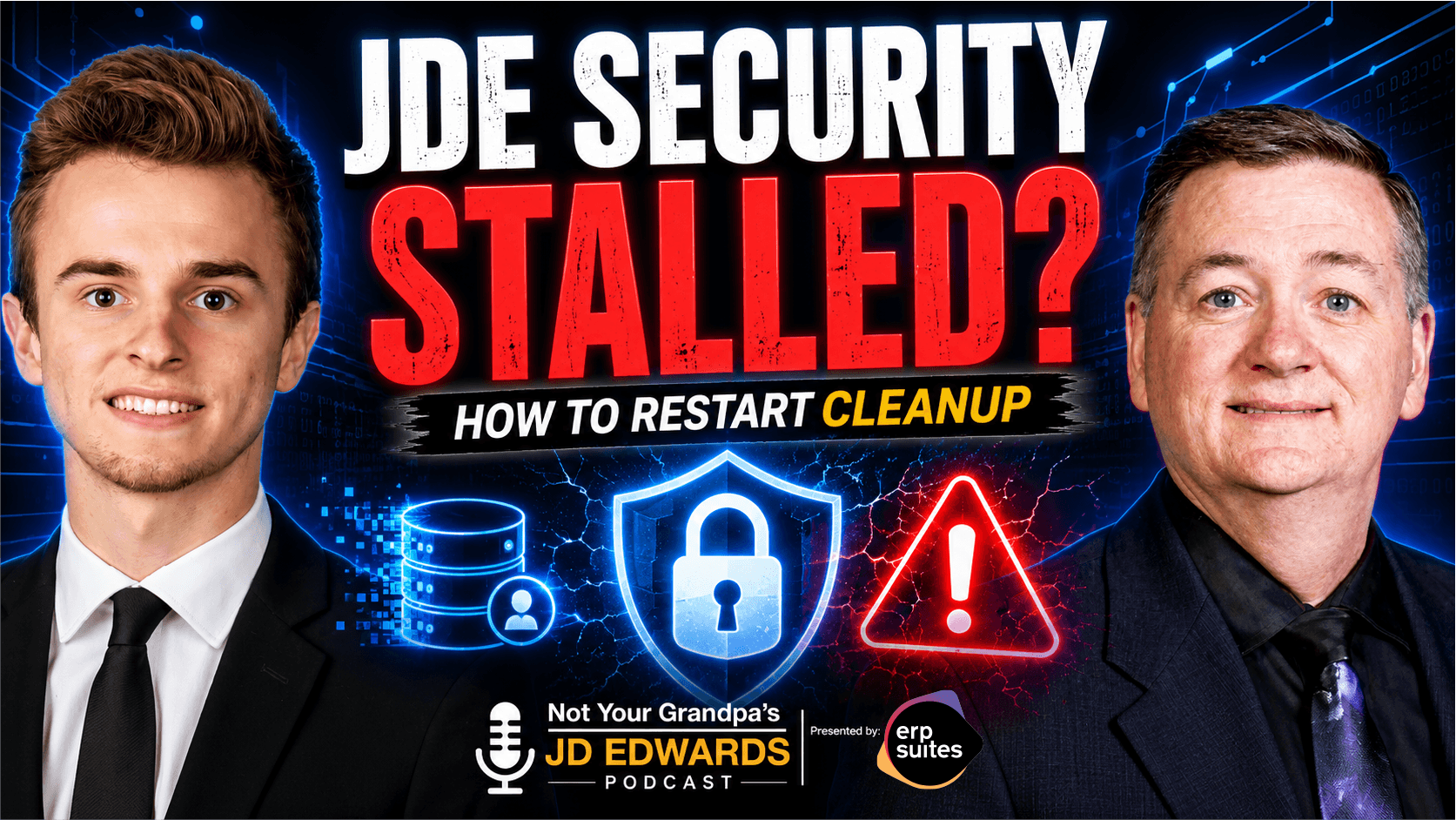
Upgrading JD Edwards doesn’t automatically resolve the security risks already in your system. In this episode, Brian Connor joins Nate to discuss where security gaps hide, which issues to address before an upgrade, and what can wait. Learn how outdated permissions, integration accounts, and overlooked controls can create risk, plus practical steps for testing security and preparing for a successful go-live.
Table of Contents
- Introduction and Brian Connor’s JD Edwards Background
- Hidden Security Risks: Outdated Users, Roles, and Excessive Access
- Built-In Security Controls, Integrations, and Fraud Risks
- Prioritizing Security Fixes Before an Upgrade
- Addressing Security Issues Without Disrupting the Business
- Security Improvements That Can Wait Until After the Upgrade
- User Acceptance Testing and Security Validation Before Go-Live
- Verifying Security Settings, Final Sign-Off, and Closing Takeaways
Introduction and Brian Connor’s JD Edwards Background
Introduction: Why AI Agent ROI Matters in JD EdwardsAre you preparing for a JD Edwards upgrade without knowing what security risk might be hiding in your environment? And how do you know which security issues need to be fixed before upgrading, and which ones can wait?
Today, we're breaking down where JD security gaps tend to hide, how to prioritize the fixes, and what to check for go live. By the end, you'll have a practical approach to strengthening security without turning your upgrade into a much bigger project.
Welcome back to Not Your Grandpa's JD Edwards podcast, where we help JD Edwards customers make smarter decisions about their ERP environments.
When companies prepare for an upgrade, they usually think about performance, new features, downtime, and making sure everything works when they go live. But what about security? Over time, permissions changed, integrations get added, and security configurations can become harder to manage. And just because you're upgrading your JD Edwards system doesn't mean those issues automatically disappear.
So today, we're answering an important question. What should you actually fix before upgrading? And where should you start?
Joining me is Brian Connor from ERP Suites to walk us through what JD Edwards should be thinking about. Brian, how are you doing today? And for those out there that haven't seen you on the pod before, could you maybe give us a little background about your JD Edwards history?
Absolutely. Thanks for having me on again, Nate. Happy Wednesday.
So I've been in the JDE space since 1995 quite a while, been focused on security and compliance risk management for JDE customers since about 2009. So a lot of, a lot of time doing this for a lot of different customers.
Yeah, As for sure. I mean, 2009 is an interesting year to start in JD Edwards. But you've definitely seen a thing or two throughout these years. It's it's been a wild ride. And I don't think you ever really thought about having to do security for AI during this. So it's a little different these days.
I mean, I've heard of those 2 letters.
Yeah, fair enough. Well, then again, I think Terminator came out around 2009, so maybe you had heard of it at that point. So you never really know.
Hidden Security Risks: Outdated Users, Roles, and Excessive Access
So let's start here. What are the biggest security weaknesses JD Edwards customers should look for before starting an upgrade?
I think a few areas to look at. So old information that's in the system, so old decremented use, users that have left the company, roles that are no longer in use, things that were created that nobody understands why they were created because that's just a lot of stuff that you don't need to take forward to the new system, to the new platform, wherever you're going.
So looking at that plus it, it's a risk because you don't know what they actually have access to or if somebody's using it. Looking at your underlying infrastructure, looking at things such as improvements in some of the security technologies going from SSL to the TLS and the constant updates that Oracle's making there. And then also some of your connected system. So things that are reaching into JD Edwards or that JD Edwards is reaching out to?
Yeah. And that's, that's interesting. I was just talking to one of our good friends, Drew Rob, about this of yeah, you can have security inside of your JDE system, but when it comes to communications outside of it, that's where security can get a little tricky, especially for something like an upgrade. So how can user roles and permissions create security risk that companies may not even realize they have?
Absolutely, a couple of different ways. We'll go with the the end user focused one first. So accumulated access. If somebody's been at the company for a while, they have helped out in various areas where they've got a promotion or move departments. And so they've accumulated access from, you know, purchasing to accounting to various other areas within the company. Roles get added, but very rarely do any roles get taken away from the user. So the accumulated access is definitely a big one.
The other part is kind of what you were referencing with Drew, which is some of these integration points. When these are being built, typically you use an account that has all access just to make sure that your orchestrations, your APIs, everything is going smoothly. Very rarely do those accounts get right-sized to make sure that they're only accessing the parts of JD Edwards that are relevant to the job being done. And you end up with access in production with, you know, no restrictions.
Yeah. Which is always so funny to me because security is one of those things that, yeah, you usually don't think about until you need to. But it's also one of the most important things for a JD Edwards system, especially when dealing with sensitive data. Yet it gets overlooked so much. I mean, we talk about this all the time, the amount of times that security gets overlooked until maybe the last week of an upgrade, isn't it? So it's more about being proactive on all this stuff, which is, again, it baffles my mind.
And it's been that way for 30 years. So this is nothing new. Customers always come in and say, you know, we're probably, you know, the worst you've ever seen. And and typically not, they've just done it the way all customers done it, which is make sure the system works and does what you needed to do for the business, which is absolutely critical. And like you mentioned, security comes in at the last minute and somebody says, hey, did we create some roles around these people? And so everybody's scrambling and, and you don't get the complete picture at that point.
All right, I have to ask the question, what is the worst you've seen?
I think the worst that I've seen is a company, I don't recall what it sometime within the last probably seven years, their security table consisted I think of a grand total of 60 records for a 300 person company. So that was a little bit shocking.
So if if for the listeners who aren't familiar, JDE security is open by default. So until you lock it down, users can access whatever they want. So having a security table with only roughly 60 records in it is not good. So I, I honestly, I was a bit shocked with that one. Hopefully you're not listening.
I can't imagine. I can't imagine.
Yes.
Built-In Security Controls, Integrations, and Fraud Risks
All right, let's get back on top of here. Sorry for that tangent, but I needed to know what should companies examine beyond JD Edwards application level security.
JDE, Oracle have provided some really good tools that sit inside of JD Edwards. They relate to security, but they don't sit in the security table. So things like your batch approvals, making sure that if I enter a batch I can't approve it, somebody else has to approve that batch before it can get posted. That's been there for a long time. Unfortunately, it's not used as much as it should be.
Address book data privacy to restrict access to employees and vendors, personal information, so home address, phone numbers, dependents, all of that sort of thing. A little bit more recent bank account masking to hide the account numbers so that people can't take the routing number and the account number and try to use that for fraudulent means. So those are those are a few of them that I think are are pretty important.
Yeah. And it's a great way to at least start. You know, there are still more in there, but I think those are maybe the most important to at least start with.
I think so. And you know, just back to the bank account masking that kind of happened without a lot of companies understanding it. It it came out through through an ESU and was turned on by default globally. So a lot of companies went and just effectively did an undo on it and allowed everybody full access to all the bank accounts and have never revisited it.
Because in a pinch you have people that need to see that information. And without knowing exactly what needed to be done, they they did their own patch to it, which opened it all back up. And a lot of them haven't gone back to readdress that.
Yeah. And maybe talk about things that need to be readdressed. How can integrations and automated processes create additional security concerns?
They're bringing data in from outside. And if a user, you know, perhaps has access to the system that originates the data and is then brought in automatically via an API or through an orchestration, they're controlling the data that's being pushed into the system and then they process that within the system.
So from a fraud perspective, and I hate to be so cynical, but that's kind of my job. If you can manipulate the invoices in a third party system before they come in and then pay those invoices, even though JD Edwards doesn't see it as a conflict because they're integrated versus you manually entering them, it's still leaving you open to the potential for fraud. Thankfully, most employees aren't doing that. But it only does only take one.
Yeah, like you said, most. There are some of those out there.
Prioritizing Security Fixes Before an Upgrade
All right. I know for this next question you're going to say everything, but let's play the game. Once security issues are identified, how should JD Edwards customers decide what needs to be fixed before an upgrade and what could maybe wait other than everything as you mentioned?
I think those things that impact business operations. So if you have multiple operating companies and you have a lot of issues around your row or column security, then I would recommend you take a look at that and get that cleaned up and working properly because that's going to provide a significant gain in business operations. Depending on how you have your row security set up currently could provide a boost in performance going from exclusive to inclusive.
So I think anything that is going to have an impact on how you are able to do business and then protecting the business is the next one. So if you don't have some of those built in tools being utilized, look at implementing those as part of a as as part of the process.
And then last I, I know a lot of people consider it just housekeeping and it can wait to phase two, which rarely happens to be honest, is cleaning up a lot of the items that have just been gathering dust in your system. So, you know, when a hoarder moves from a two-bedroom house to a five-bedroom house, you don't bring all the stuff with you. So start clean.
Yeah, you should talk to my mother about that. She's a little bit of a hoarder herself, but yeah, I like that. Like the housekeeping. You're right. When it comes to phase two, they're looking into so many different things that they're typically not like, Oh yeah, we should do some housekeeping. Right now. They're I, they're focused on other things.
But it is such an important part because if it's broken before you actually upgrade, then it's going to be broken after you upgrade. So you're literally just pushing, you're kicking the can down the road. You're going to have to look at this eventually. And if you do it before an upgrade, you're going to mitigate those risks before you take this next step in evolution.
Exactly.
So what types of security issues should companies treat as non negotiable before moving forward?
Admin level access. So users that were part of the project team from the last upgrade or from the original implementation that still carry that level of access forward just in case. I think that needs to be remediated right away.
A big part of that, and I know I won't make friends with CNCs here, but CNCs don't need full access in production. There are things that they need to be able to do, access to all of their tools 100%, but a CNC does not need to be able to enter a purchase order or sales order or anything of that nature.
They may need if they're helping to troubleshoot something, inquiry access to be able to get in and look at things. Or preferably since you're working with live data, if there's an issue, you should be testing and troubleshooting that in a lower environment so that you don't accidentally impact your bottom line with that with doing things in production.
So as as a recovering CNC myself, I know I did not like to have full access in production in the event that there is any issues and it not necessarily fraud. Let's say somebody accidentally runs the sales update report wide open. I don't want to be a part of that conversation because I have the ability to do it. So I as as a technical person, even doing security, I don't like being in production. And I push to make sure that my access is limited to only what I need to see.
Yeah. And I know we're not trying to make any friends here when it comes to CNCs, but we do have a lot of great CNCs on our team.
Oh yeah, some of the best, if not the best in the business.
But I would argue that they're OK with only having that specific access for what they need. They don't need full access.
Addressing Security Issues Without Disrupting the Business
How can companies fix serious security issues without disrupting the business or even creating bigger upgrade problems?
JDE is flexible. So you have a lot of different options for being able to do this. So if you have an issue with let's say your *PUBLIC and you need to make some adjustments there, you can create another role. I like to use a role called PUBLIC, just without the star in front. Apply the settings there where I can then apply that to individual users and they can now validate what a *PUBLIC model would look like without actually affecting everybody. So you can add or remove that role as necessary.
You can copy roles. So you can take a role and copy it from, you know, role A to role B, make the changes there, assigned it to the test user and that sort of thing.
One that I like, but you have to be careful with. You need to make sure you understand what you're doing is running multiple security tables. So you can have a table, your default table for your production environment and an additional table for your lower environments where you can then make those changes to the actual roles or to *PUBLIC. And when you're in the non production, you're in a completely different security environment and there's a zero chance of that impacting your live environment. And once users have tested and signed off with that, then you can migrate that forward.
Yeah. And that really will mitigate most of the risk, if not all of it. Yes, there's still that risk of a user not fully understanding what's going on or something like that, you know, but in terms of mitigating risk, which is what security is all about, that seems like it will actually mitigate 90. Well, maybe not 90% of the risk, but maybe 70–75% of the risk.
I, I would put it above 90 actually, Nate, because really in a completely separate table. So let's say you're wanting to move from exclusive row security to inclusive, that's a system level change. So if I flip the flag and you've got one security table, everybody's in inclusive mode, so you better have it right or you're not processing transactions.
If I do dual tables, I can flip the flag in the non production table and it only affects that set of environment. So zero risk to production. But it allows you to migrate your settings from an exclusive to an inclusive mode and and there can be a lot of work there depending on on how your row security is set up. It eliminates that risk because it's all non production and you have zero chance of affecting your production environment.
Now, I'll say the caveat with that is making sure you construct it properly, make sure your JAS servers, everything are set up properly, which you need really good CNCs for like Diane.
Yeah, to make sure that's done correctly.
Security Improvements That Can Wait Until After the Upgrade
What security improvements can reasonably wait until after the upgrade?
I think anything compliance related I I hate saying that out loud because compliance is a big part of what I do. But when you're going through an upgrade, you're looking for feature functionality. So can I still do what I need to do day-to-day? If you're looking at compliance, that's not a requirement prior to an upgrade. It would be nice to have.
And if you're putting that off because of an upgrade, make sure that you are. You have that project on the books with a start date for post upgrade so that it doesn't get lost in the shuffle.
So it's feature functionality. So anything that is going to limit the business's ability to do what they need to do to get product out the door or product manufactured, whatever that is home sold. That's that's the point of the upgrade is supporting the business.
So anything that's going to reasonably high risk of disrupting that I think needs to be looked at very, very carefully as as potentially being delayed until you're live with the new system.
User Acceptance Testing and Security Validation Before Go-Live
So what should a JD Edwards customer do to confirm their security is ready to go before the upgrade system goes live?
User acceptance testing. So I, I, I love this term. Not very many people do it well, but going in and having users actually test the system, that doesn't mean logging in and opening a screen and saying, Oh yeah, my sales order process is good.
Running a sales order process through from beginning to end to make sure it hits the 9/11, the nine O 1, everything is 100% done and posted. That's when you know the process works. And if you've made changes to security, you know that the security has not introduced any risks of things not working if you can do the entire process end to end.
So I know you touched on it a little bit there, but what specific security testing should companies perform before going live?
I think the big thing is your so all of your day-to-day processes. I think for the most part, most companies are testing that day in, day out anyway as part of the upgrade, looking for changes and how things work.
But look at your periodic processes. So what do you do at year end? You only do it once a year, but you need to make sure that that works or your year end, quarter, end type of processes, anything that isn't done on a regular basis needs to be tested.
So you're positive testing to make sure that everything works. Your search and selects come up, you can find the data you need to. You're not restricted from viewing the UDC's values for populating any screens.
I also think negative testing making, if you're making changes and you're trying to lock things down from an access perspective, make sure that your users that used to be able to, let's say, go in and modify UDCs can no longer modify them. They still need to see them and select them, but they shouldn't be able to add or change any of the UDC values in the system.
Yeah. So check to see what works and check to make sure that things that shouldn't work shouldn't work. All right, I like that. Simple, simple and easy, you would think, right?
Yeah. You in words anyway. A lot. It's a lot of work on the end user. On the end user side. I don't want to make it seem like it's it's not work. It is. There's a lot there. And having good scripts that are kept up to date is a key aspect of users being able to do this easily.
Yeah. Yeah, exactly.
Verifying Security Settings, Final Sign-Off, and Closing Takeaways
Verifying Security Settings, Final Sign-Off, and Closing TakeawaysSo how can teams verify that their existing security settings carried over correctly during this upgrade?
So you have to do a compare. So if you're changing systems, you know if you're upgrading in place, your 950 table is staying the same. So you have the same table before and after.
I always even if you don't think anything is going to do changes to your your 95950 W table for your UDO security, I always like taking backups anyway. Once you're through the go live and everybody's happy, then you go ahead and delete your backups. But I like to have those upfront just in case.
Otherwise you're going to do, you know, your SQL count and compares on on the state on on the tables. The nice thing with tools like Claude AI, you know, speaking of not need not even knowing about it 20 years ago, you can pull that information out and rather than you trying to do it other than a basic record count, that's pretty easy to do. But to do a compare looking for differences between the two tables, your AI tool of choice can be great leverage to help you validate that information.
So who would you say should ultimately sign off that the environment is secure and ready for go live?
I think there's there's two points. So from if you've moved systems and you've had the copy tables across your CNC needs to be involved in your CNC DBA needs to be involved in that because they own the technical piece of migrating information.
Otherwise, the business needs to sign off, the security is there to support them, and they need to say we're good with the access that we have. If if they're not good, then there's going to be problems.
But if you're preparing for a JD Edwards upgrade and aren't sure where your biggest security risks are, ERP Suites can help. Our team can help you evaluate your current environment, identify what needs attention, and build a practical strategy for a more secure upgrade. Visit erpsuites.com today to connect with our team like Brian Connor or one of our many other JD security experts.
But that's a wrap on today's episode of Not Your Grandpa's JD Edwards. The big takeaway? A successful upgrade isn't just about getting on to the latest technology. It's about knowing what security risk you're carrying forward, facing the critical issues, and making sure your environment is ready for what's next.
Huge shout out to you, Brian, for coming back on the pod. I don't know how many times you've been on this podcast at this point, but it's been a lot of fun and I really do appreciate you joining us.
But it is that you do these and have great conversations.
Heck yeah. We're having the conversations that other people aren't, which that's the most important thing. But if this episode was helpful, subscribe, leave a like and share with someone who's preparing for a JDE upgrade.
But until next time, keep modernizing, keep asking better questions. And remember, this is not your grandpa's. JD Edwards. Catch you next time.
Brian Connor brings more than 31 years of JD Edwards experience and has been with ERP Suites for nearly 5 years. He is a senior JD Edwards Security and Compliance Consultant with deep expertise in role-based access control (RBAC), Segregation of Duties (SoD), risk management, and enterprise security architecture. Throughout his career, Brian has worked across independent consulting, Oracle Gold and Platinum partner organizations, and enterprise IT leadership roles. His experience includes co-designing StartOut for ALLOut Security, leading more than 15 full-lifecycle JD Edwards security restructuring projects for global organizations, managing multi-instance JD Edwards environments with up to 1,600 users, and delivering compliance programs supporting SOX, FDA, and SEC requirements. At ERP Suites, Brian specializes in JD Edwards security, Segregation of Duties analysis, and risk management. He helps organizations strengthen security controls, improve compliance, and align security architecture with audit and regulatory requirements. His combination of hands-on technical expertise, practice leadership, pre-sales support, and executive-level client engagement enables organizations to effectively balance security, compliance, and operational efficiency. Brian holds ITIL Foundations, AOS Audit & Compliance Professional, and AOS Security Implementation Professional certifications. His team brings extensive experience managing complex JD Edwards security environments, including security assessments, reimplementation projects, compliance initiatives, and financial and operational risk management. Outside of work, Brian has been married for 36 years and has six children and two grandchildren. He enjoys scuba diving, smoking meats, and stout beer.
Topics: