
JD Edwards Application Support vs CNC Support: What’s the Difference?
August 10th, 2026
30 min read

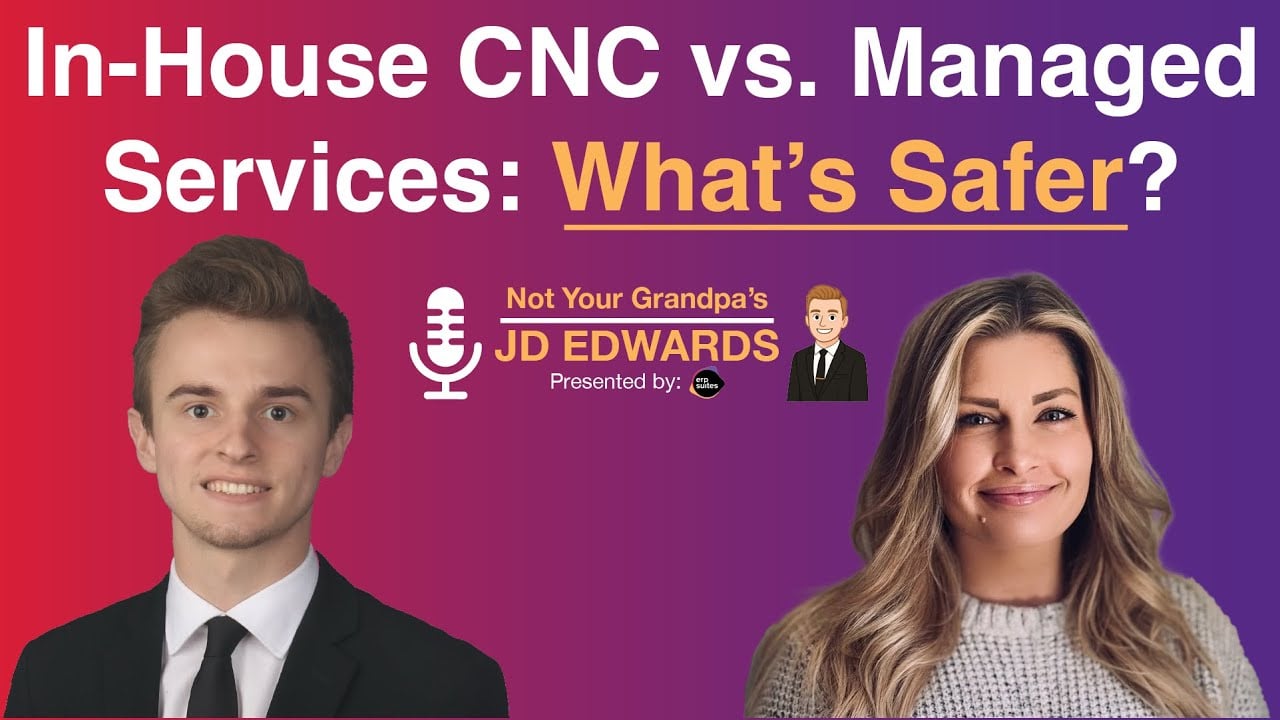
This episode of Not Your Grandpa’s JD Edwards breaks down the difference between JDE application support and technical CNC support. Nate Bushfield and Miranda Coyne explore how to identify functional versus technical issues, route support tickets more effectively, recognize recurring problems, and determine when both teams need to work together. They also discuss what organizations should look for in a JDE support partner and how the right support model can reduce downtime, prevent repeat issues, and keep JDE environments running efficiently.
Table of Contents
- Introducing Application Support vs. Technical CNC Support
- What Application and Functional Support Handles
- What Technical CNC Support Handles
- Why Application and CNC Issues Get Confused
- How to Diagnose and Route JDE Issues Correctly
- When Functional Problems Look Technical—and Technical Problems Look Functional
- Using Recurring Tickets to Build a Better Support Model
- Choosing the Right JDE Support Model and Support Partner
- Key Takeaways: How People Work vs. How the System Runs
Introducing Application Support vs. Technical CNC Support
Introduction: Why AI Agent ROI Matters in JD EdwardsAre your JDE users saying JDE isn't working, but nobody is sure whether the issue is functional or technical? Are tickets getting routed to the wrong person before the real fix even starts?
In this episode, we'll break down the difference between JDE application support and technical C&C support with practical examples of what each team really handles.
By the end, you'll know how to route issues faster, reduce confusion, and decide what kind of JDE support your team really needs.
Welcome back tonight your grandpa's JD Edwards. I'm your host, Nate Bushfield. And today we're answering a common support question for JDE teams.
How do you know whether an issue needs application support or technical CNC support?
Because when a user says JDE isn't working, that could mean a process issue, configuration issue, security issue, batch problem, or maybe something deeper in the technical environment.
But joining us today is Miranda Coyne. Did I say that right?
Yeah, you did.
I'll cut this.
You're good.
All right.
Just wanted to make sure.
Joining us today is Miranda Coyne, a service delivery manager at ERP Suites, to break down the difference and explain how JDE teams can route issues faster and avoid repeated questions.
Miranda, welcome back to the show. It's been a while since we've been on. So for the people that are out there that might have not seen you the first time, can you give us a little bit of background for us?
Yeah, for sure. Thanks, Nate. Thanks for having me again. It's great to see everybody and talk to everybody again.
I've been in therapy suites now for over 16 years, which is just crazy. But I started out in ACNC role. Technically I started out as a Co-op, but then you know, graduated college and then was hired on as ACNC full time.
So I've been in the CNC role for the last, I would say 14 years and then in the CNC tech lead role for the last, I don't know, four or five years. And then I've just recently moved into the FDN position as well. But I'm still kind of balancing both, both acts, but still a lot of experience in CNC and still work in CNC every single day.
So a little bit about me.
That's awesome. You are a reoccurring guest now. And with that comes a little bit of a responsibility for our viewers out there. So you know what, let's just get into it.
When a company says they need JD support, how do you separate application support from technical CNC support?
What Application and Functional Support Handles
Yeah.
So like really, I'd say this is one of the first, you know, things that we try to untangle whenever a company comes to us and says we need JDE support. I mean, that phrase can really mean 2 completely different things. And the way I try to frame it is kind of with one question and I try to ask, you know, is this about what the software does for the business or is this more about keeping the software running and deployed?
And I feel like that one question really kind of helped sort out almost everything when it comes to we need JDE support.
So on the application side, which we kind of call it application slash functional side here, that's the actual business process on and how that works and that's living inside the modules. So think of things like finance, distribution, manufacturing, HR, it's kind of the things like our GL, is it posting the way that we expect or the tax is calculating incorrectly on this order type A functional person thinks in terms of business cycle, so procure to pay or order to cash.
They're not thinking really about that technical backbone or let's say servers of that matter or anything like that.
So from the CNC side, think of CNC, it stands for configurable network computing and that's actually the platform and that technical backbone of the JDE system. So it's the package filled the deployment, the web servers, the logic servers, it's doing tools releases, ES us, we do web logic patching, Java patching, performance tuning.
So the giveaway there I feel like is the stuff like nobody can log in or the system is really slow across the board or we need to push this change to production. So it's kind of a totally different skill set.
So that's kind of, you know, when a company says we need JDE support, that's kind of how we initially separate out the application functional support versus the DNC support.
Yeah.
So let's dive in a little bit deeper on that. What are maybe some examples of issues that clearly belong to that application slash functional side of support?
Yeah, I mean, I think the easiest way to spot an application issue is that the system is up, it's running fine on, nobody's locked out, but the business result is wrong. So, you know, the software is doing something, it's just not doing what the business needs.
So I feel like a classic one, for example, would be on the finance side, and that's something like the GL isn't posting in the way that you would expect, or you're running a transaction and it's hitting the wrong account, for example. Or sometimes maybe it just doesn't even post at all. And I feel like 9 times out of 10, that's something with the way that the module is set up or the account set up.
It's a configuration thing inside that module. So nothing is really broken technically, it's just set up and doing the wrong thing.
I would say like another one that comes up a lot is distribution. So you know sales orders that aren't relieving inventory correctly. You ship a product out the door but your on hand quantity just doesn't move the way that it should.
And again, like the system was working exactly as it's told to, it's just the order of those like activity rules inside the module, the line type or like that setup behind the order. It's just not working correctly for the business. So that again points to that functional app side.
Another one I think is a great example is tax. Like this one comes up all the time. So tax is calculating incorrectly on a certain order type or for a certain, certain customer. And really that's like never a technical problem. That's just the way that the tax is set up and the rules that are behind it.
So I feel like, you know, there's the whole category of how do I, you know, how do I run this report? Why can't I find the field or how do I set up, you know, a new item for a new supplier? You know, that is kind of the end user support and that's like actually helping people use the tool, the JD Edwards tool functionality to do their job.
And so like really, if you think about it, the common thread across all those things that I mentioned, like the GL, the inventory, I think I mentioned the tax and like kind of the how to's right? Like that the system is healthy. Nothing's down, nothing flow, everybody can log in. The problem is what the software is actually doing for the business.
And that's really the big tell for that. So the moment you hear the result is wrong, instead of the system is broken, you're kind of almost certainly in that application functional support window there, right?
I like, I like how you put that. It's not that you can't do anything, it's just that the result isn't what it should be. I like how you made that distinction.
So let's switch to the CNC support side that's more technical. Is that like what are some examples there?
What Technical CNC Support Handles
Yeah.
So I mean, you think of the CNC side, it's kind of the mirror image of that, right? So again, with the application support, the system is healthy, the business result is wrong. With CNC, the opposite, that mirror image, so the setup might be perfectly correct in the modules, but the system itself, the technical back end is just not cooperating.
So, you know, it's down or it's slow across the board, or we can't get something deployed. People can't log in. And I think really the most obvious one is, you know, nobody can log in. So you have a whole group of users that you know, suddenly can't get into a particular environment.
So, you know, no business person has set, you know, anything up wrong here. It's just that the platform is just not behaving as it should. So that's either a server issue or I would say a sign on security issue, an environment problem. And and that's something that points to CNC every single time.
Another one I would say is, you know, the system is super slow across the board and we get that a lot at CNCS. And you know, I specifically want to stress like across the board, right? So everybody is experiencing slowness and that's really the tell.
So if everything is dragging for everybody, then that's usually a server issue, whether that's the Jazz or the database enterprise server, maybe it's a tuning issue. So we need to go in and evaluate what's going on with these servers, maybe tune them up, and that's really the infrastructure. Again, that technical backbone.
Another one I would say is like, let's think of deployments, you know, the pure CNC, right? So we build a change out, it's tested and now we need to push that change to production. You know, that whole world, the the package builds the, the moving objects between environments, promoting up that code. You know, that's AC and CS job and a functional person just doesn't touch anything like that.
So, you know, there's everything with just keeping the platform current, applying patches, ES us doing tools, release upgrades, really the maintenance of the technical backbone, like nobody on the business side is asking for that in terms of the business results.
So it's really just about keeping the whole environment healthy and just really supported, you know, so the common thread here with that the C&C side of things and P&C supported is think of just again, login system slowness. We're doing deployments, upgrade, you know, everything that keeps that JD Edwards system up and running.
And that's kind of that fine line, right. So, yeah, if, if the plan is the system's broken or it's slow need it's deployed, remember that C&C if the result is wrong, that again points to application or functional.
So it's like the back end versus the front end for this.
Yeah, that's a good way to look at it.
Yeah.
Why Application and CNC Issues Get Confused
So it's, it seems pretty simple, but obviously there are people that do confuse the two. Like why is that?
I mean, like, honestly, it's really understandable to be confused and kind of mix those two up and it really comes down to where the user is sitting kind of everything to them looks probably like an application issue.
So they're staring our JDE screen and their whole experience that that's like their whole experience of the system. So whatever goes wrong, their instinct is well, something's wrong with this application, you know, because the screen is the only part that they ever see.
They don't see the servers behind it and the environments and how all that is configured on the backside. You know, to them it's just all kind of this is JDE, this is what I'm looking at every single day.
So, you know, a deeper reason I think is, you know, the the symptom that is happening really points to, you know, specifically what that causes. So that is what really kind of engages people and like what the user is feeling and what's actually broken can be two completely different things.
So you get these complaints that sounds simple, but really, you know, you could go a dozen different directions. So you know, hey, I can't access this. It sounds like one problem, but that could be security or it could be the way that the module is set up and just not having the correct access and how the module is set up.
So another one is like, hey, this report is wrong. I'm not getting the correct, you know, result from this report. So that could be a data problem, which is the functional side, but it could also be the logic behind the report. Maybe something didn't get deployed correctly, the wrong version got deployed. So that could point to C&C.
So that's kind of where, you know, the water gets a little hazy and it gets a little confusing. So, you know, the symptom doesn't just reveal like the root cause on its own. And that's just why things can just easily get, you know, a little muddied up and, you know, a little confusing.
So you also have to take in the organizational side of it too. So, you know, your business team, they know all the processes, they know how finance works or distribution should work. So your I team, your IT team should know the infrastructure so that you know, the servers, the networks, all that stuff.
But JD ES that's kind of right on top of both of those worlds. So a lot of issues need someone who kind of understands both, you know, the technical backbone and the actual, like, processes that are happening in the functionality of JDE.
So, you know, that's kind of where that gap lies, right in the middle. And again, that's where that confusion lives.
Yeah.
So when that confusion happens, what typically do you see when these issues are routed to the wrong support person or even the wrong team?
Yeah.
So I feel like a good way to look at that is that that's where it gets really expensive. And, like, it's not in the most obvious ways.
So, you know, the most immediate thing is that tickets just take really a lot longer to resolve, which is not good. Something that should be a quick fix, you know, kind of drags on for multiple days now. And it's all because it really started in the wrong place and you know, it's had to find its way around to the right person.
And obviously the person that Shields with the most is the user that is putting in the ticket. So they get bounced around. They're reporting the issue to one team. That team that's poking around at it decides, you know, it, this isn't this isn't mine, this isn't my team. They hand it off.
You know, now the user time to go tell their story to a whole nother team. And you know, just that bounce back. And so time gets wasted there and, you know, they start to lose faith in that whole support process.
And, you know, when everybody's trying to hard, it just feels like that process is broken to them and they're not really feeling supported, you know, And then behind the scenes you've got all these teams that are burning time troubleshooting the wrong issue.
And so somebody's digging into the server, you know, convinced it's ACNC problem when really it's the module configuration. So you just have hours wasted kind of chasing a long thing.
And then like this is the talent cost side too. You know, you have looking at one problem and they're wasting their time when it's not even the TNT issue and it's a functional issue and vice versa. So you're getting your, you know, your key players here pulled into the wrong direction and where they could be working and resolving other things that are their specific, you know, lane, right.
So I think it just kind of unfortunately bites a lot of people in the long term when when these issues get nutrouded, the root cause is just missed, right.
So it just it comes back and it comes back again and you know, sometimes you'll start to see a pattern and then the real root of the issue is just never actually getting resolved, which is also not what you want to happen.
So, you know, with all of it low tickets, just users getting bounced back and forth, you know, you're wasting time troubleshooting with the wrong team, just experts kind of out of their lane and all these repeat issues. It just kind of traces back to, you know, that one upfront decision of just making sure tickets get routed right the first time.
And when you get that right, most of all that other stuff just kind of disappears, which is what we aim for. Right?
Yeah.
So it saves money, it saves time, it saves that downtime that you could be dealing with with one of your systems. And yeah, maybe the cost is in exponential in the first part, but it can add up over time if your system can't reach that resolve that you're looking for with one of these tickets.
So yeah, main thing to remember is if it's a back end issue where something's moving slow or maybe there's a process that's out of place and that's more of the technical side.
And then if it's a result issue where that number isn't adding up, it doesn't make sense of how that whole, how that whole process is really getting done. Then that's more of the functional application side.
Am I right in those?
Yeah, absolutely. So again, just remember it's, it's the business result. It goes back to that functional application side and like the technical backbone is that CNC layer.
Yeah.
OK.
How to Diagnose and Route JDE Issues Correctly
So when a user says JDE isn't working, how should teams kind of figure out whether the issue is functional or if it's technical or if it's both?
Yeah.
So I'll be honest, JDE isn't working. It's probably, I would say the single most common thing here. So if you're not putting a lot of detail in a ticket and somebody's just putting in something JDE isn't working, that is probably the least useful sentence in the world to us because it just doesn't tell us anything.
It's the starting gun, but it's not the answer by any means.
So I think the most important piece of this is kind of like what you ask next in this in this format, right? So you know, the first thing that I was trying to do is kind of back up and just say, you know, what are you like, what are you actually trying to do? Not what you know, what's broken, you know, where you know, what were you doing when this happened?
So tell me exactly the steps that you took and then like what happened when you took these steps? Give me some screenshots, give me as much information as possible, like were you trying to run a post batch where you trying to log in or enter sales order?
And the moment I know what the actual like, calf is like, what the user is actually doing, you know, I feel like I'm kind of halfway to knowing kind of which world we're living in here, whether that's the functional side or the sea and sea side.
And then, you know, the next thing you really want to try to figure out is the scope. Like, who is affected by this? What is the business process that is stuck here? And I feel like this one's big because like, the scope is honestly the fastest way to sort out this issue.
So is it do you, is it everybody in your role? Is it 1 module? Is it reports? You know, is the whole system down right? Because that tells you so much information right away.
So if if it's one person on one screen, you know something's not working specifically for them. Everybody else seems to be doing OK. That kind of to me smells more functional, but if it, you know, everybody's affected all at once, I mean that kind of smells more CNC, right?
So that's certainly on the back end, on the technical back end or the platform of JDE. So you know, I feel like the scope alone will point you really in a really good direction before you kind of have to look towards other directions as well.
And you know, like another thing too is. I think this one is really important and maybe doesn't come up as often as it should, but you know what changed recently because most of the time issues do not appear out of nowhere.
So you know, I'm asking things like did we just deploy a package? Did we just deploy you code to production? Did somebody just update security or did any type of security change? Was there some kind of configuration change? Did we just come off a new tools release and some functionality is not working correctly? Or did you guys just turn on like a new integration and just not tell us?
Which has happened from time to time, more times than I would like to admit.
But really like 9 times out of 10, whatever changed last, it's kind of sitting right next to whatever broke. So I feel like that question alone solves a like shocking number of these issues that we're seeing as well.
So I feel like once you kind of get those three things in line, you kind of actually know where it lies, whether that's CNC or the functional application side.
So you know, we, we like to get as much information as possible because that just hope that's identified the issue much faster. And if you can help us get to that, you know, with all that information, get to that point, we're going to be able to help you so much faster.
So, you know, sometimes it can be both too. So I don't want to take that out of the pod either because there are plenty of times where it can be really red on the theme.
And sometimes, you know, the application and functional team are working together with the TNC team to try to figure out what's going on because it can be confusing sometimes. And even for ATNC or a functional resource, it can be confusing for us.
And we got to work together and just try to figure out, you know, how to get how to get past this issue and work through it together as a team.
Yeah.
So could you maybe give us an example of where an issue looks like application support but is actually technical?
When Functional Problems Look Technical—and Technical Problems Look Functional
Yeah, So these are good ones too, because it's kind of, it helps being able to go through some of these things to understand like, hey, I think this is functional, but it's actually a CNC issue.
So like one of the examples I would say is, you know, screen is, let's say a screen is broken after a recent package deployment. So some people might think, OK, that's the app. The app is broken, but it could mean that there was an issue with the deployment of the package.
So the deployment of that code going to production and then you know, that's where CNC would need to go dive back in, check the package build logs and see if everything go correctly and compiled correctly and was pushed out successfully.
I would say another one would be, you know, hey, this report is wrong, but that could be because the wrong version or object was promoted and CNC would need to go back and like validate that, validate the correct object got promoted and that things again got deployed correctly.
You know, users can complain that JD is slow, so that can be issues with a bad report. So again, if you don't give us the whole, you know, broad spectrum of like this is what's going slow for me to think of a report that's out there running and it's backing up a ton of job, you know, we're we're going and saying, OK, is there an issue with the web server? Did it Max out on CPU memory?
But some people think, well, maybe this is an issue with the with the job itself. So that's where that can get tricky. But it is pointing to CNC.
So that's kind of a few examples of what I would say that, you know, may seem like an application issue, but actually is more of a CVC issue.
All right, so let's flip it then. What's maybe an example or two of where it looks technical, but it's actually application support.
Yeah.
So let's go back to the batch job, right? So a user submits A UVE and it errors out. And what could actually be the issue and what sometimes most likely is the issue is the setup.
Whether you be used wrong or some MATE master data may be missing, or there could just be bad data in the table so the report failed. But you know the users like well this isn't working. You know what's going on with the system.
But really it's a configuration piece where bad data announced on the functional side where you could get like a system error, but that could be caused by an invalid processing option.
So you know, the system error is happening, but the functional resource didn't set up the, you know, profit processing option correctly. So they're there to kind of help figure that out and make sure that the correct processing option is in place.
It's pointing to the correct, you know, information and it's, you know, therefore going to run the next time successfully.
Or let's say a posting issue is caused by configuration or bad transaction data. So you know, again, that muddies up the water a little bit.
But if a posting issue is out there and it's just not working, you know that users thing they're going well, this isn't working. So they're confused by if this is a whole CNC problem or if it's actually maybe again, just let's say bad data.
So those are, I would say a few application are a few C&C type things that could look C&C but are actually functional set up and functional resource related.
So maybe going a step further of like how should reoccurring tickets like be used to improve this support model that we have in place?
Using Recurring Tickets to Build a Better Support Model
Yeah, I actually really like talking about this because I feel like most companies kind of treat tickets as you get a ticket, you work it and you close it, you fix it, you move on, on to the next one.
But I feel like here to your peace, we really try to take a step back and really look at these reoccurring tickets. And I feel like it's kind of one of the best signals you have where you can kind of take a step back and look at, you know, why is this issue keep popping up, happening again and again.
So I really like the trick is to stop looking at tickets one at a time and really look at them as a whole because I think the patterns can tell you really different thing depending on like which side they're coming from.
So you know, if you're seeing the same application tickets over and over again. So, you know, the same questions, same mistakes. It could be that's not a issue. They're usually pointing to one or a few things.
And maybe it's a training gap. So people genuinely don't know how to do the process. They don't know how the module works, and they need somebody to help them understand how this module works.
And maybe it's a configuration problem that just never got fixed. So, you know, people just kind of keep pushing that off and maybe that process is just funky or maybe there's just bad data.
But again, you keep looking at these reoccurring tickets and you start noticing these patterns and like, again, we like to take a step back and see what's going on and try to like fix that.
You know, so goes the same way for the CNC side. If we're getting repeated tactical tickets, you know, it could be pointing to something with a performance tuning or a monitoring gap or, you know, something that's going on in the system that we need to take a step back and look at and say, you know, if this server is constantly hitting, you know, Max resources, so it's maxing out on CPU or memory.
Like this is maybe an opportunity for us to add more resources to the server. And then hopefully that, you know, orchestration that's running out there on the EIS server starts running more efficiently and isn't dying in the middle of processing.
So really I feel like when you kind of zoom out and you look across all the tickets and you see these trends, you know, maybe also you could be simply just under resourced.
So again, that's something if you kind of look at these and you're getting, you know, high, old and high of the tickets coming up and you're, you're just not able to handle that volume. You know, it's, it's useful to be able to look at that stuff and say, well, maybe we need to hire another functional resource or a CMT for that.
So, you know, really I feel like the way I'm just kind of summing up is don't just close the tickets, like really read them, make a step back, look at the patterns.
You know, the individual ticket is a problem solved. But like that pattern across all the tickets is really, I feel like a road map and how we we do a better support model for our customers.
So the team's really just, you know, they pay attention and they stopped fighting the same fires over and over and we just actually start fixing things. And not only does it make our lives easier, it makes our customers lives a lot easier. So I feel like that's the most important piece of that.
So, yeah, yeah.
And it's that idea of like, yeah, you can have these recurring tickets and you can put out that fire every time. And yeah, that might be a quick win, but you're not getting at the big fish there. You're not getting at the true problem there.
So you're going to have that problem over and over and over again until you really do. And that's a perfect way of putting it. Take a step back, really assess why this is happening instead of being focused in on, all right, this is the main, this is the specific issue.
Let's try to fix that specific issue because then, yeah, you can see it in multiple things other than just that one specific situation that you're in.
But what should like a good classification look like between application and CNC teams?
Yeah.
I mean, I think again, the most important thing here is just to really emphasize through users putting in the tickets to just put as much detail as possible. I think that's really the 1st and then like most important thing, you know, what is happening, where is it happening?
How is it affecting you? Is it affecting just you or is it affecting multiple people? Has anything changed recently, you know, and when exactly did this start happening?
So those types of things are so helpful and really quickly just help us identify what's going on.
And so from there, you know, the goal is just identify that issue quickly, but not try to force that into the wrong bucket. So sometime it's obviously an application issue and then sometimes it's clearly ACNC issue.
But again, you know, there are plenty of situations where it's not immediately obvious, and that's OK. But I think the worst thing that you can do is just spend hours arguing over like the ownership instead of just solving the problem and working together as a team.
So I feel like that's where that collaboration, you know, part really becomes important. And if the root cause isn't clear, whether it's application again or CNC, it's important just to work together as a team behind the scenes.
And you know, that's, that's helping the application team can validate the business practices working correctly, while the CNC team can verify, you know, the environment or the backbone, you know, technical backbone there or the security, you know all that is working as it should.
So, you know, if you're able to look at it from both perspectives, I feel like usually you can get that answer much faster than working and that like isolation or working on your own.
But I would say at the same time, there still needs to be very clear ownership. So if both teams are involved in working together, I do think it's important that like one team owns that communication with a customer because you don't want that back and forth.
And then again, you're wasting time going back and forth between multiple people. The one team should ideally own that communication with a customer to really drive, you know, drive the issue to a resolution.
And that just prevents the tickets from falling through the cracks and gives the customer like a really single point of contact, which just, you know, always makes things easier.
And really, you know, finally, like the, the good support isn't about just closing the ticket, right? It's, it's about recognizing those patterns again, you know, if you see the same type of issue occurring over and over, that's an opportunity to improve the training, fix the process, like address some configuration or tuning issues.
And then, you know, that's when the support really becomes proactive instead of just being reactive.
Oh, I like that. I like that a lot.
But it's a big theme that we have on this podcast is being proactive instead of reactive because again, like you could be sitting there and having these similar issues, taking down your system that cost money, that cost time.
And those two things for a lot of our customers are something that they will not give away.
So I mean, yeah, all you have to do is kind of look, take a step back and understand the actual problem and tag it there.
But that kind of goes into my next question here. How should some of these JD customers decide whether they need application support or technical CNC support or maybe a combined support model?
Choosing the Right JDE Support Model and Support Partner
Well, and that's like a really great question. And you know, again, we do have a lot of customers that come to us and they may not be clear on like what they actually need.
And you know, I think our kind of recommendation is, you know, think of, think about this from the business perspective and really, you know, look at look at your task tickets, like look at, you know, what's actually breaking.
So whether you're looking at, let's say the last three months or six months worth of issues that have come up, you know, go through those tickets and read them. I know it takes time, but that's really like what is important and what helps you kind of identify the support that you need.
So you know, looking at those patterns and, and that should really help you just determine like what direction to go in here for support.
And again, the way I look at it from a business perspective is, you know, if most of your issues are about the users and the business process and like actual functionality of using JDE, somebody can't post the transaction or a reports coming out incorrectly or master data is just an absolute mess.
You know, set up questions on AP, something like that or you know, procurement, manufacturing that really points to application, application or functional support. That is the functional world.
And it's it's people trying to do their job in a module and something is just not behaving.
And now if you flip that, if most of your issues are about the system kind of underneath again, that technical backbone, the environment setup, deployment package build, doing the tools, release upgrades, applying ESU, performance tuning your batches, how you know how your batch jobs are running, security, you know, that's all that technical level, that's the the CNC side.
And the users might not even see that directly. But when when stuff goes sideways and JDE like and everything is going sideways again, that points to you're having a lot of technical CNC issues and you probably should go the CNC route for support specifically.
And for like a lot of businesses when they kind of sit down and do that exercise again, I know it takes time, but the answer could honestly be, well, maybe we need both and that's kind of the third tab.
So you know, maybe you're having a lot of technical performance issues, but you often need help with how a module's working and that functionality of the module.
So when they're cross functional or when it's just kind of maybe really difficult to diagnose and you're having a lot of those cross functional issues, you know, that's where maybe you start to look at, well, maybe I need functional application and I need C&C support.
So you know, there there's the thing, you know, with the theme between the functional and technical side, right? But that's where the handoffs live and that's where you know the handoffs or where the time gets wasted.
So when you can look at it like a company or a business that can provide both that functional and that Technical Support layer, and you can sit there and, and work with both teams or they're working together behind the scenes, you know, that combined, that combined model really kills that ping pong and that wasted time.
So what question should buyers ask a support partner before they sign up or something like this?
All right, well, I think, you know, one of the most important things buyers can do before signing up with a support partner is just get a very clear idea of what support actually means.
And trust me, that word can mean, you know, very different things from, from one provider to another. We, we know this from experience. We hear this just based off of, you know, talking to our customers and getting that feedback.
And you know, I'd really start by asking what's included in the application for, you know, are they only fixing issues when something breaks or, you know, are they like actually helping with user questions and business processes and guidance and training and, and testing and ongoing optimization, right.
So if you're using, you know, if, if you're using JD Everett from a CNC perspective, I'd also ask, you know, what's covered there.
So this is the court includes system administration, performance tuning, package build are are they going to help us go into the right direction?
You know, when we're looking for guidance on what our our system needs, do we need to upgrade those types of things? You know, is that included in, in that support that we're getting?
Like I would also say too, like asking more questions on what is supported is, is so helpful too, because you might be surprised with some, what some companies offer support wise, other companies don't even think about, you know, so we, we, we always try to look out for our customers.
We always try to cover, you know what we can for our customers, even if it's stuff that we don't necessarily support, we will try to help as best we can, right?
We can't guarantee you we're going to be able to fix that problem, but you know, we can be there for that support, whether that's the application side or if that's that technical layer.
I think another important question is how do they handle tickets that specifically aren't very clear exactly what we've been talking about, right?
So in the real world, users don't always know what the problem is, whether that's technical, functional, again, maybe a training issue.
So I feel like a good support partner should really have that structure, triage of the process and how that identifies that root cause instead of just simply bouncing, you know, the ticket between the team.
So you want to know that when you're you're looking for a support partner that they have these support teams that are going to work together behind the scenes and really try to make the customer successful.
You know, I'd also want to know whether the they provide both functional and typical support. So you want to make sure they have both that expertise.
There might be companies that only kind of dabble in the, the functional side or that CNC side, right? So, you know, you want to make sure that if you're talking to a support company that you see if they can support both of those.
And it's just really important to kind of understand where they draw the line between the support and the project work as well.
You know small enhancements. You know practice improvement. Small pools upgrade their configuration changes. You know, sometimes those can fall into the Gray area.
So really setting, you know, those expectations up front kind of helps avoid some of those surprises later.
And I'd also ask like, how do they deal with the reoccurring issues? Again, we talked about that earlier.
If that thing ticket keeps coming up, are they simply just resolving that over and over or are they actually taking a step back and investigating that underlying cause and really trying to find a permanent solution so that this doesn't keep happening and it's not a pattern that keeps happening.
So, you know, one last thing is just, you know, like what monitoring tools do they use? I think that's kind of a really important question as well.
How do they manage tickets? Do they, you know, handle documentation? Do they document processes? Is there knowledge sharing? How do we handle escalation?
Those types of things and, and those types of things may not be exciting, but those are some of the most important things that you should know going into working with the support partner.
And you know, like ultimately the best support partners, you know, we don't just keep the lights on. We really help customers mature over time.
We want to be the we want to be the expert for you and help, you know, move you into the right direction.
And instead of being reactive and, and trying to break fix these models, we want to have a proactive approach and we want to fix these reoccurring problems and, you know, help reduce these issues.
And we want your system to be more stable. And, you know, that's, that's just what our goal is at the end of the day.
It's not just the, hey, put in a ticket. We're going to fix it. We're done.
You know, we really want to help support you and, and have the best, most efficient system as possible.
Yeah.
So if you're if you're one of the customers that are out there right now listening to this, what would you say the best take away from this episode would be?
Key Takeaways: How People Work vs. How the System Runs
I mean, you know, if you take nothing else from the full conversation, you know, the one thing that I would really want you to remember is it really comes down to that single question, you know, is this about how people work in JDE or how JDE itself runs on that technical backbone?
You know, are you actually having issues with the functionality of JDE or the performance of JDE or both of these things, right.
So you know, that's kind of the whole framework. So it's it's really about how users work in the system. You know, they're trying to enter an order or run reports or something's just not behaving. You know, again, think of that as application for it. That's the functional side.
And if it's about how the environment runs underneath the servers or the tax build performance, you know, that kind of stuff, how people work versus how the system runs, you know, that one line will correctly sort out that vast majority of what kind of support you need.
So, you know, I would say sometimes it touches both. Don't force it to be in one box. And I think that's a mistake that I really warned people again. And there are some pretty reliable tells that you're kind of in both territories, and that's OK.
It's OK to not always know whether it's a functional or CNC issue. So, you know, when you genuinely can't tell what that root cause is, You know when the tickets are bouncing back and forth, nobody's owning it.
You know, problems show up right after deployment and you know, something along those lines. You know, when a technical problem is knocking over an actual business process or the business issue turns out to be tied back to some technical change, You know, sometimes it's, it's a signal.
It's just, you know, your internal team is just underwater and can't cover that whole service area anymore.
So, you know, here's why, you know, getting that right the first time matters, putting that information into a ticket and, and really explaining that detail, you know, the right support model can help really diagnose those issues faster.
So the more information we have, the more that we can help you out and get to a solution faster. And it really cuts down on those repetitive issues and really prevents them from from coming back.
So, you know, it's time, it's money, and it's really sanity for your team, but also all the teams involved. So, you know, think of it that way too.
So again, like the biggest take away here is, you know, sorted out by how people work versus how the system runs And when clearly, you know, sometimes it could be treated as both that is OK, but have a support team that can work together behind the scenes and, and really work together to get that issue resolved for you.
And that's again, something that, you know, our teams here at your PCs, we're great at that. You know, we can assess where where all these holes are and help you build up that right mix of application CNC and really just monitors the support as a whole.
So you're not just guessing and you're not just trying to jam every problem into one specific category because at the end of the day, the goal isn't just to like pick this team or that team. It's, it's really to get the issue resolved.
And our main clarity is just helping make our customers as successful as possible. So I would say that's my biggest take away.
So yeah, then the more detailed you can be, the faster those tickets get closed, the faster that you can get your system running the right way.
And that's, that's really the main take away here is the more detailed. And yes, you might not have a complete understanding of what is what, but as long as you are as as detailed as you possibly be with some of these problems, it'll get to the right people and your system will be healthier even faster.
But if your team is trying to figure out whether you need JD applications for technical CNC support, or maybe even both, the EAR IECE ways can help you evaluate your current support model and identify the gaps.
Whether you are dealing with reoccurring issues, system instability, limited internal expertise, or backup of JDE work, ERP Suites brings the functional and the technical expertise to help you stabilize, support, and modernize your JDE environment.
Visit erpsuites.com today to connect with their team and maybe figure out a little bit more about your system.
But that's a wrap on today's episode of Not Your Grandpa's JD Edwards. But the big take away is this application support and CNC support. They solve different problems.
Application support helps the business use JDE correctly. CNC support keeps the technical environment running correctly. And when those two areas work together, JDE teams can resolve issues faster and reduce repeated problems.
Huge shout out for you, Miranda. Thank you for joining us.
If this episode was helpful, subscribe, leave a like and share it with someone on your JDIT or even your operations teams.
But until next time, keep modernizing, keep asking better questions. And remember, this is not your grandpa's JD Edwards.
Miranda Coyne began her career as a co-op with ERP Suites nearly ten years ago and quickly rose to a leading CNC. She is a Clarity product champion using data analysis to inform better decision making around user performance and security. Her insights into the customer experience continue to shape our products and processes.
Topics:


.png?width=960&height=540&name=Blog%20Images%20(81).png)
.png?width=960&height=540&name=Blog%20Images%20(79).png)
.png?width=960&height=540&name=Blog%20Images%20(76).png)
.png?width=960&height=540&name=Blog%20Images%20(28).png)
.png?width=960&height=540&name=Blog%20Images%20(27).png)
.png?width=960&height=540&name=Blog%20Images%20(5).png)