
Many organizations first engage a JD Edwards consulting partner for a specific need. They may be implementing JD Edwards for the first time, planning an upgrade, migrating to the cloud, or addressing a technical challenge that requires specialized expertise.
Once that project is complete, it can be easy to assume the partner’s job is finished.
That is often when some of the greatest opportunities begin.
JD Edwards is a long-term investment that continues to evolve through new Oracle releases, enhanced functionality, automation capabilities, and emerging technologies such as artificial intelligence. Your business is evolving too. Priorities shift, processes change, employees come and go, and new operational challenges emerge.
Getting more value from your ERP requires more than completing a successful implementation or upgrade. It requires a long-term strategy for improving how JD Edwards supports the business.
A knowledgeable consulting partner can help you build that strategy, successfully execute projects, identify underused capabilities, prepare for Oracle’s roadmap, and introduce new solutions as your needs change.
Some of the greatest improvements do not require replacing your ERP or purchasing an entirely new platform. They come from making better use of the JD Edwards system you already own.
In this article, we will explain how a JD Edwards consulting partner can help you maximize the value of your ERP throughout its lifecycle.
ERP Value Does Not End at Go-Live
For many businesses, an ERP implementation or upgrade feels like the finish line. After months of planning, testing, training, and deployment, the focus naturally returns to daily operations.
Unfortunately, that is also where many companies stop looking for additional value.
An organization may complete an upgrade, bring the new environment online, and continue working much as it did before. Meanwhile, new functionality, workflow improvements, automation opportunities, and user experience enhancements remain unexplored.
The business has invested in a newer version of JD Edwards, but employees are still relying on the same manual processes, customizations, reports, and workarounds.
An experienced consulting partner helps prevent that outcome by making value realization part of the project—not an afterthought.
Instead of simply handing over the upgraded system, the partner can help explain what has changed, demonstrate relevant enhancements, and identify opportunities that may be appropriate for a later phase.
Too many JD Edwards customers complete an upgrade without taking advantage of the new capabilities they have just paid for. A strong partner continues the conversation by helping the customer understand what the updated environment can now support.
That mindset turns JD Edwards from a system that is periodically upgraded into a business platform that evolves over time.
Stage 1: Building the Right Foundation
The first way a consulting partner creates value is by helping the organization determine where it is going before a project begins.
Before writing code, changing infrastructure, or selecting new technology, an experienced partner should understand your current environment, business priorities, operational pain points, and long-term goals.
That assessment may include:
- Reviewing the current JD Edwards environment
- Evaluating business processes and user challenges
- Identifying aging infrastructure or unsupported components
- Assessing cloud readiness
- Reviewing customizations and integrations
- Prioritizing projects based on business impact
- Developing a practical ERP modernization roadmap
Without this broader planning, ERP initiatives can become disconnected from one another. A company may solve an immediate technical issue without considering how that decision could affect an upcoming upgrade, cloud migration, integration, or automation initiative.
A roadmap helps connect those projects.
It gives the organization a clearer view of what should happen first, what can wait, and where multiple initiatives may be combined. It also helps leadership evaluate ERP spending based on business outcomes rather than isolated technology requests.
The objective is not to create the largest possible transformation plan. It is to create a realistic sequence of initiatives that supports the organization’s priorities and available resources.
Stage 2: Delivering Projects Successfully
Once the direction is clear, a consulting partner helps turn that strategy into a successful project.
JD Edwards initiatives can involve many interconnected components, including applications, tools releases, databases, operating systems, middleware, integrations, security, custom code, and reporting tools.
An experienced partner understands how changes in one area can affect another.
That experience is valuable across projects such as:
- JD Edwards implementations
- Application and tools upgrades
- 64-bit migrations
- Oracle Cloud Infrastructure migrations
- New module deployments
- Third-party integrations
- Security initiatives
- Custom development
- Infrastructure modernization
Consultants who have completed similar projects can recognize risks earlier, recommend proven approaches, and help the internal team respond when unexpected issues arise.
Their experience can reduce common problems such as:
- Incomplete planning
- Uncontrolled scope growth
- Insufficient testing
- Integration failures
- Undocumented dependencies
- Unrealistic timelines
- Delayed business decisions
A strong partner also understands that not every improvement belongs in the initial project.
Customers are often reluctant to expand the scope of an upgrade because they want to control cost, reduce disruption, or reach the new release as quickly as possible. Those concerns are understandable.
Rather than forcing every possible improvement into one engagement, a consulting partner can help divide the work into manageable phases.
The first phase may establish a stable technical foundation. Later phases can address process automation, new modules, reporting improvements, or customization reduction once the organization is ready.
Instead of asking a customer to take on one large transformation, the work can be divided into smaller, more manageable projects that build on one another.
This gives the company a clearer path forward without overwhelming its users, budget, or internal team.
Stage 3: Providing Ongoing Guidance
Once the project is complete, the focus should shift from deploying technology to helping the business realize its value.
This is where a long-term consulting relationship differs from a one-time project engagement.
Ongoing guidance may include:
- Reviewing new Oracle capabilities
- Discussing changing business priorities
- Identifying underused functionality
- Evaluating future projects
- Revisiting postponed improvements
- Providing recommendations based on new risks or requirements
- Updating the ERP roadmap
These conversations do not always lead immediately to another project. Their purpose is to help the customer make informed decisions and maintain a clear direction.
For example, a feature that was not relevant during an upgrade may become valuable six months later when a business process changes. A postponed automation project may become a higher priority after an employee leaves or transaction volume increases.
A strategic partner remains familiar with the environment and can help the organization revisit those opportunities with the proper context.
ERP Suites has begun making post-go-live enhancement discussions part of its process. The goal is to ensure customers understand the functionality available in their updated environment and can determine which capabilities may create meaningful business value.
That continued engagement helps prevent the ERP strategy from becoming outdated as soon as the project team disbands.
Stage 4: Optimizing the ERP You Already Own
Ongoing guidance identifies opportunities. Optimization turns those opportunities into measurable improvements.
Many companies assume that greater ERP value requires a major software purchase or a large transformation initiative. In practice, some of the most valuable changes involve improving processes within the existing JD Edwards environment.
Optimization may include:
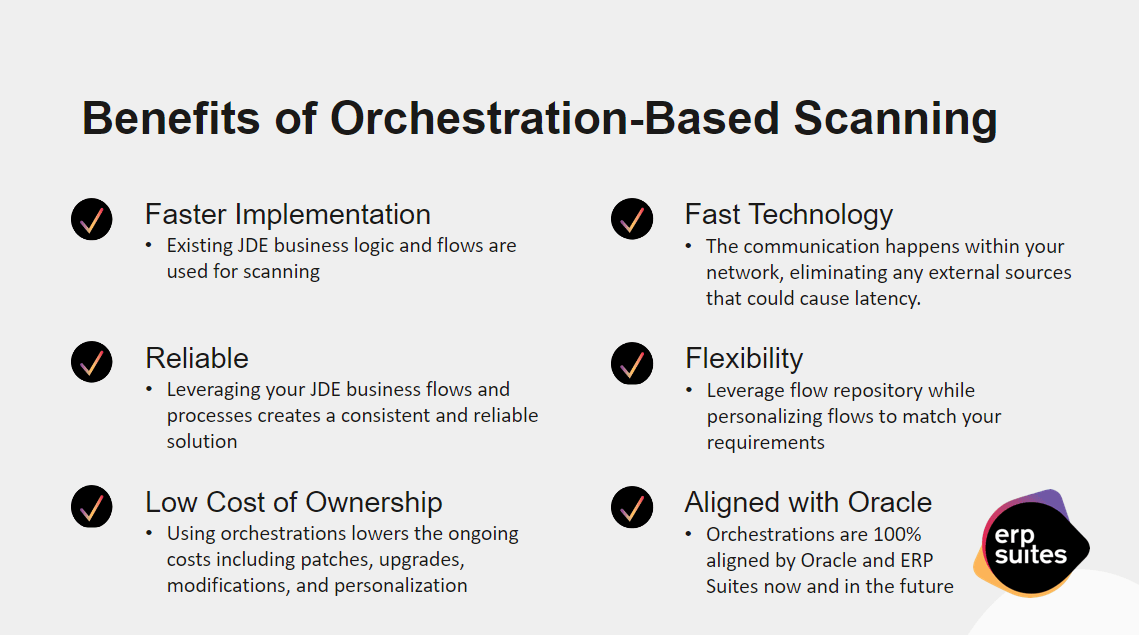
- Automating repetitive tasks with Orchestrator
- Replacing customizations with standard functionality
- Simplifying approvals and workflows
- Improving dashboards and reporting
- Reducing duplicate data entry
- Improving the user experience
- Removing obsolete custom code
- Addressing accumulated technical debt
These initiatives can help users complete work faster, reduce errors, improve visibility, and make the ERP easier to maintain.
Customization reduction is a particularly strong example.
A customization may have been necessary when it was originally created because JD Edwards did not offer a practical alternative. Years later, Oracle may have introduced new functionality, or Orchestrator may now provide a more maintainable way to meet the same requirement.
A consulting partner with current JD Edwards expertise can identify those opportunities rather than automatically retrofitting every customization during an upgrade.
ERP Suites encourages its consultants to look for opportunities to replace older customizations with orchestrations or newer functionality when appropriate. That approach can reduce technical debt while giving the customer a more modern and supportable environment.
Optimization is not about changing technology for the sake of change. It is about finding practical ways to help employees work more effectively and make the existing ERP investment more valuable.
Stage 5: Helping You Stay Current with Oracle
Internal ERP teams are often focused on immediate business needs: resolving issues, supporting users, running critical processes, and keeping the environment stable.
That can make it difficult to closely monitor every change in Oracle’s roadmap.
A JD Edwards consulting partner works across multiple customer environments and typically spends more time tracking changes to:
- Application releases
- Tools releases
- Middleware requirements
- Infrastructure support
- Security updates
- Cloud capabilities
- User experience enhancements
- Oracle support timelines
This broader perspective can help customers identify important changes before they become urgent.
For example, an upcoming WebLogic support change may affect infrastructure plans. A future JD Edwards release may introduce interface improvements that influence upgrade timing. A new security requirement may need to be addressed before another project begins.

The value of a partner as being proactive about these developments is important. Rather than waiting until a support deadline or technical change creates an immediate problem, the partner can help the customer understand the issue early and evaluate its options.
Staying current does not necessarily mean adopting every Oracle release as soon as it becomes available.
Different companies have different levels of risk tolerance. Some want early access to new functionality, while others prefer to wait until a release is more widely adopted.
An experienced partner can help the organization understand those tradeoffs and choose a timeline that fits its business.
Stage 6: Helping Your Organization Innovate Faster
Staying current keeps the ERP environment supportable and prepared for change.
Innovation goes a step further by using JD Edwards and complementary technologies to address new business needs.
Internal IT teams may have limited time to explore emerging technologies while supporting daily operations. Consulting partners are exposed to a wider range of customer challenges, Oracle capabilities, integration methods, and technology trends.
That experience can introduce possibilities the internal team may not have considered, such as:
- AI-powered business processes
- Intelligent assistants
- Document processing
- Workflow automation
- Process orchestration
- New integrations
- Cloud services
- Modern user experiences
Innovation does not always require waiting for Oracle to build a specific feature directly into JD Edwards.
Because EnterpriseOne can connect with other applications and services, a consulting partner may be able to design a solution using APIs, Orchestrator, AI, or other integration technologies.
JD Edwards customers can often work with a partner to develop new functionality rather than waiting for a future vendor release. That flexibility can allow companies to respond to business requirements more quickly while continuing to use JD Edwards as their core system of record.
The most valuable innovations are not necessarily the most complex. They are the ones that solve a real problem, improve a process, or give employees better access to information.
A capable partner helps separate practical opportunities from technology hype and determine where innovation can create measurable value.
What Should You Look for in a JD Edwards Consulting Partner?
Not every consulting firm will provide the same level of expertise or strategic guidance.
Some providers are primarily focused on completing assigned project tasks. Others are equipped to support the customer through planning, delivery, optimization, modernization, and ongoing decision-making.
When evaluating a JD Edwards consulting partner, consider asking:
- How much of the firm’s business is dedicated to JD Edwards?
- Does it employ functional, technical, and CNC consultants?
- How does it train and develop its consulting team?
- Does it stay current with Oracle’s roadmap and new JD Edwards capabilities?
- Can it support both immediate projects and long-term planning?
- Does it have experience with cloud, automation, integrations, and AI?
- Will it proactively identify opportunities or wait for instructions?
- Can it help reduce customizations and technical debt?
- Does it offer ongoing support after the project?
- Can it scale resources as your needs change?
The partner’s investment in its own people is especially important.
Customers should consider whether a consulting firm continually trains its employees, maintains relevant certifications, and encourages consultants to apply modern approaches rather than automatically repeating what has always been done.
A partner cannot help your business evolve if its own knowledge and methods are standing still.
The right firm should bring more than available resources. It should bring informed recommendations, current expertise, and a willingness to challenge outdated practices when a better option exists.
Final Thoughts
Getting more value from JD Edwards is not about completing as many projects as possible.
It is about making better decisions throughout the life of the ERP.
The right consulting partner can help your organization establish a strong strategy, deliver projects successfully, uncover underused capabilities, optimize business processes, prepare for Oracle changes, and evaluate new technologies.
Each stage contributes to a larger goal: ensuring JD Edwards continues to support the business as its needs evolve.
At ERP Suites, we believe a consulting relationship should extend beyond the completion of a single engagement. Our team works with customers to understand their environment, identify practical opportunities, and develop a long-term path for improving JD Edwards.
Whether you are preparing for an upgrade, reducing customizations, exploring automation, evaluating cloud options, or considering how AI could work alongside your ERP, the objective should remain the same: helping your organization get greater value from the JD Edwards investment it has already made.

.png?width=960&height=540&name=Blog%20Images%20(96).png)
.png?width=960&height=540&name=Blog%20Images%20(88).png)
.png?width=960&height=540&name=Blog%20Images%20(81).png)
.png?width=960&height=540&name=Blog%20Images%20(71).png)
.png?width=960&height=540&name=Blog%20Images%20(68).png)
.png?width=960&height=540&name=Blog%20Images%20(62).png)
.png?width=960&height=540&name=Blog%20Images%20(63).png)
.png?width=960&height=540&name=Blog%20Images%20(42).png)
.png?width=960&height=540&name=Blog%20Images%20(28).png)