

Should You Outsource CNC Support? JDE Managed Services vs In-House Comparison
December 15th, 2025
19 min read
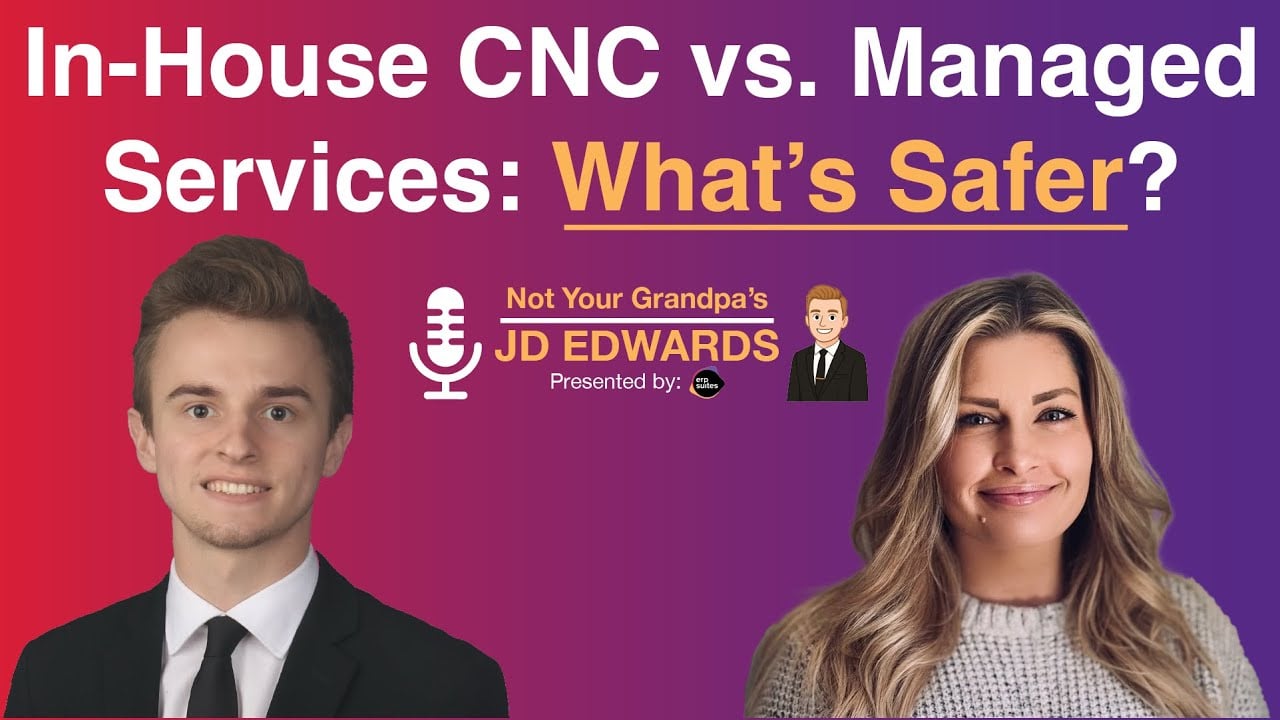
Watch on Youtube:
Listen on Spotify:
This episode of Not Your Grandpa’s JD Edwards explores the evolving role of the CNC administrator and asks a question many JD Edwards customers are facing today: does CNC still need to live entirely in-house? Through a practical, experience-driven conversation, the episode breaks down what CNC teams actually do behind the scenes, the growing challenges of hiring and retaining specialized talent, and the operational risks of relying on a single individual. It also examines how managed CNC services work, what to watch out for when outsourcing, and how hybrid models can balance control, expertise, and risk.
Table of Contents
- What CNC Is and What CNC Admins Actually Do
- What Breaks When CNC Isn’t Functioning Well
- The Invisible Work CNC Does Every Day
- The Hard Part of In-House CNC: Hiring, Retention, and Risk
- How Managed CNC Services Work and What to Watch Out For
Transcript
What CNC Is and What CNC Admins Actually Do
Have you ever wondered what your CNC admin actually does all day, and whether you really need that role inside your company anymore? In today's episode, we're breaking down the CNC role in exploring how managed services are transforming this essential JD Edwards job. Walk away with a smarter strategy for staffing, system support and saving money without sacrificing system health.
Welcome back tonight your grandpa's JD Edwards. I'm your host, Nate Bushfield, and today we're answering a big question facing JD customers. Do you still need a CNC admin in house?
To help us unpack this, we're joined by Miranda Clarkson, a CNC team lead at ERP Suites. Miranda, welcome to the show. First off, how you doing today? I'm doing great. Thanks, Nate, for having me. Of course we always love having new people on this show, so we we do have a reoccurring guest. Don't get me wrong, but now you can put on your resume that you are a reoccurring guest. But let's get into the reason why all these people are here today.
What is the CNC admin and what does the CNC admin really do in a JD Edwards environment?
Yeah, so CNC, if you didn't know it stands for Configurable Network Computing. And I would say it's essentially like the technical backbone of a JD Edwards environment. So I would say if you think of JDE as like a living system, the CNC is kind of the person that keeps the heart beating.
You know, we're responsible for making sure that the system is always stable. We try to keep it secure as possible and you know, performing the way that the business needs it to. I would say we manage all of the technical components that kind of fit underneath the applications.
So everything from like your servers, the configuration between servers, the databases, the security, you could see batch processing, user access, I mean the list kind of goes on and on. We do package deployments, maintenance activities. A lot of those things fall under everything that we do.
So you could kind of look at it as if if JDE is running, a CNC is involved behind the scenes in one way or another to make that happen.
Are you invested in a Chady Edwards upgrade? So, weren't you seeing the ROI you expected? Could a few overlooked factors be quietly sabotaging your investment? In this episode, we break down the top reasons companies fail to realize their full return from their JDE upgrade. Stick around, you'll learn how to avoid these mistakes and turn your upgrade into a strategic advantage.So what systems and processes depend on like this rule actually functioning well?
Yeah. So I mean, I feel like pretty much every part of JE depends on the CNC role functioning well. So if you look at your business, everything from your batch processing for payroll, manufacturing, like financial reporting, purchasing, you know, any of the like technical layers underneath of them, if those go down, those processes will stop.
And you know, obviously that brings your business to a halt, which is not good. So, you know, the CNC is what keeps the entire JD Edwards system healthy.
You know, we maintain the servers, we do the tool releases, maintain the pack codes, the security, all the performance tuning. You know, if one of those areas isn't being monitored or maintained, you know, I think it will obviously directly impact the business operation, which is, again, not good.
So, you know, even though users might not interact with the CNC on a day-to-day basis, I think they rely on work that we do constantly.
The Invisible Work CNC Does Every Day
Yeah, So I feel like a lot of DNC tasks kind of go unnoticed. And a lot of the work that we do, I think, is invisible when things are going smoothly, which is obviously kind of the goal.
So I think some of these important tasks would include monitoring performance, tuning behind the scenes. We keep the servers patched and stable. We do web logic patching, for example, every quarter.
We deploy packages quietly behind the scenes with little to no user interruption as best as possible. We manage a lot of the security access and the compliance behind the scene. And then we're cleaning up the environment, hopefully, so everything runs efficiently and just kind of proactively fixing issues before any users may be affected.
So, you know, I feel like some of those things, they don't always get a spotlight, but it's kind of what helped keep keep the JD Edwards system reliable. And when everything is just like, working, that usually means your CNC is doing a good job.
Yeah. It's like it's if you weren't there, they'd notice. But since you are there, they don't notice. It's one of those funny things. It's one of those funny things.
So like, you don't know what you have until it's gone. Yeah. And yeah, as funny as that does sound, it's it is very common for this role of being that unsung hero that, yeah, maybe a lot of companies don't really notice that you're there day-to-day fixing problems behind the scenes, but they would definitely notice if you weren't.
The Hard Part of In-House CNC: Hiring, Retention, and Risk
What are the main challenges businesses face with maintaining in house CNC support today?
You know, I think one of the biggest challenges companies face is just finding and keeping strong CNC talent. I feel like the role is very specialized and to be honest, I feel like it requires years of experience. And I think the number of people who know JD Edwards at like that deep technical level, I think that has been shrinking a lot.
And I think a lot of like the CS and C and CS are starting to get near to retirement, which is even scary for me because, you know, I'm working with these C and CS on a daily basis and they've kind of been the ones that have helped mold and shape me along the way. And, you know, I just feel like there are very few new people that are entering our field.
You know, I think companies end up relying on one person who kind of carries all that knowledge into their environment. And that obviously creates a lot of vulnerability and a lot of risk. So if that person leaves or they get sick or like what if the person goes on vacation? If you have that single person, I mean, that's a huge risk, right?
I just feel like this role is just so technical and it it takes months to recruit and I feel like train somebody new, especially if there's like a lot of customizations or specific business processes. So I just, I would say I think that's probably the biggest challenge businesses face, which is having one in house C&C.
Yeah. And would you say that there are a fewer amount of people that are actually interested in going in this role?
Yeah, I, I definitely feel like younger IT professionals are gravitating towards different IT roles. You know, I feel like you hear people going into AI now or cloud engineering or cybersecurity, you know, those things. They're not going into some legacy ERP system.
So I think finding newer and younger CNCS is very difficult. You know, you have these companies that are still running all these like super mission critical operations and, and this is how their business functions and this is how their business runs.
So, you know, you have an increasing demand for the CNC expertise, but like a very shrinking pull of talent because no younger IT professionals are like going into the CNC role. And to be quite honest, just like myself coming out of college, like I didn't even know what CNC was though. I never heard of CNC.
And I think a lot of people just don't have that knowledge of what that is and what that role, you know, includes. So I think that has become a big reason why I think companies are starting to look towards a managed services option because there's just more expertise and CNC availability, you know, going that direction.
Why Keep CNC In-House and What Are the Risks?
So what benefits come from having someone focused on C&C in house?
You know, I think having an in house C&C definitely have its benefits. They know your business really well. They know your customization, you know all your integration, you know your users, they know your processes.
You know, I feel like they can respond a lot faster just because they're right there. So if somebody is having an issue, you could literally walk over to their desk and ask them the question, right? Like, hey, can you take a look at what's going on?
You know, they have that availability to fit, physically fit into those internal meetings and, you know, they're building longer term relationships with the other in house teens. So, you know, I think there's definitely a lot of benefits to having an in house CNC, but you know, there's also risks involved in that as well.
Yeah. And that actually plays into the next question beautifully. What are those risks other than obviously the shrinking talent pool and if there is just one person and they get sick or go on vacation, a lot of those tasks are just not looked at.
Yeah, I mean, I think obviously and and what you would look at it as is like the biggest risk is just having that single point of failure. So it's kind of plain and simple, right? You have one person that has all that knowledge and that business is vulnerable because that person gets sick or they're gone.
You know, it comes much harder to manage the system. So, you know, system upgrades are happening, tools releases and just like all this work that a CNC does again, behind the scenes that I think a lot of people don't know, maybe one person just doesn't have all of that time or the weekends, you know, the weekends or the, the late nights to be able to do that.
If they're just one person, you know, it makes it a lot harder. But you know, if that seems to leaves the company, that knowledge gap can disrupt the operations for months. And I'm, I'm saying like if you if you have an in house CNC, it is valuable, but relying on that one person, I just feel like creates a level of operational risk that many companies, I feel like underestimate.
Yeah. And because they're underestimating this, would you say that they're more reacting to, oh, somebody's out, we got to scramble to get this or are they maybe being proactive finally with this shift?
Yeah, I mean, I think a lot of companies probably start by reacting. Unfortunately, you know, usually something happens, maybe there's like a failed upgrade or like a major outage or like stay at C&C resigns and maybe they don't realize they have that after hours coverage or support.
And I think that's where they start looking towards the managed services route. But I do feel like I see a shift towards a lot of companies being more proactive too. You know, I think they're recognizing that JDE is just too critical to rely on one person, right?
So I think more organizations, at least from my experience and like what I'm starting to see is they're kind of intentionally blending like in house, you know, CNC or just it doesn't have to necessarily be ACNC, but somebody in house that has that knowledge that has that, you know, strength of the company and knows all those business processes and how the company works.
But then, you know, utilizing man of services for that additional expertise for like the after hours coverage. So I think it kind of gives them the best of both worlds.
You know, again, someone who knows the business deeply and internally, but then also having that, you know, external managed services that can cover those extra hours or handle the big upgrades or, you know, really just have that whole team behind them, you know, with all that level of expertise.
So, you know, I, I also think that, you know, more companies are starting to realize too, that going to full main services route with the right partner can be extremely beneficial. And you know, it can, it can really be an extension of your team rather than just outsourcing.
So, so yeah, I think it's kind of a mix of both, you know, reacting, but also being more proactive too, just depending on the situation.
How Managed CNC Services Work and What to Watch Out For
Well, that plays in perfectly to the next segment of this, at least talking about the managed services side. How like, how does that actually work? How would someone on the outside manage your CNC services?
Yeah, that's a great question. So I feel like a man of services team supports, let's just say JD specifically, we remotely act as like an extension again, like we really try to be an extension of your internal IT team. You know, we're monitoring the environment 24 by 7. We're handling those day-to-day CNC tasks. We're responding to issues and really just managing that technical side of JDE just like an in house DNC would, but with the benefit of again, having that entire team on our side.
So, you know, if there's something one CNC may not have experienced or you know, worked on before, there's going to be probably a handful of other CNCS that do have that expertise or that knowledge or experience. So I feel like most managers as providers have a really good level of just that team extension for that internal IT team feeling and that relationship there.
But with that, you know, I, I know security is really important too, right? So I think a lot of customers should know that like when we're accessing a system, you know, we have very secure remote access. We don't take that lightly and we use, I, I would say typically a lot of managers of companies use some really great quality monitoring tools. We use ticketing systems. We have regular meetings and just really good constant communication to stay connected to the customers.
So, you know, we may not physically be in the building, but we're still keeping the system stable and we're catching the systems and we're kind of performing around the clock, you know, monitoring. Yeah. And it's something as simple as that.
Where yeah, a lot of companies out there, they the security is one of the highest priority things, especially with sensitive data. And to know that there are secure lines where you can plug in and there isn't any risk on that side of it. It's something that, yeah, not a lot of companies may know about like actual outsourcing CNC work with the managed services in this at least scenario.
But what other risks may come from utilizing the managed services model like like this or CNC support?
Yeah, I mean, I think like any outsourcing model, there's obviously risks involved like you can't not have any risks, right. So, but with that said, in my opinion, what I think the biggest risk is is choosing the wrong provider. I think one that doesn't understand your business, that isn't responsive or doesn't have that like strong expertise in CNC, you know, you, you run a risk of choosing the wrong provider and things can go very badly very quickly.
You also, I think need to prioritize very good communication and just really good documented processes. I think that's really important. And I think another risk is if like the relationship isn't managed well, the company can start to feel really disconnected from their own JDE environment.
So I think it's really important and selecting a partner that works with you, and I know I keep emphasizing this, but as an extension of your team, right? Not some just outsourcing company, you know, somebody that really values and wants to be an extension of your team. And I think that can really make or break how your system is managed, you know, 100%.
Outsourcing vs Hybrid vs In-House: What to Choose
And the partnership aspect of it is maybe the most overlooked when we're talking about manage CNC option here because yeah, like you could have an in house and you know, that person's going to be working with your best interests at heart every single day 365. But if you are outsourcing and you do choose that company, that's like, yeah, you're just a dollar amount to us. Like we're going to do this and not talk to you much. Then that really creates the sort of risk because they, you know, that maybe they're not prioritizing your security, maybe they're not prioritizing your true business function in that way.
But you have a yeah, but to have a partner such as ERP suites, but also many of the other managed managed CSE services that are out there. Like there is such a great aspect that comes to it when you look at a partnership versus just and paying these people to do a task. Like it's very different, different ways to look at it I guess.
But do services like performance monitoring, patching and even upgrades improve with outsourcing or is it kind of the same as in house? To be honest, I feel like usually yes, out first teams tend to be extremely strong in areas like monitoring and attaching. And then you have like the upgrades, the tools releases, you know those kinds of things just because the experience level is a lot higher because we have a lot more experience working on several different platforms and several different versions of JE on all different levels, right.
So I think when you look at it like that, we have seen every single kind of scenario, every error out there, every problem, just because, you know, our team as a whole has probably experienced one of those things happening. And, you know, we have dedicated resources who can focus exclusively on that maintenance. So I think you get more consistency and a higher level of expertise with that.
Yeah, I was trying to do the math on the experience that ERP Suites has, just ERP Suites in this way. And I got to around 100 years and I was like, yeah, I think I would have stopped doing math now because that's kind of the same to me. And that's the type of thing that you can get with a lot of these managed services teams out there. It's not just ERP Suites, it's the others that are in this space. A lot of them have been around for a long time, which means that they have seen almost every single problem you could possibly think of.
And we're talking back from the days of the floppy disk. I was talking with Frank Jordan not too long ago actually on this podcast, and he had mentioned the floppy disk, which is something that I don't know if I ever utilized the floppy disk. I know what it is, but I don't think I used it. And I'm 26 years old. Like, it is very funny to me how different everything has changed, but because of them being there at the beginning and sticking to it until today, you would assume that they have seen every single thing that could possibly happen.
Yes, there are upgrades. There are new things that are out there. So maybe there is one or two things that they haven't seen, but they know someone that does because the JD Edwards space is very tight knit. And if they don't know the answer to whatever problem you have, they know somebody that does, which is great.
Yeah. And yeah, go ahead. Well, I was just going to mention on top of that too, I mean, like with that expertise in the managed services side, we also have access to the other teams to help us. So we have Vbas, we have developers, we have infrastructure, right? So it's not just C&C's. So if there are other deeper issues like we have the team on the outside too to help us kind of figure out other issues going on at a deeper level. So I think that really helps being a managed services provider and having that ability and access because again, you know, if you have in house stuff, you don't always have ADBA on hand or you don't always have that knowledge of the infrastructure team or you know, development there, right? So I think it's super helpful.
So can companies still retain strategic control while outsourcing CNC tests? You know, I think absolutely, right. I think the strongest companies keep that strategic and control in house. And I don't think outsourcing it means handing over your system. I think it just means you're getting that additional expertise to support it. You know, internal ITI think still makes the the decisions about upgrades and, and timing and budgeting and you know that long term planning. But the managed services team executes that technical work and we provide the guidance and you know, the that allows the business to kind of always stay in the driver's seat in my opinion, right?
And it's, it goes back to the partnership thing. And I hate to keep bringing this up. They're like, yeah, if you're just using ACNC to do a few tasks, like, yeah, maybe they're going to do whatever they want to because they're not really in that constant communication. But a lot of the companies that we see now and a lot of the managed services companies out there are having weekly debates or conversations of, oh, we want to switch to this or, oh, how's our system doing here? And they want to know specific features or they want to know specific issues that are going on.
And yeah, you mentioned the ticketing system earlier, which is one of the best things that you can truly do for something like this because it's direct from the customer saying, hey, there is this issue that we need to solve and we want it to do this. And then the CNC being able to understand that and also ask more questions on that weekly basis, they get a little bit more of an understanding of exactly what direction they want to go.
Am I right with that? Yeah. And I mean, you know, you just have to look at that like the communication aspect, right? If a customer is putting in a ticket, you know, you have that communication through the customer and the CNC or the other teams on the managed services side, but you're also keeping track of SL as or for auditing purposes too, right? So you know, you kind of have that all bundled into that as well. So I think that really helps too for for just the business needs.
So what would you say? And this is just because I keep bringing up partnerships. So what would you say a healthy partnership between an internal IT team and a managed services provider look like? Oh, it's a great, I feel like it's a great question. I, you know, I feel like a healthy partnership looks kind of like shared ownership. And what I mean by that is like the internal I team IT team, I feel like understands the business processes and, and the priorities there, right? But the man of services team kind of brings in that CNC expertise and, you know, we like to offer the best practices and we have that 24 by 7 coverage.
And I think when those two groups communicate really well, you know, having those bi weekly or weekly meeting those clear, you know, ticket workflows and the communication in there and really just to kind of deciding those responsibilities, I think it really becomes kind of like a seamless support model for us. So, you know, the best partnerships. I don't feel like, you know, feel like outsourcing and I, I know I've said this probably three times already, but they feel like an extension of your team. And I think that helps get everyone aligned and, you know, everybody moving forward on the same goal.
Yeah, exactly. Exactly.
So when does it really make sense to keep AC and C in house? And when should a company maybe go the managed services route? Yeah, I mean, this is, this is kind of like not an easy question to answer, right. I, I think it really just comes down to, you know, the size of the organization, maybe how complex the environment is, what level of coverage the business needs.
I think keeping an in health CNC makes sense when the company has like a really heavy JDE footprint or like a really highly customized environments or very specific business process, business processes. I think that requires somebody to be kind of deeply involved and deeply rooted in that like day-to-day operation. But I also think again, there's risks with that and that's where that blended model I feel like comes in really, really well.
So you have that in health person that has all of that, you know, internal, you know, information that they know the business processes, how things function. But then you have that managed services side that's eliminating that single point of failure because you don't want that risk involved.
But when it comes to, you know, going the managed services route, I think it becomes a better choice when companies need a broader expertise. You know, you have that whole pool of CNC's and all that expertise behind the scenes or you know, they are a 24 by 7 company, right? So you need that 24 by 7 support and I think it can be cost effective for some companies rather than having like that single, you know, internal CNC or you know, maybe, you know, just the amount of work just isn't suitable for justifying a full time in house CNC.
But just having that like safety net, you know, of a whole team and maybe saving money, you're in there for certain things. And again, just mitigating that risk of that single point of failure, I think is pretty critical and pretty important.
Yeah. And we've talked about the hybrid model a little bit throughout this. Would you say that that's the best of both worlds? Is that what people should shoot for or is maybe just a managed services that just do the trick as well? You know, I, I truly think like a hybrid model is always going to be beneficial, right, Because you, you have somebody that stays internal to understand your business practices and your pain points.
And then you layer on that managed services for things that are harder to, you know, maybe handle on your own again, the after hours for that performance tuning, the big upgrades and then like that proactive monitoring. I think it gives you a solid foundation for managing your system with the hybrid model.
And you know, you, you have, you have, I think a lot more success when you have that internal person that knows all those critical business functions and then you're backed by a manager's team who can fully support you and, and jump in whenever you need them. You know, and again, as always, it just eliminates that single point of failure risk.
And you know, you're keeping, while you're doing that, you're keeping that strategic control and help at the same time. So I think it's I think it's a really good model and I think it works for a lot of people. But you know, some people just don't wanna deal with the the in health, you know, in health risk whatsoever. So they they allow a manager to team to, to handle everything. So I think it just really depends on on what the company is looking for.
Yeah. And I would also assume that it kind of keeps the managed services provider in check a little bit of if they are BS ING you, if they are saying that, oh, this is going to take X amount of hours, but you have that in person or that in house personal, maybe they can say it shouldn't take that long. I don't know what they're really talking about. They could probably give you that sign of reassurance of if that managed services provider is doing right by you and building that partnership or maybe going the other direction.
Am I right with that? Yeah, I I totally agree with that. So you're, you're heading, heading the nail on the head.
How to Future-Proof
So regardless of which path a customer would take, how would you say that a business can future proof their CNC strategy? You know, I think future proofing is very important. And in my opinion, it comes down to, I think, I don't know, I would say probably 3-3 really important things.
I always feel like documentation is so important. So you know, you're documenting all your processes, you have environment diagram, your security model, your upgrade history, all your integrations, you know, kind of like the whole picture. If you have all this stuff documented well, I think I think that's a huge successful thing to future proof your company.
I think a redundancy in coverage is probably the second most important thing, you know, whether that's in house or outsource. I mean, you can't just rely on one person. So if you have that redundancy, I think you're setting your yourself up for success there.
And then I would say like the the third most important thing is just planning. You know, companies I feel like needs long term like Rd. maps out there, So when they want to upgrade, when they want to modernize and really just like how to align your JDE environment and, and ideas with where the company is going in the future.
So, you know, if you, if you have those three, I think major pieces, just documentation, the redundancy and just kind of a road map for your company, I think that puts you in a really strong position whether you stay, you know, in house or you outsource or you kind of blend the 2 model.
Yeah. And couldn't have said it better myself, honestly.
But if your team is still shouldering the burden of in house CNC and you're wondering if there's a better way, ERP suites can help. We offer flexible managed CNC services that reduce stress, increase uptime, and free up your team to focus on growth and your future. Visit erpsuites.com today to connect with Miranda's team and start this conversation.
Huge shout out to you, Miranda, for your insights today. We really do appreciate you jumping on if you're rethinking your CNC strategy or if your CNC is your strategy. It's time to explore your options. Subscribe, leave a review, and share this episode with your IT leadership. This has been not your grandpa's, JD Edwards, and we'll see you next time.
Miranda Coyne began her career as a co-op with ERP Suites nearly ten years ago and quickly rose to a leading CNC. She is a Clarity product champion using data analysis to inform better decision making around user performance and security. Her insights into the customer experience continue to shape our products and processes.
Topics:



.png?width=650&height=325&name=Blog%20Images%202_1%20(4).png)
.png?width=650&height=325&name=Blog%20Images%202_1%20(5).png)
.png?width=650&height=325&name=Blog%20Images%202_1%20(3).png)
.png?width=650&height=325&name=Blog%20Images%202_1%20(2).png)
.png?width=650&height=325&name=Blog%20Images%202_1%20(1).png)
.png?width=960&height=540&name=Blog%20Images%20(96).png)
.png?width=960&height=540&name=Blog%20Images%20(90).png)
.png?width=960&height=540&name=Blog%20Images%20(88).png)
.png?width=960&height=540&name=Blog%20Images%20(87).png)
.png?width=960&height=540&name=Blog%20Images%20(86).png)
.png?width=960&height=540&name=Blog%20Images%20(85).png)
