

JD Edwards ERP Projects: Avoid Costly Proposal Mistakes
February 24th, 2026
21 min read
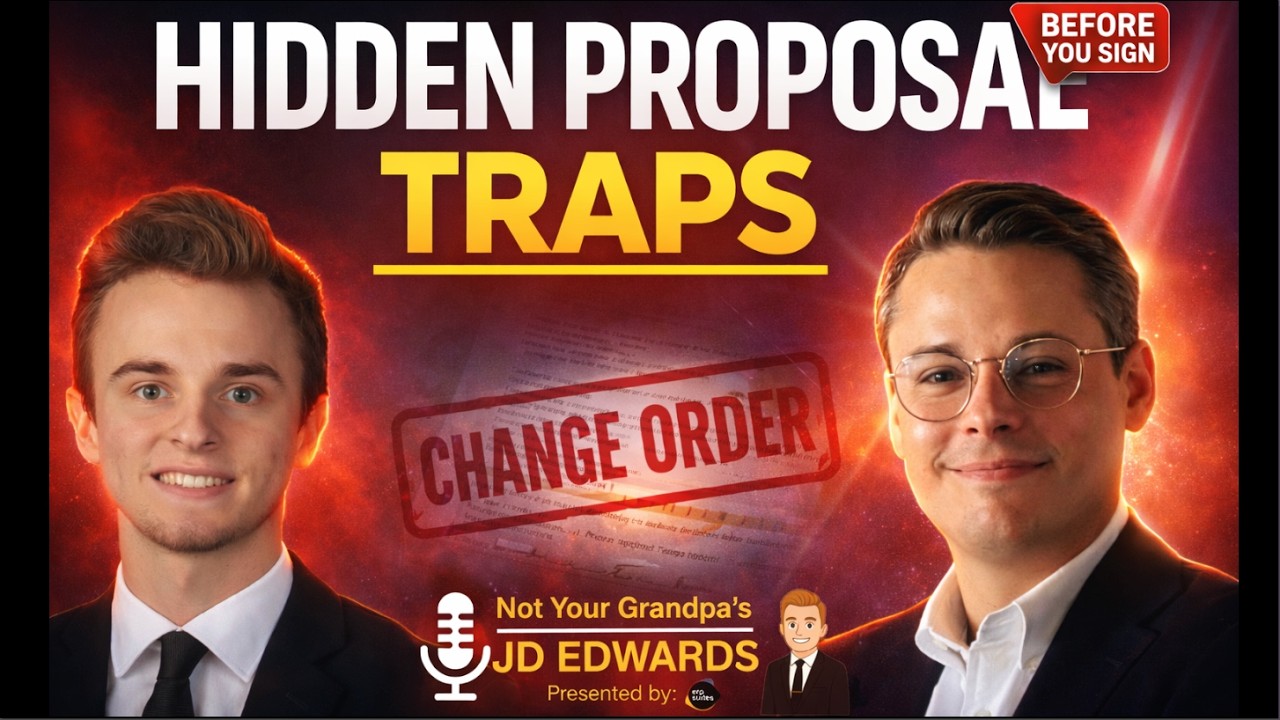
In this episode of Not Your Grandpa’s JD Edwards, we break down how to read ERP consulting proposals like a seasoned buyer. Explore why scope creep and budget overruns happen, how vague language and weak assumptions create risk, and the three types of change orders every buyer should understand. From evaluating deliverables and timelines to spotting red flags in statements of work, this conversation provides a practical framework for protecting your budget, setting clear expectations, and building stronger consulting partnerships.
Table of Contents
- Introduction
- Why Scope Creep and Budget Overruns Happen
- Evaluating Language, Assumptions, and Resource Requirements
- Change Orders: Ethical, Negligent, or Strategic?
- Red Flags to Watch For in Statements of Work
- Building Trust Through Clarity and Accountability
- Overwhelm, Trust, and Final Advice for Buyers
Transcript
Introduction
How do you tell a solid, trustworthy proposal from one that sets you up for scope? Great. When do change orders signal real surprises, and when are they just part of the pricing strategy? In this episode, we'll show you how to read proposals like a seasoned buyer. From deliverables and assumptions to exclusions and dependencies, you'll get a clear framework of how to avoid costly surprises.
Welcome back tonight, grandpa's JD Edwards. I'm your host, Nate Bush Shield. And if you have ever sat down with a proposal that sounded good only to watch the projects spiral out of scope and budget, this episode is for you. We're diving into the red flags hiding in plain sight and how you can spot them before you sign. Joining me is Stuart Peterman, an account executive here at ERP Suites, who's reviewed and written more proposals than most people who ever read. Stu, welcome back. And for those that haven't seen you on the pod before, can you give us a little bit about your background? Yeah, absolutely. And excited to be back. I think this is number 3 for me. I've been counting the days. My name is Stuart Peterman. I'm an account executive at ERP Suites based out of Denver, Co. But I've got a pretty long history in tech sales in general, four of which on the professional services side, working especially in the JD Edwards community, in the Oracle community. Prior to that, I was at NetSuite and Oracle for a period of time. And then before that was it Salesforce. So I've seen a lot of different statements of work. I've seen a lot of different approaches from professional services organizations and some good, some not so good, but wanted to kind of help those out there understand what they can look forward to, make sure that an SOW is all-encompassing and that it's not going to go off the rails at any point as much as we can.
Why Scope Creep and Budget Overruns Happen
Yeah. And you've been in this space for a long time now. You have been around a lot of different proposals when it comes to the tech consulting side of it and specifically JD Edwards, which is what this podcast specializes in. So to kick off, why do you so many ERP or even consulting proposals lead to budget issues in scope creep?
Yeah, it's a great question and you know, maybe less exciting of an answer than you were hoping. But I think the real culprit for why scope creep happens is because either customers are not as forthcoming as they should be in the discovery process, or maybe the professional services or consulting firm isn't asking the right questions. I think often times when I've seen projects go sideways or budgets really increase and change orders are required is when companies just don't give that consulting firm the full scope of what they need. Unknowns are really what caused scope creep. Unknowns on the professional services side and unknowns on the customer side. So it's not always that the customer doesn't share that information or they're too tight lipped about what they should be sharing with the consulting firms. Sometimes they just don't know. And same on the other side, sometimes the consulting firms just don't know the right questions to ask. So in my experience, that's really what causes projects to expand and balloon past what the SOW would have dictated.
Common Proposal Flaws That Set Projects Up to Fail
Yeah. And maybe go to go a little bit further, what are some of the most common flaws that you see in these proposals that set projects up to fail? Yeah, I think a lot of times it can be some ancillary application that's connected to, let's say an ERP system or connected to ACRM system that causes, you know, that application if it's upgraded to just crash or, or to fail. Sometimes it's a requirement that they didn't explicitly state in the beginning that now they want later in the game. And it causes some friction on both sides because sometimes on the consulting side they say, well, you're you're telling us this now.
And and then on the customer side, it often times they're saying, well, yeah, you know, we've only known this because it's our system. We didn't know that it wasn't regular for every company out there. The one thing that I've come to understand is that there is no two, There are no two companies that are the same. There are no two ERP systems or CRM systems that are the same. There are no two processes that are the same. And there are no two people that are the same from one company to the other. Whether it's the controller that wants a specific accounting function or, you know, a warehouse manager that wants a specific warehouse operation function for a picker, it's there's a lot of variation. And sometimes everyone thinks what they do is what everyone else does. And that's really almost never the case.
Evaluating Language, Assumptions, and Resource Requirements
Yeah. And to dive deeper into the people side of it, do clients generally know how to evaluate these documents or are they more relying on the vendors to kind of spell it out for them? Yeah. I, you know, I've seen all ends of the spectrum of SOWS. I've seen very vague SOWS that kind of allude to getting a project done in a specific amount of time without much mapping or planning to specific milestones or key points in that project that they want to hit, who's involved in that, what time frame they're planning on hitting it, and what it takes from the customer side. Often times customers don't really realize what resource requirements are going to have to happen on their side.
So, you know, when it comes to people, I think that the real pitfall here is that you're not asking the questions that are circling around in your head. You'll see an sow, it looks fine to you. You may even get a little bit of in, in the sales world, what we call happy years, which is I'm hearing everything I want to hear. I'm hearing that this project can be done in the allotted amount of time that I want it to get done. And in reality, you're not asking the tough questions around how we plan on hitting it in that period of time. What resources might be required from my end, the customer's end and you know, what sort of meetings might be required between the two sides. So sometimes you'll undergo a project in the middle of busy season you're you just can't spare the extra people and that causes the project to go a lot longer and therefore it goes a lot longer. It typically is going to be more expensive.
So the pitfalls really, just to summarize it are around not asking the right questions or not asking the questions that you're thinking about in your head. So, you know, there are some stupid questions, I guess, but very rare. So, you know, if you have a question in your head, chances are it's a good question. So ask it if it's a good professional services firm like I believe ERP suites is, we're always happy to answer questions or go into more detail on a statement of work. You know, it's it's good if we both understand what's going to occur during that project time frame. Yeah. And when it comes to the language side of it, are some of those maybe stupid questions, but maybe real good questions. Do they come from on the Singer language that might be in some of these deliverables or maybe assumptions? Yes. You know, a lot of the language in a statement of work or a contract or even a proposal is they on purpose. And it's vague because it has to be. It has to be somewhat vague because there are a lot of potential options and opportunities and events that can arise throughout an evaluation cycle. So, you know, a lot of it can seem really vague. Contracts are often written in vague ways. So to ask to elaborate on a very specific clause or an area in the contract that cites anything around timeline or resource requirements or resource allocations, you know, often times it can be vague. So I would encourage every customer out there to just ask questions. You know, it's, it's not an attack on us. If you're asking us to elaborate on specific part of a, of a statement of work or an MSA, typically we're we're happy to do it.
Change Orders: Ethical, Negligent, or Strategic?
Yeah. And with the vagueness of some of these documents, you can see some change orders that could be placed in there in the future. Is that, is that something that you've seen of a lot of change orders utilized by vendors just to get extra revenue at the end of the day or is it more strategically they're using the change orders if they absolutely have to?
Well, there are in my mind three different change order types. There are change order types that an organization in the consulting world or the professional services world has already kind of built into the statement of work to say, hey, if this is our, this is our understanding as of right now. If this understanding changes because some of what your requirements are change or you know, there are things that arise that we weren't aware of, we reserve the right to go through the process of doing a change order and those are necessary. They are stated beforehand. And I think they're responsible. You know, they're they're ethical, they're responsible. If the client changes their requirements after the sales, the the statement of work is signed off on, then you do have to readjust your thinking or else, you know, consulting firms and professional services organizations just wouldn't exist. They wouldn't be profitable anymore and and they would cease to be able to operate in this space. So that is a necessary part of a statement of work or a review of an overall project or initiative.
The second that I've seen is due to, I don't like to use the term negligence, just not being as prepared as they would like to be or they should be not asking the right questions and therefore a change order is required. Now, there's a little bit of fault on both sides at that stage where, yeah, there's some fault on the customer for not being totally forthcoming with the information that is required of us. But then on the on the consulting firm side, there's a little bit of responsibility there too for not asking the right questions and not making it known that, listen, you know, this is our understanding of the scope here. If it changes, we do have to change our resource allocation and we would then have to change the amount that this may cost the other side's time and materials. You know, you give a rough estimate, you bill them for what time it actually takes. And those are a little bit harder to peg. Those are a little bit harder to nail down in terms of what they could be. But you know, at the same time, if, if it's a good organization that's keeping you in the loop at every step of the way, you will know and be able to track where you are in relation to where we thought we would be in the the course of that project.
The third, unfortunately, is a reality in the space. I can't say I've ever seen, at least in my role in a consulting firm, anyone either in my company or in any of the companies that I have worked with or been a part of the evaluation process with a purposefully underbidding or under baking a statement of work in order to get the business and then change ordering them. I haven't seen it first hand as I've been a part of the professional services side, but I have seen it a few times when I was an account executive at a larger company that had a slew of professional services organizations that I would then interview or speak with as the account executive for the product side. It's been blatant. In some cases it's been a little bit less blatant than others, but I have seen it and it does exist. And that's an unfortunate reality. But if you are able to kind of catch it in your review of a statement of work, sometimes you can get ahead of it. You know, if you're looking at a really big statement of work and it's a pretty big project, you have the right as a customer to ask questions about if we could better define the timeline, the scope and so on. And, and frankly, those organizations that I saw that would underbid and then change order, those companies it they had a hard time. Most companies are not happy about a change order halfway through a project. And sometimes those companies refuse and they'll say, you know, all right, well, this is where your stop is. You can get off here and, and we'll bring in another company that can take over where you left off. So I I wouldn't say it's good business practice from an ethical standpoint or from a, from a, an actual revenue standpoint, but you know, unfortunately it does exist.
Red Flags to Watch For in Statements of Work
So let's maybe go into a little bit of how communicate this, Let's make it a little practical, save that a proposal in front of me. What red flags should I be standing for? Yeah. So if it's a larger statement of work, you know, this doesn't always apply to let's say if you're doing maybe a 20 hour statement of work to build an orchestration for a specific process. The time frames and the kind of the hours allocated to the various weeks, months of that statement of work is a good area you can look at closely to understand if this professional services organization is really taking into account all the factors. You know is if they're really looking into and scrutinizing and really being detail oriented around their statement of work, that's a really good place to look. If they have kind of really standard metrics, you know, this week is going to be user acceptance testing or this week is going to be discovery or this week is going to be you know, when we actually implement the solution. The more vague the terminology, especially related to the timeline, the more you should be asking questions.
The same goes for the overall deliverable section. You know, in many statements of work there is a services to be provided section and sometimes those sections are really, really detailed and they go into, you know, a lot of description of what exactly we're going to provide when we deliver on this project. That's a good sign. You want those statements of work to be lengthy, to be detailed. And if they're not, if they're really vague, you should be asking questions around why we think we can hit a specific gold timeline or, or a specific budget that you and your company have set for a project like this. You know, typically, unless it's a really, really vague time and materials that you don't know really what is required and we don't know what is required. And we have that mutual understanding that you know what this one's going to be time and materials and, and we'll keep you abreast of the situation, but we're going to have to, we're going to have to play this one by ear a little bit. If it's not a a project like that, I would really ask lots of questions around the deliverables, the services section, the services out of scope section, because that should also be very detailed is what we won't be doing in this project and what you or your team would be accountable for providing along with that, you know, required resources or another really good area I've seen is the assumptions clause. This is what we assume based on what we've talked to you and your team about. If those assumptions are incorrect or off base, you should correct them. It will only affect both parties negatively if our assumptions and our understanding of scope is incorrect.
Building Trust Through Clarity and Accountability
Right. And to maybe backtrack a little bit of if you do see one of those vague ish where there is that understanding, but that would really open the door for maybe a change order. So what would a strong change order policy look like in how can you maybe spot a weak one? Yeah. So a strong change order policy is typically in the form of a a group of sections, but also a disclaimer. And in many cases there are disclaimers in these statements of work that will say something along the lines of, and I'm paraphrasing, you know this is our current understanding. We have given you the statement of work based on the information provided and perhaps even the history, the customer history if it's a recurring clients from a consulting firm standpoint. And then it is really outlined in a detailed services to be provided or maybe another way to phrase that section and then services that are out of scope section.
So to cover the consulting firm, typically they will say this is our understanding of scope. We're going to be providing these services. It's going to take us around this amount of time that breaks down typically into a number of hours or in some cases, if it's outside of the United States, days use day rates in a lot of cases. And then this is what's out of scope. This is what you and your organization are going to be entitled to provide. And then in the services to be provided, you know, break it down. This is what we want to get in the initial discovery phase because in many cases there's a, there's an additional discovery or an assessment that happens after the statement of work. Then we put together our plan of action. Then we build and we deploy this solution or we go through and we implement this upgrade and then we account for the retro state. And then we go through user acceptance testing and then we provide documentation and then there's a really extensive deliverable section. So really what you're looking for is detail and it's in the assumptions clause. You are looking at some things that you didn't know that you provided or perhaps even someone else in your organization may have provided that could be incorrect. It's really important for you and your company to really. Read that top to bottom, start to finish. Understand what you are going to be accountable for and what you are not. Understand what your resource is and your resource requirements are going to be. And then if it's really, really vague for a really complicated project, I would review it and then maybe ask for more specific terminology in there to protect both you and the consulting firm. Because the last thing you want is to budget a project for you to get excited and for you to be happy that you're coming in under budget. And then 2/3 of the way through it, you and the consulting firm are now at odds because they've come back to you and said, hey, we're way over budget on this. We have, you know, we've got, you know, 20% more hours already than we proposed for the entire project. And we're in week 30 out of 50. So it, it's worth your time to read into that and make sure you understand everything that's being said. If you don't understand what's being stated in that statement of work or, or in that MSA ask, you know, it's, it's kind of like no, no good consulting firm will be upset that you're asking questions about it. It's just a part of the, it's a part of the process and, and we account for it in time and, and we're happy to do it. You know, as an account executive, if there are questions that I can't answer, I can bring in an additional resource that can. So never be afraid to ask.
So are there signs that a vendor is intentionally vague to say, flexible or is it worse? It's like profit later? It really depends on how open the dialogue is between you and the customer. If there's really open dialogue, it's a mutual understanding that you know, we know that there's a problem here. We do not know the root cause because really a litany of different reasons. It can be that the customer doesn't know where to find the root cause and therefore can't share that with the consulting firm or professional services firm. It can be because it's just a, it's a new problem and, and you know, maybe a lot of companies are experiencing it. No one's really figured out how to resolve it. And there's going to be a certain amount of digging and sleuthing, I guess, to get to the root cause of that problem. Really what you want to look for is how open is the dialogue and really as a consulting firm employee, the customers that I work with best are the ones that are the most honest and upfront with me. You know, we're, we're not here to spread your information. We typically have Mndas signed anyway. If that that were something that we wanted to do, we wouldn't be able to do it legally. Although it's not really the lack of information sharing is where I see these things go sideways. Now, the opposite end of this is I have seen really big statements of work. I've seen them done by really savvy organizations that do it maliciously and and intentionally. Again, not in the JD Edwards space. I've yet to see that, which is a good thing.
But then there are just vague statements of work because perhaps the consulting firm is young, you know, it's not as well established, there aren't as many employees. Maybe they're early in their lifespan as a consulting firm and maybe the CEOS writing statements of work. And he's also doing a lot of the legal stuff. And then they're also, you know, going through and and doing marketing and sales. So, you know, they just don't have the time to devote to a really thorough statement of work. But I think it really all depends on if it passes the smell test. If you as a customer read through that statement of work, you find it to be very vague for a project that's fairly complicated, you know, in the to the tune of hundreds of thousands or even millions of dollars. And you ask them to elaborate on specific subsections or maybe add specific detail to a, a section of a, a statement of work or a contract. And they push back on you or they are unwilling to answer any questions around it or they may not know and you can see them kind of fumbling with their words. Those are signs that you should probably dig deeper and make sure that those concerns are addressed. If I get caught in a, an area where someone asks me for additional detail and I simply don't know because I'm not the subject matter expert, I'm I'm an account executive and I need to loop in a, an additional resource. It, it doesn't take that much work and it's actually typically pretty easy. All resources make themselves pretty available for questions. Just this morning I asked four different people, four different very technical questions that I just could not answer on a call myself. And typically my talk track around that is, you know, it's, it's a great question. I could try to answer that, but I, I'm afraid I'd be kind of talking out of school or I, I just wouldn't know all the intricacies of that. Let me let me talk to a resource like let's say Tim Cramer for IBMI or you know Luke over in our X86 private hosting practice. You know those those sorts of things are really easy to go and ask my Co workers about. So if if you encounter a situation where someone pushes back pretty hard on you asking a question that is really centered around a vague subset of a statement of work, that is a red flag and you should consider it a red flag and you should push a little harder to get them to answer that question.
Yeah, exactly. I mean, if you can't have that conversation with a customer where you're trying to build that relationship, you're trying to build that trust, that's a tremendous red flag. If they're not willing to give you the answer or at least find it because yes, most sales executives, they're not going to know the answer off the top of their head, but they know somebody that does. So at the end of the day, if you're having those issues with those conversations, that's one of the biggest red flags that you could possibly see in this. Yeah, I'm not saying run, but I am saying don't, don't stop asking that question just because you get a little resistance. You you should hold firm in that and and maybe get them to bring in a couple of other people so that they can go into that in more detail because, yeah, that is that is certainly a red flag.
Overwhelm, Trust, and Final Advice for Buyers
So to talk a little bit deeper about an actual proposal, is there maybe a tone or a style of writing that makes a proposal maybe feel more trustworthy? Yeah, I think when it comes to how a statement of work is written, there is a tone and there is a type that makes it a lot more comforting, let's say on both sides. Thorough, it being very thorough, it being very detailed. That is a very good sign that a statement of work is one that has accounted for all the variables. Now, again, I want to say this with the caveat of there are statements of work that are for smaller projects that don't need to be that thorough. If every statement of work that ever existed was 25 pages or more than, you know, all projects that you're outsourcing to a trusted partner would grind to a halt and they would become really difficult to get through, especially if you have those on a tight timeline and you need to get something done in short order. But for those that are larger and, and have a lot of moving parts, let's say a a big upgrade to code current or yeah, you know, especially if it's, you know, going from 32 to 64 bit or you have a lot of ancillary systems that are connected to your ERP system that, you know, could potentially need retrofit work. And those aren't spoken to or addressed. Being thorough is the most comforting thing about a statement of work. The next thing is it draws very hard, specific guidelines as to what we will do and what we won't do. If if we say no, no, we'll, we'll do whatever you want us to. You just, you know, you just tell us, but we'll make sure we stay in this parameter of your budget. You know, those two things are at odds. Those two things can't exist simultaneously. So if they seem a little laissez faire in the approach, you should ask for more detail. You should ask for more specific language within that.
Now the other thing is there are specific subsections of that statement of work. Typically there is going to be you know an overall, you know, this customer has agreed to enter into this agreement with us as a company and you may even refer back to the original MSA or original contract you signed. You know the location that it's going to be provided because that can also cause a little scope creep too if location isn't explicitly stated. And you know, maybe in consulting firm's mind everything can be done remotely. But in your mind, you really need that extra hand holding. You need someone on site. You need someone that can provide some more personal touch, let's say. And that requires them to fly out. And it's a, you know, it's a 30 week project. So they're flying out every week on Sunday night or Monday morning for 30 weeks. That can add up pretty quickly. The other part is, you know, in the services to be provided section, they iron out every little bit that they plan on providing, plan on undergoing from a discovery standpoint, what phases are going to occur and what timelines, not just the overall phases are going to have behind them, but even some of the individual steps in those phases can provide as well.
And then a deliverable section, you really do want a thorough deliverable section that says this is what at the end of this project, this is what we're going to hand off. There's going to be, you know, of course, a, a code current JD Edwards, you know, release 242526 solution and we're going to provide hypercare afterwards and we're going to give you a lot of documentation so that you and future employees of this company will be able to refer back to it if need be. We, we state very clearly service is out of scope and we, we tell you what we assume, we assume you're going to give us access to your system through AVPN or we assume that you're going to have services or, or resources on hand to help us with XYZ. If you're a company that has really strong development team, you know, we may state in the assumptions that we're going to take a little bit more of a back seat on the development side and we're going to have a project manager there to manage the time frames. That's another thing, you know, really good project manager can help keep things on track. So all of these things should be thorough. They should go over every bit of what you believe this project is going to entail. And then if there are things outside of it, please be upfront. We want you to be upfront. We want to know if things are going to maybe expand past what we thought because we want to give you accurate pricing. We, we don't ever want to go back and have to ask for more money. It's always harder to do that than it is to just be upfront, be honest about what your expectations are. And we are honest about what our resources can do and in what time frames. So I, I know that was a long kind of verbose way of explaining, you know, honesty is the best policy if it's a partner that you trust and one that you're going to end up trusting with a pretty pivotal business stopping solution. If, if something goes sideways, you should you should be as honest with them as you can be. And we will always appreciate that.
Yeah. And there's so much that goes into the trust side of it, but maybe there's an issue on the client side of maybe they're just overwhelmed by a proposal. What would you say to a buyer who is feeling overwhelmed trying to evaluate one of these proposals? Yeah, You know, I think it's probably easy to get overwhelmed by one of these proposals. It's it's a lot easier for me to read through one of our statements of work because they're typically written using similar language, although they can be larger or smaller based on the requirements. So even when I started at ERP Suites coming on about two years ago, when I first looked at our statement of work, you know, it, it was a little bit overwhelming to read through. So I don't blame a customer for feeling that way.
I think if you're feeling overwhelmed by what a what language exists in a statement of work, just ask. I think you can ask your fellow Co workers, especially if they've worked with that specific consulting firm in the past, or you can ask the company themselves. You know, typically I would say in 99.9% of all cases, no one at a consulting firm is attempting to pull the wool over your eyes. Because if you don't understand it, chances are we're going to get in an argument with each other down the road and there's going to be some friction. And we don't want that either. We want you to understand what's going to happen, what time frame it's going to happen in, what you're going to be asked to do what what we're going to do.
From our standpoint, I think it's a really it, it's, it's a partnership, It's a, it's an ongoing, you know, in, in some cases decades long partnership from one company to the other. So the better we understand each other, the better we'll work together. So I guess all I can say, and maybe there are other things that you can do to understand it a little bit better, just ask if you ever have a question or you ever feel overwhelmed, ask someone from that consulting firm or from your company to explain it to them like they're five years old. That's, that's kind of what I always ask. It's like, Hey, what if, what if I was 5? How would you explain this to me? And more often than not, the people that know their stuff can explain it in a way that is easy to understand if you don't really know that very well. You know, I, I kind of make a career out of that. But if you're evaluating a proposal or already mid project and see red flags, ERP Suites is scared to help. We've helped JD clients decode proposals, rescue struggling projects, and avoid costly mistakes. Reach out to our consulting team at erpsuites.com to schedule a proposal review or a project check in. Let's make sure that your next move is a confident one. But that's a wrap for today's episode of Not Your Grandpa JD Edwards. Huge shout out to you Stu for breaking down the red flags that buyers need to understand. If you got value from this episode, subscribe, share with your team and leave us a rating. Until next time, evaluate wisely. Lot of nice confidently and keep your projects on track. Catch you next time.
Topics:




.png?width=650&height=325&name=Blog%20Images%202_1%20(4).png)
.png?width=650&height=325&name=Blog%20Images%202_1%20(5).png)
.png?width=650&height=325&name=Blog%20Images%202_1%20(3).png)
.png?width=650&height=325&name=Blog%20Images%202_1%20(2).png)
.png?width=650&height=325&name=Blog%20Images%202_1%20(1).png)
.png?width=960&height=540&name=Blog%20Images%20(96).png)

.png?width=960&height=540&name=Blog%20Images%20(90).png)
.png?width=960&height=540&name=Blog%20Images%20(88).png)
.png?width=960&height=540&name=Blog%20Images%20(87).png)
.png?width=960&height=540&name=Blog%20Images%20(86).png)
.png?width=960&height=540&name=Blog%20Images%20(85).png)
