

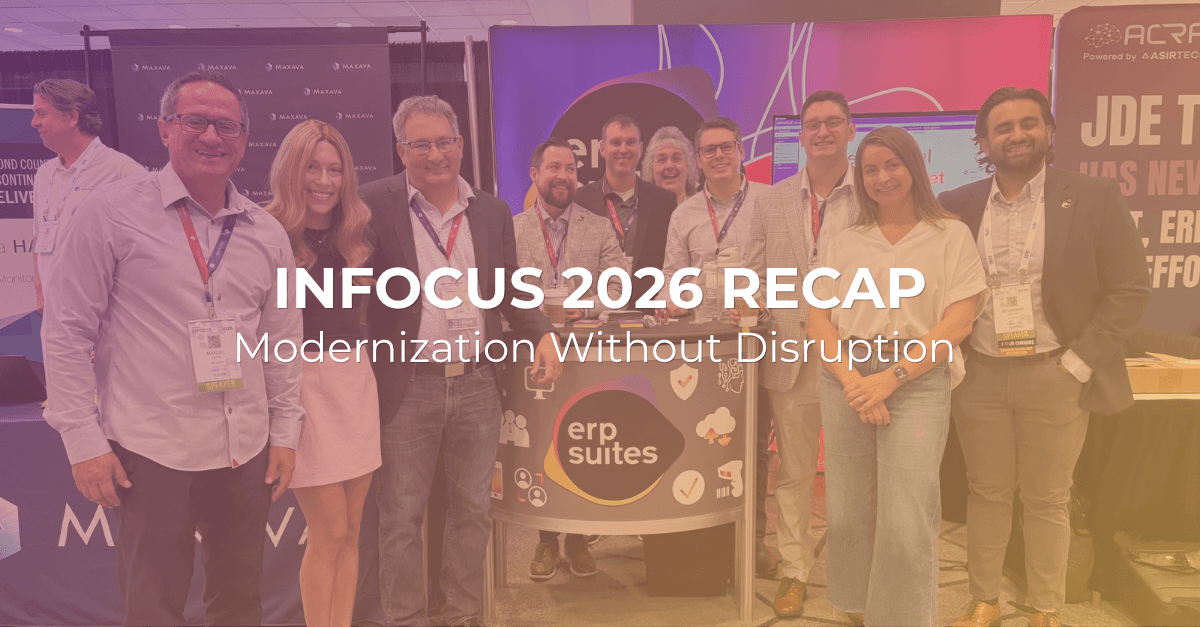
If there was one message that summed up INFOCUS 2026, it might have been: just keep moving forward.
Oracle opened the conference with a nod to Forrest Gump and the idea that JD Edwards has continued running for nearly 50 years. But behind the joke was a larger message for JD Edwards customers: moving forward does not have to mean replacing what already works.
The theme of the keynote was “modernization without disruption.” Oracle encouraged customers to keep their JD Edwards foundation stable while continuously adopting new capabilities, enabling their people, and finding opportunities to extend their workforce with technologies like AI.
That message was carried throughout INFOCUS 2026. From AI and MCP to Redwood, Java, 64-bit, and other platform updates, there was plenty for JD Edwards customers to pay attention to. There were also nearly 200 sessions, customer stories, product discussions, and conversations happening across the conference.
So, whether you attended INFOCUS or missed Denver this year, here are some of the biggest updates and takeaways worth knowing.
What Was Oracle’s Main Message at INFOCUS 2026?
Modernization has been a recurring conversation in the JD Edwards community, but INFOCUS put more emphasis on how organizations can modernize without unnecessarily disrupting their existing environments.
During the keynote, Oracle broke that idea into three parts: keep the core steady, enable your people, and extend the workforce.
The first part is about keeping JD Edwards stable while still making room for improvements. Customers don't have to overhaul their entire environment every time they want to take advantage of something new.
The second part focuses on the people using the system. New features and tools only provide value if employees understand how to use them and how they fit into their day-to-day work.
The third part brought AI into the conversation. Oracle discussed AI agents and a digital workforce to extend what employees can accomplish rather than simply replacing the people already doing the work.
Together, those ideas point toward a broader approach to JD Edwards modernization: organizations do not necessarily need to choose between keeping the environment they depend on and adopting newer technology. The two can happen together.
What JD Edwards Updates Did You Miss at INFOCUS 2026?
While modernization provided the overarching message, several individual technology updates stood out throughout the conference.
AI Is Becoming a Bigger Part of the JD Edwards Conversation
It would have been difficult to attend INFOCUS without hearing about AI.
AI was discussed in the keynote, dedicated sessions, vendor conversations, and demonstrations across the conference. However, the maturity of what was being presented varied.
Some sessions demonstrated working AI capabilities and real use cases, while others remained focused more on theory, possibilities, and what organizations could eventually build. That distinction is important. AI is becoming more tangible within the JD Edwards ecosystem, but not every AI conversation represents a production-ready solution today.
Oracle’s own framing also connected AI to a much larger modernization strategy. The keynote positioned a digital workforce as something organizations can begin exploring after establishing a stable core and enabling their existing workforce.
That makes the conversation less about adding AI simply because it is available to more about identifying where it can provide practical value within an existing business process.
Oracle Plans to Bring MCP to JD Edwards
One of the more notable AI-related updates was Oracle’s plan to introduce a Model Context Protocol (MCP) server for JD Edwards.
MCP can provide a standardized way for AI agents to interact with enterprise systems and tools. For JD Edwards customers, Oracle described the planned capability as a way to make JD Edwards more accessible to agent-driven workflows.
The keynote specifically connected the planned MCP capability to AIS and Server Manager and noted that organizations that have already invested in Orchestrator should be able to build upon that work as they explore AI agents.
This doesn’t mean AI suddenly becomes part of JD Edwards itself. Instead, it creates another way for external AI technologies and agents to work with the processes and information that already exist within the JD Edwards environment.
For organizations evaluating enterprise AI, that connection could become increasingly important as agents need secure, structured ways to interact with core business systems.
Redwood is Giving JD Edwards a New Look
Redwood continued to be another visible topic at INFOCUS, particularly as Oracle prepares for Release 27.
For users, the most noticeable change will be the updated appearance. Oracle discussed new fonts, colors, icons, and an overall refreshed user experience.
But one of the most important details is what isn’t changing.
Oracle emphasized that Redwood is not intended to fundamentally change the applications or the way users navigate JD Edwards. Existing applications remain the same underneath the updated experience, and Oracle said automated testing should continue to work because the changes do not extend to that deeper level.
The refreshed experience also brings JD Edwards closer visually to other Oracle applications, which could create a more consistent experience for organizations operating across multiple Oracle products.
In other words, Redwood is a visible example of the broader “modernization without disruption” message: change the experience without forcing customers to relearn the system underneath it.
Java is Taking a Significant Step Forward
Java was another important technology topic at INFOCUS 2026, particularly with changes coming in Release 27.
For customers moving to Release 27, Oracle announced the transition from Java 8 to Java 21, with plans to move toward Java 25 in the future. For those not yet moving to Release 27, Java 17 is also an important part of the transition to newer Java versions.
While these changes may not be as immediately visible as Redwood or AI, they are an important part of keeping the JD Edwards technology stack current.
Moving between Java versions also involves changes behind the scenes, so organizations should understand what their current release supports and what preparation may be needed before making the transition.
The takeaway is that Java modernization isn't limited to Release 27. Customers should evaluate their options based on their current JD Edwards environment and future upgrade plans.
Platform Planning Still Matters
Not every important conversation at INFOCUS was about AI or user experience.
Oracle also continued emphasizing the technology foundation required to keep JD Edwards current. That includes the ongoing move from 32-bit to 64-bit and changes across the supported platform stack.
During the keynote, Oracle reiterated that following Release 27, JD Edwards will move to 64-bit only at both the tools and application layers. Customers that remain on 32-bit environments were encouraged to begin planning their path forward.
WebLogic was another topic that came up in conversation during the conference. The extension of WebLogic 14.1.1 support through December 2027 remained a notable technology discussion for customers thinking about their upcoming infrastructure plans.
These updates may not generate the same attention as AI, but they reinforce another part of Oracle’s INFOCUS message: modernization depends on maintaining a technology foundation that can support what comes next.
What Were the Sessions Like at INFOCUS 2026?
INFOCUS is different from a conference built primarily around major product announcements. Much of its value comes from seeing how other JD Edwards organizations are actually using the technology.
With 214 sessions across three days, the challenge wasn't finding something worth attending. It was deciding what to attend. Sessions covered everything from system administration and financial management to manufacturing, security, reporting, and modernization. Many focused on practical challenges, with customers sharing their experiences, lessons learned, and approaches to improving their JD Edwards environments.
AI was one of the biggest themes of the conference, appearing in nearly a third of the session descriptions. But the conversation wasn't limited to what's possible in the future. Many sessions explored how organizations could use existing tools, particularly JD Edwards Orchestrator, to introduce AI and automation into everyday business processes.
With so many topics to choose from, overlapping sessions were inevitable. At one point, 21 sessions were happening simultaneously, making it helpful for organizations to send multiple attendees and divide up the schedule.
Despite the extensive program, attendance in individual sessions appeared relatively light. Based on observations from the conference, many sessions averaged around 15–20 attendees, with some drawing as few as one person.
Still, INFOCUS provided opportunities to hear directly from other JD Edwards users, ask questions, and learn how organizations are approaching similar challenges. That exchange of practical experience remains an important part of what makes the conference valuable.
What Was Happening Beyond the Sessions?
Some of the most useful conversations at a conference don’t necessarily happen inside a scheduled session.
The exhibitor floor gave attendees an opportunity to see technology in action, compare approaches, ask questions, and talk directly with other people working in the JD Edwards ecosystem.
AI was especially visible in those conversations. But one takeaway from the show floor was that there isn’t a single way organizations are approaching it. Different vendors demonstrated different platforms, architectures, and levels of maturity, reinforcing how quickly the enterprise AI landscape around JD Edwards is still developing.
The same was true during private AI demonstrations. ERP Suites hosted scheduled, one-on-one meetings with customers in a dedicated conference room, giving them an opportunity to see AI use cases in action and discuss how those capabilities could apply to their own businesses. Those conversations often moved quickly from what AI could do to a more specific question: How would this work for our business?
That is an important distinction. Even when two organizations want to automate a similar process, their requirements, data, approvals, exceptions, and existing workflows can be different.
INFOCUS also provided plenty of opportunities to connect outside the educational agenda, from customer dinners and informal conversations to community events and after-parties. Those interactions remain an important part of the conference because they give JD Edwards users, partners, and Oracle an opportunity to compare experiences outside the structure of a formal presentation.
Final Thoughts
INFOCUS 2026 covered a lot of ground, and not every update will have the same urgency for every JD Edwards customer. The biggest takeaway was that JD Edwards continues to move forward. Through changes coming with Release 27, new ways to connect AI, or continued investments in automation and the underlying technology.
ERP Suites was there throughout the week, presenting sessions, meeting with customers, demonstrating AI agents, and connecting with the broader JD Edwards community. Those conversations gave our team the opportunity to hear firsthand what customers are working through today and what they are beginning to plan for next.

As these changes continue to develop, the important thing is understanding what they mean for your specific JD Edwards environment and deciding where it makes sense to move forward.
Topics:








.png?width=650&height=325&name=Blog%20Images%202_1%20(4).png)
.png?width=650&height=325&name=Blog%20Images%202_1%20(5).png)
.png?width=650&height=325&name=Blog%20Images%202_1%20(3).png)
.png?width=650&height=325&name=Blog%20Images%202_1%20(2).png)
.png?width=650&height=325&name=Blog%20Images%202_1%20(1).png)
.png?width=960&height=540&name=Blog%20Images%20(96).png)
.png?width=960&height=540&name=Blog%20Images%20(90).png)
.png?width=960&height=540&name=Blog%20Images%20(88).png)
.png?width=960&height=540&name=Blog%20Images%20(87).png)
.png?width=960&height=540&name=Blog%20Images%20(86).png)
.png?width=960&height=540&name=Blog%20Images%20(85).png)
