

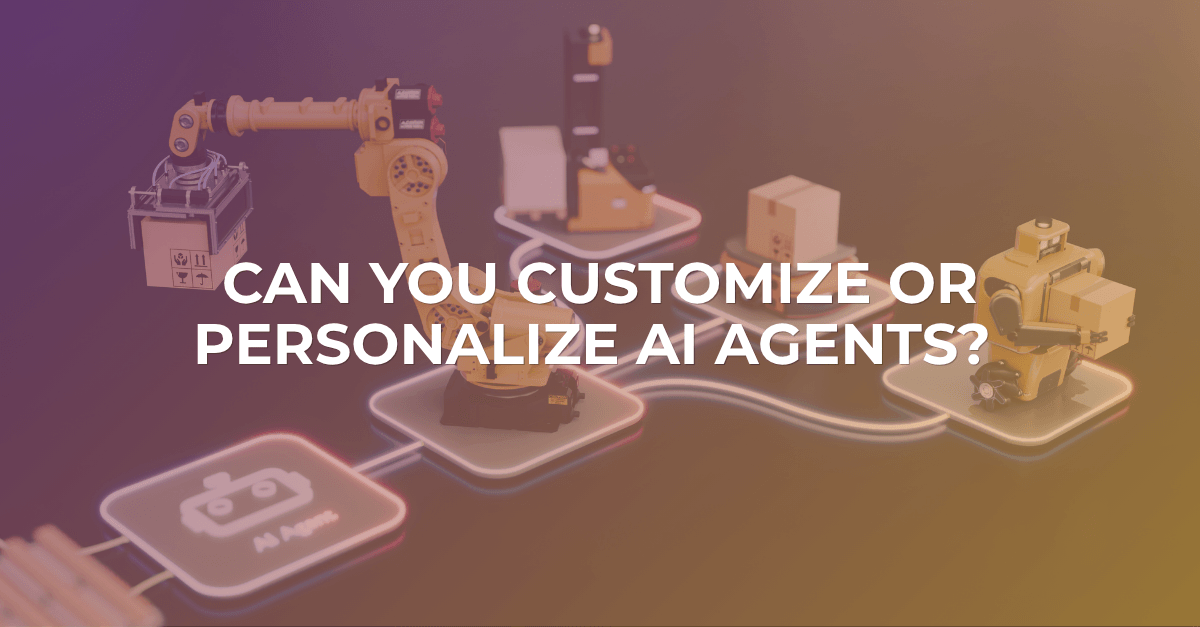
Yes—AI agents can be customized and personalized. In fact, they need to be.
One of the biggest misconceptions about enterprise AI is that it works like traditional software: you install it, configure a few settings, and it's ready to go. AI doesn't work that way.
Whether you start with a prebuilt AI agent or develop one for a specific use case, the agent must be tailored to your organization before it can deliver meaningful value. It needs to understand your systems, your data, your workflows, your business rules, and the goals you're trying to achieve.
It also needs to provide different experiences for different users, ensuring employees only receive the information and functionality that's relevant to their role.
In this article, we'll explain the difference between customization and personalization, why every AI deployment is unique, and how organizations transform a generic AI agent into one that truly understands their business.
Customization vs. Personalization: What's the Difference?
Although the terms are often used interchangeably, they describe two different parts of building an enterprise AI solution.
Customization determines what an AI agent can do. It includes the systems it connects to, the knowledge it can access, the workflows it supports, and the business rules it follows.
Personalization determines how the AI works for each individual user. It adapts responses based on a person's role, permissions, preferences, and responsibilities, allowing the same AI agent to deliver different experiences across the organization.
The best AI solutions combine both. They're customized for the organization and personalized for the people using them.
What Can Be Customized in an AI Agent?
Enterprise AI agents can be configured in many ways, including:
- Connecting business systems such as ERP, CRM, warehouse management systems, document management platforms, and other enterprise applications.
- Learning company documentation, policies, and procedures.
- Supporting workflows like accounts payable, sales orders, inventory allocation, customer service, and approvals.
- Following existing security models and user permissions.
- Applying business rules that determine when actions can be completed automatically and when human approval is required.
- Presenting customized dashboards and user experiences.
The purpose of customization isn't to make the AI unique for the sake of being different. It's to ensure the AI works naturally within your existing technology and operational processes.
There Is No True "Off-the-Shelf" AI
Many organizations assume they have two options when implementing AI: purchase an off-the-shelf solution or build a completely custom application.
The reality is much different.
Most enterprise AI agents begin with a proven framework designed to solve a common business problem. For example, an accounts payable agent already understands the general AP process.
But that's only the starting point.
Before that agent can deliver real business value, it must learn how your organization operates. It needs to understand your accounting structure, approval hierarchy, security model, business rules, vendor data, document sources, and operational objectives. These organization-wide configurations customize the AI for your business before it's ever personalized for individual users.
That's why there really is no such thing as "off-the-shelf" AI. Even when two organizations deploy the same accounts payable agent, the finished solution won't be identical because each business has different systems, processes, and objectives.
At ERP Suites, we have a growing library of enterprise AI agents that provide a proven starting point. Rather than beginning every implementation from scratch, organizations can start with established AI frameworks, customize them for their business, and personalize the experience for the employees who use them.
What Does Personalization Actually Look Like?
Personalization isn't about changing what the AI can do—it's about changing how it interacts with each user.
Imagine three employees using the same accounts payable AI agent: an accounts payable clerk, an accounting manager, and a CFO.
Although they're working with the same AI, each person has different responsibilities, permissions, and objectives.
The accounts payable clerk may use the AI to process invoices, identify missing information, or review exceptions before entering transactions into the ERP system.
The accounting manager may ask the AI to identify invoices awaiting approval, monitor processing bottlenecks, or prioritize work for the team.
The CFO may be more interested in cash flow, outstanding liabilities, payment trends, or high-level financial insights that support strategic decision-making.
The AI's capabilities remain the same, but the experience changes based on the user's role. It presents relevant information, respects existing security permissions, and helps each employee accomplish the tasks that matter most to them.
That's what personalization looks like in practice.
Why Personalization Matters
Without personalization, every employee receives the same experience, regardless of their role or responsibilities.
Once an AI agent is personalized, it presents the right information to the right people at the right time. An accounts payable clerk, accounting manager, and CFO can all interact with the same AI, yet each receives responses, recommendations, and actions that are relevant to their responsibilities and security permissions.
This makes AI more intuitive, improves productivity, and helps employees focus on the information that matters most to them.
The value of AI isn't simply that it's intelligent. It's that it understands your business and adapts to your people.
Common Misconceptions About AI Agents
One common misconception is that AI agents either work immediately or require months of custom development.
Most organizations start with a proven AI framework, customize it for their business, and then personalize the experience for their users.
Another misconception is that personalization means the AI automatically learns everything on its own. While AI can improve over time, organizations still need to define objectives, business rules, governance policies, and security requirements.
Finally, personalization isn't a one-time activity. As your business evolves, AI agents should evolve alongside it, incorporating new processes, integrations, and business priorities.

Final Thoughts
Organizations shouldn't ask whether AI agents can be personalized—they should ask how quickly an AI agent can begin understanding their business.
That's where the real value comes from.
As enterprise AI continues to mature, organizations won't be choosing between standard software and completely custom AI. They'll increasingly begin with proven AI frameworks, customize them for their business, and personalize the experience for their users.
That's the approach ERP Suites is taking with Enterprise AI—combining reusable AI frameworks with the flexibility to customize them for each organization and personalize the experience for every user. The result is AI that delivers value faster while adapting to the unique needs of the business and the people who rely on it.


.png?width=960&height=540&name=Blog%20Images%20(90).png)
.png?width=960&height=540&name=Blog%20Images%20(86).png)
.png?width=960&height=540&name=Blog%20Images%20(80).png)
.png?width=960&height=540&name=Blog%20Images%20(71).png)
.png?width=960&height=540&name=Blog%20Images%20(61).png)
