

How to Build a Business Case for JD Edwards Modernization
June 25th, 2026
4 min read
If your company runs Oracle JD Edwards, chances are the system has been in place for years—maybe even decades. And for many organizations, that's not necessarily a bad thing. JD Edwards has earned its reputation as a reliable, flexible ERP platform that supports critical business operations.
The challenge is that many organizations still view modernization as an IT project when it's really a business initiative.
Companies don't modernize JD Edwards because they want newer technology. They modernize because they want to reduce inefficiencies, improve employee productivity, gain better visibility into operations, strengthen security, and create systems that support future growth.
Building a strong business case starts by connecting ERP improvements directly to measurable business outcomes.
What Does JD Edwards Modernization Actually Mean?
One of the biggest misconceptions about modernization is that it means replacing JD Edwards entirely.
Modernization typically means improving your existing JD Edwards environment, so it better supports how your business operates today.
That may include:
- Upgrading tools releases
- Moving infrastructure to the cloud
- Improving integrations
- Automating workflows
- Enhancing reporting and analytics
- Strengthening security
- Implementing orchestrations
- Improving user experiences through dashboards, widgets, and modern interfaces
- Implementing AI Agents
Modernization is not about changing systems for the sake of change. It's about making JD Edwards easier to use, easier to maintain, and better aligned with business objectives.
Many organizations still rely on spreadsheets, manual approvals, duplicate data entry, and disconnected processes because their ERP environment has not evolved alongside the business.
Modernization helps eliminate those inefficiencies through automation, improved visibility, and streamlined workflows.
The goal is not simply keeping technology current.
The goal is to improve business performance.
Why Upgrades Alone Don't Deliver ROI
One question business leader frequently ask is:
"If we're already upgrading JD Edwards, aren't we already modernizing?"
Not necessarily.
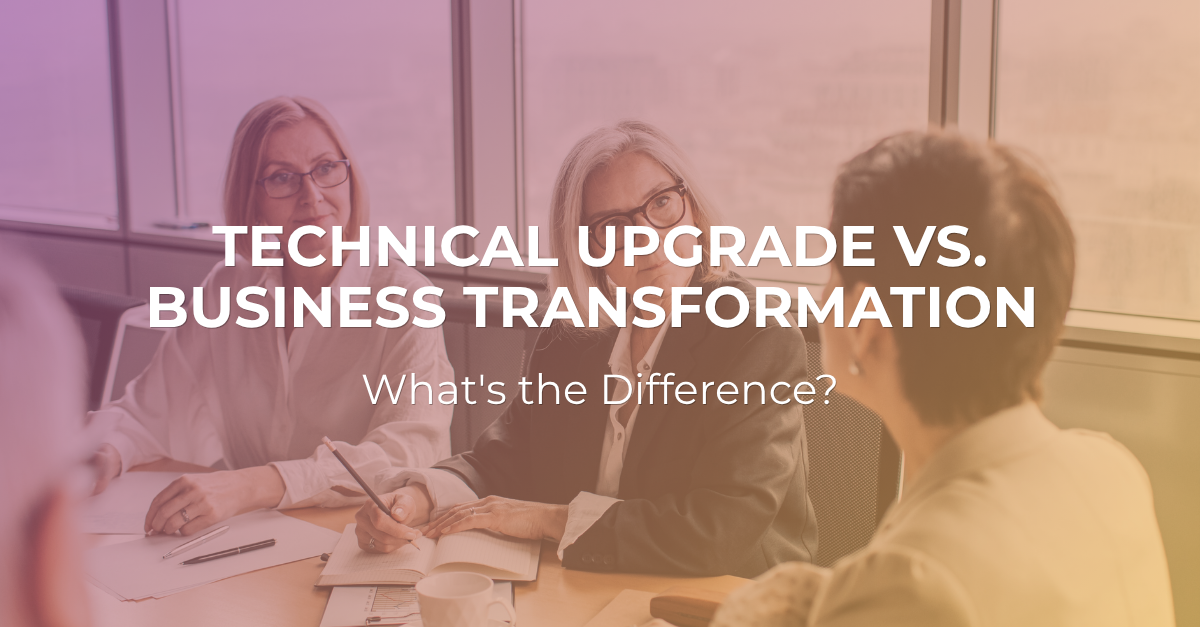
A technical upgrade and a modernization initiative are two very different things.
A technical upgrade keeps your environment current. It may improve security, maintain supportability, and provide access to new platform capabilities.
Those outcomes matter. But they don't automatically improve how employees perform their jobs.
Many organizations approach upgrades as "lift-and-shift" projects. They move from one release to another with minimal changes to business processes. The result is a technically current system that operates much the same way it did before.
That's why many upgrades fail to generate meaningful ROI.
Real ROI comes from using the upgrade as an opportunity to improve how the business operates.
That may include:
- Automating manual tasks
- Streamlining approvals
- Improving reporting visibility
- Reducing clicks and screen navigation
- Eliminating duplicate data entry
- Simplifying supplier onboarding
- Accelerating invoice processing
The upgrade creates the opportunity.
Business improvements create value.
Organizations that see the greatest return don't treat upgrades as maintenance projects. They treat them as opportunities to solve business problems.
The Real Business Impact of an Outdated ERP Environment
ERP modernization affects far more than IT.
In finance departments, outdated processes often slow month-end close, reporting, forecasting, and decision-making. Employees spend valuable time gathering information instead of analyzing it.
In operations and manufacturing, disconnected processes can create inventory inaccuracies, communication delays, and production inefficiencies. Teams often rely on spreadsheets and manual workarounds because systems are not integrated well enough to support real-time collaboration.
IT teams face challenges as well. Older environments have become increasingly difficult to maintain, secure, and support. Internal resources spend more time maintaining legacy systems than helping the business innovate.
The result is an organization that works harder than it needs to.
Modernization addresses these challenges by improving how people work every day.
How to Build a Strong Modernization Business Case
Many organizations make the mistake of trying to build a business case around modernization itself.
That's often where projects lose momentum.
Modernization is not a business case.
The business case comes from improving specific business processes.
A Simple Framework for Building a Modernization Business Case
When evaluating modernization opportunities, ask three questions:
- What process needs improvement?
- Who owns that process?
- What metrics are we trying to improve?
For example:
- Reducing invoice processing time
- Accelerating supplier onboarding
- Improving purchasing workflows
- Eliminating duplicate data entry
- Streamlining approvals
- Improving inventory visibility
A modernization initiative tied to a measurable business outcome is much easier to justify than one focused solely on technology.
Instead of saying:
"We want to modernize JD Edwards."
The conversation becomes:
"We want to reduce invoice processing time by 40%."
That's a business case leadership can support.
Once pain points are identified, organizations can begin quantifying the cost of inefficiency through labor hours, delayed reporting, excessive approvals, downtime, support costs, inventory inaccuracies, and compliance risks.
The more clearly you can connect modernization efforts to measurable business outcomes, the easier it becomes to justify the investment.
Why Employee Experience Matters
One of the most overlooked benefits of modernization is its impact on employees.
When ERP systems become difficult to navigate, users naturally create workarounds. They rely on spreadsheets, emails, duplicate data entry, and disconnected tools to complete daily tasks.
These workarounds increase errors, reduce visibility, and create inefficiencies across the organization.
Modernization helps simplify workflows and improve usability so employees can work more efficiently inside JD Edwards itself.
Capabilities such as:
- Orchestrations
- Widgets
- Dashboards
- Workflow automation
- Embedded reporting
- Improved integrations
- Higher employee satisfaction
- Reduced overtime
- Better customer experiences
- Lower turnover
- Greater organizational agility
can dramatically reduce repetitive work while improving visibility and productivity.
In many organizations, employees are forced to navigate multiple screens to complete a single task.
Modernization can eliminate unnecessary steps, reduce clicks, and simplify daily work.
The benefits go beyond productivity.
When employees spend less time on repetitive administrative work and more time on meaningful responsibilities, organizations often see:
ERP success is not just about system performance.
It's about helping people do their jobs more effectively.
What Successful JD Edwards Modernization Looks Like
The strongest modernization initiatives are not driven by technology alone.
They are driven by business outcomes.
Organizations that modernize successfully focus on improving processes, empowering employees, and solving operational challenges. They involve both business stakeholders and IT teams, identify measurable goals, and use modernization as a catalyst for broader organizational improvement.
The strongest business cases focus on outcomes such as:
- Faster reporting
- Reduced manual work
- Better visibility
- Greater productivity
- Improved employee satisfaction
- Lower operational costs
- Systems that can scale with the business
ERP Suites helps organizations evaluate their JD Edwards environments, identify modernization opportunities, and build practical strategies that align technology investments with business goals.
From managed services and cloud guidance to workflow optimization, automation, and long-term ERP support, ERP Suites helps organizations modernize JD Edwards in a way that benefits both IT teams and the people who use the system every day.
Kevin Van Horn brings more than 35 years of JD Edwards experience spanning implementation, product development, industry solutions, presales leadership, and enterprise transformation. Since joining ERP Suites, Kevin has focused on helping organizations leverage emerging technologies, including artificial intelligence, to maximize the value of their JD Edwards investments and drive business innovation. Kevin's JD Edwards journey began in 1991 as a customer, where he led the selection and implementation of JD Edwards software for Wheelabrator Technologies. Serving as project manager, he implemented Financial Management, Project Management, and Enterprise Asset Management (EAM) solutions, gaining firsthand experience with the operational challenges and opportunities organizations face when adopting enterprise software. In 1994, Kevin joined JD Edwards as an implementation consultant and played a key role in developing the JD Edwards Homebuilder solution (System 44H). He worked with numerous homebuilding organizations to implement industry-specific ERP solutions and later expanded his expertise into construction, homebuilding, and facilities management. Following Oracle's acquisition of JD Edwards, Kevin advanced into presales leadership, helping organizations evaluate, design, and optimize ERP strategies while remaining a trusted advisor within the JD Edwards ecosystem for nearly two decades. Kevin holds an MBA and a Master of Science in Organizational Leadership, combining deep technical expertise with a strong foundation in business strategy, leadership, and organizational development. His unique blend of industry knowledge and enterprise software experience allows him to bridge the gap between business objectives and technology solutions. Outside of work, Kevin enjoys spending time on the beaches of Cape Cod, and is a proud dad of his son, Jack.


.png?width=960&height=540&name=Blog%20Images%20(90).png)
.png?width=960&height=540&name=Blog%20Images%20(86).png)
.png?width=960&height=540&name=Blog%20Images%20(80).png)
.png?width=960&height=540&name=Blog%20Images%20(71).png)
.png?width=960&height=540&name=Blog%20Images%20(61).png)
