
JDE vs EPM vs Excel: Where Should Finance Teams Actually Work?
September 8th, 2026
14 min read
By Mike Piloto
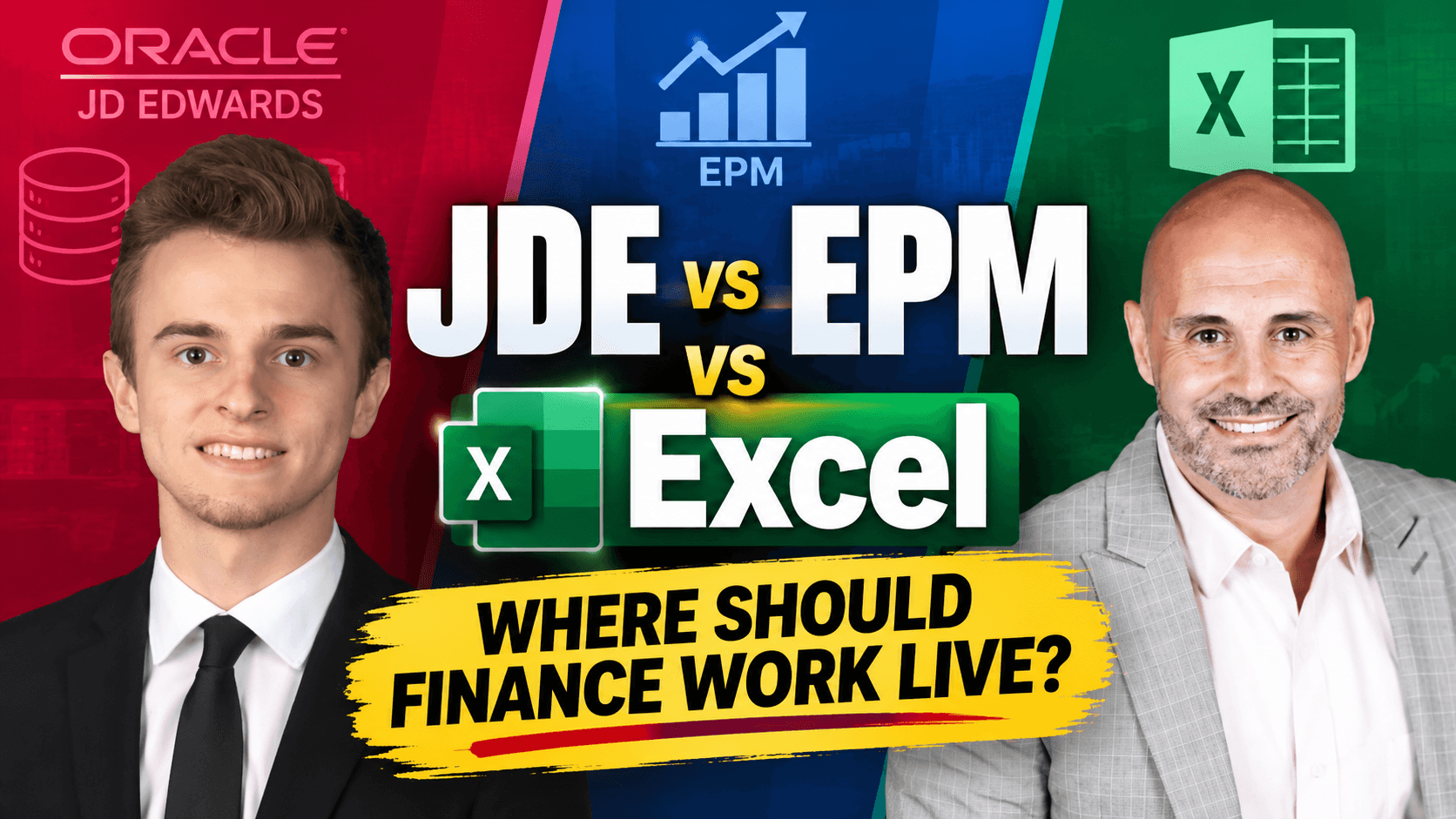
Where should finance work actually happen — in JD Edwards, EPM, or Excel? In this episode of Not Your Grandpa’s JD Edwards, we break down the role each tool should play across finance. Learn where JD Edwards works best as the transactional system of record, when EPM becomes a better fit for planning, forecasting, consolidation, and performance management, and where Excel still belongs without becoming the backbone of critical finance processes.
Table of Contents
- JD Edwards’ Role in Finance
- When Finance Work Moves Beyond ERP
- What Belongs in EPM
- Where Excel Still Fits and Where It Becomes Risky
- Choosing Between JD Edwards, EPM, and Excel
- When Complexity and Governance Change the Equation
- Finance and IT: Who Owns What?
- Getting Started & Final Takeaways
JD Edwards’ Role in Finance
Introduction: Why AI Agent ROI Matters in JD EdwardsAre your finance teams asking JD Edwards to more than it was really designed to do? Are you relying on Excel custom reports, manual workarounds to manage planning, forecasting, consolidation or executive reporting? In this episode, we're breaking down a question. A lot of finance and it leaders eventually face. Where should finance work actually happen? Is it in JD, EPM or in Excel?
We'll talk about what belongs in each system and where companies create unnecessary clothes and reporting pain, and how to recognize when finance has outgrown ERP base reporting. Allow.
Welcome back to Not Your Grandpa is JD Edwards, the podcast for JD Edwards customers who are modernizing, optimizing, and rethinking what is possible with our ERP environment. Today's topic is a comparison episode, but it's not about replacing JD Edwards. It's about understanding the right role for JD, EPM and excel in the finance function. JD Edwards is extremely strong as a transactional and operational system of record, but finance teams often start using it or Excel connected to it for planning, forecasting, consolidations, scenario modeling and management reporting.
At some point, they can create more manual work for reconciliation and more closed cycle pressure than it solves. So today we're asking when should finance stop forcing ERP to do EPM show? Mike Bilodeau, welcome back to the show. But before we get into comparison, can you, give us a little bit of your background work with finance teams and EPM?
Yeah, absolutely. And, Nate, thank you for having me again. You know, looking forward to this conversation. My vice president of our EPM and analytics practice. So bring 20 plus years in really helping organizations do their financial and digital transformation. And, you know, this topic I think will resonate with a lot of CFOs as well as CIOs, because, again, it's a joint partnership that has to get to what the business processes need to be versus what the system of choice will be.
Yeah. So let's start off with one of the main questions that I'm sure a lot of people are having. What is JD Edwards really built to do well for finance teams out there? Yeah. No, I would say I worked with JD Edwards for many of years, and I will always tell finance leaders that JD Roberts is exceptionally good at what it's designed to do.
It is a world class ERP that manages the day to day financial operations of the business. It's transactional versus being looking towards strategic. Yeah, exactly. Like it's not the end all be all. You should utilize this for every single step of your finance. Idea. It's more of that operational side. It's more of the front facing in some capacity that I will say.
But when finance leaders called JD the Oracle source of truth, what should that actually mean? Great question Nate, because everyone uses the source of truth. The source of truth in this situation means everyone that trusts the data that's coming from the ERP. And again, that's more transactional, you know, in the sense of managing your daily, you know, day to day operations versus, again, there's other products out there that are meant to be, you know, look towards you know what what if scenarios I should say.
So like what types of financial activities should naturally like stay in JD Edwards. Anything that's transactional driven balancing data. That's your general ledger accounting accounts payable and receivables. You know, again, it's the operating accounting that keeps the business running. That's what should reside in your ERP. Yep. So where does the JD reporting usually work? Well, without needing a separate EPM process?
Great question. And on for operation reporting JD is a great job. And what I mean by that is, you know, someone's asking what did cash look like last month? It's a historical kind of data. When you start to ask questions along the lines of what if our sales dropped 10%, then that is not transactional anymore. That needs to reside in your EPM products.
When Finance Work Moves Beyond ERP
Yeah. So where would you say companies sometimes start pushing JD Edwards beyond its natural role of being that operational side? Now again, this is where you start to see spreadsheets multiply. Again, it's when people in the CFO organization is actually looking at asking the questions of if we acquire a company in five months from now, if we can, we forecast cash over the next 18 months.
Those questions are no longer transactional. And now it's going to need either, you know, pushing processes that should not be in the ERP reporting platform or then using complex Excel, macros. Yeah. So that gives us, helpful, helpful foundation. JD should absolutely remain the system of record for the operational side. But not every finance process is truly transactional.
What seems start moving into the planning, into the forecasting and consolidation, even the performance reporting. The question really becomes, is this still ERP work or is this where EPM should really take over? So like what? What would you say? What work should belong in EPM? So I always usually tell clients, ask one question. Are you recording what already happened or are you trying to understand what's going to happen next?
So those are the real differentiators. Again, where do you look from a reporting aspect to NRP versus where you then leverage the EPM tools that really govern around those what if scenarios? Yeah, and I like that you said the different EPM tools. What is designed in an EPM platform that ERP systems typically can't do. You know, again, EPM, which stands for Enterprise Performance Management, is the specifically designed for the Office of Finance, the CFO organization.
What Belongs in EPM
It purposely isn't to record transaction. You're looking to budget forecasts. What if scenarios the financial consolidations tax provisioning accounts reconciliation. That's what really resides in the CFO organization. This business processing, which is very different from transactional processing. Yeah. So I guess my question there is why can't ERP systems do this? Like why are planning, forecasting and scenario modeling often better suited for EPM instead of an ERP?
When you look at it, planning is really a straight line process. Excuse me? Finance is constantly asking questions like what if revenue grows 15%? What if tariffs increased our cost? What if we delay hiring? That becomes very complex to point into your ERP modeling. Again, the EPM is solely designed for those kind of question. It's being more strategic versus transactional.
So yeah I like how you said that because yes, like ERP can kind of track this data and where the money moves in when it moves. But you're right, it's a step further. It goes into that scenario building of what if this happens? What if this happens? How can we counteract it if it's negative or what can we do?
Because in this more revenue is coming in. Or what if we make this one change? Really like how you said that there. So why would you say consolidations in financial reporting are often that natural fit for EPM? Again, you know, as organizations grow, financial reporting becomes much more complex. So as an example, if you're in multiple currency, companies, you're using multiple currencies.
You have to do FX translations. Of course, you can do it in the euro, but it's not really meant for that. There's out of the box, you know, can't stuff that exactly is meant for these kind of. And the consolidations when you pull it's taking the trusted transactional data. But then now you're letting the EPM tool itself do its job of having the consolidation rules.
It built in, the translation rules, it built in the intercompany transaction eliminations that all resides in the EPM, which is a natural fit as that's what the products meant today. Now, would you say that's the reason that it helps finance teams move beyond the static reporting? Or is there maybe more levels to that? No, that is probably the most reason because again, static reports tell you what happened.
EPM helps you understand. You know what it means and what you should do next to remediate those issues or concerns. Or if you have growth pants, why do you want to do. Is it opening another facility? Those are what are driven based kind of scenarios that naturally reside in the EPM tool. You know, I like how we can kind of split that up.
And like ERP is what's happening now. EPM is what could happen in the future. So obviously set in stone. Things can happen, fires can arise, or maybe some great things can I? I like how you separate that because that really does put these in their specific boxes. Obviously there are some there's probably some gray areas here and there, and maybe your ERP is built to a certain degree, but EPM can really take it even further than any ERP is probably built to do at this point at least.
So how should companies really think about EPM as an extension of GE rather than a replacement for it? Yeah, no, I think this is the one of the biggest misconceptions. And what I mean by that, you know, the EPM doesn't replace JD Edwards or any ERP. It makes Jeanie Edwards and the ERP even more valuable. It you know, continues to you know your JD is continue to do what it does best managing transactions.
Now you're taking your Oracle. Those manage transactions and putting it into an EPM governed product that is now going to help you again become more strategic versus transactional I went there.
Where Excel Still Fits and Where It Becomes Risky
So now that we have JD as the transactional source of truth and EPM as the place for planning and forecasting, consolidation and performance management, now it's time to talk about that third tool in this conversation.
The finance teams are probably never going to fully give up, and that is Excel. The real question is not whether Excel should exist. I know you and I have our opinions about that, but where it is should still help and where it is creating the risk. So I guess my next question is where does Excel still fit in a healthy finance technology stack?
It I mean a healthy one. No, that is that is a great question. I know we always have these conversations. I always joke that Excel isn't going anywhere, and honestly, I don't think it should. Every financial professional knows Excel. When you look at the top tier EPM products, they have Excel add ins to it. So you can do the slicing and dicing and that's what it's really meant for.
You know, the problem where I see Excel getting, you know, in that, you know, kind of gray area is again is when finance is looking to ask those strategic questions and you're now building those processes into Excel macros, workbooks, etcetera, where it's not meant to reside with what it does. Is it also, you know, from an audit perspective, it has minimal people that understand that Excel workbook.
You're putting your company at risk because it's being managed in a non governance, system. Yeah. In cheese, if I see one more pivot table I'm probably going to pull out my hair. I think it's so when is Excel like actually helpful as a flexible analysis or even a modeling tool? Because obviously we've been talking about EPM, talking about like more of analysis and modeling and looking for the future.
When could you potentially still utilize Excel instead? Excel is fantastic for analysis. And again, you know, it could be off the ERP. It could be off of EPM. If I'm evaluating trends, building a quick financial model, creating ad hoc reports. This is where Excel is really meant to be. You're not leveraging it as your transactional, but it's not also your strategic.
What it does is it allows end users to build out quick models. And what I mean by that is, if you're looking to do an acquisition right, and it's not known yet, you can't just put that into the EPM. You can have, you know, through a side to close, maybe start to build that out. But Excel can help you say, okay, great.
What would this look like if we bring in this company, what would revenue, you know, look, from a year of the deal closing, that's where those little quick models can help you just in the diligence process. And as that does that deal does close. That's when it ships into the EPM, because that's how you start to really leverage what the company looks like through the acquisition.
And what the, you know, costs and benefits will, be from it. Yeah. So maybe let's flip the script. Where does Excel start becoming risky for some of these finance teams? It starts, becoming risky when people again are leveraging it for consolidations, budgeting and planning and forecasting and doing driven based modeling, where it really should come from the transactional data and then build in the models in an EPM.
Again, what I've seen in the past is why people are so hesitant to get rid of this is because it's been in the company since it probably started, because Excel is a powerful analysis tool, but it's not there for your consolidations, your budget and planning. And when you start to do that and build it in macros and build these kind of custom rules, that's where it becomes very dangerous.
Yeah. So what are maybe some of the signs that people are going too far with Excel. And it becomes that unofficial system of record or the single source of truth? That's a great question. Version control becomes difficult. Manual errors increase. Accountability is limited. Knowledge becomes concentrated within a few individuals that understand whatever the Excel workbook looks like.
And at this point, Excel is doing work that it really does not meant to be and governed from a financial platform.
All right. So let's maybe recap a little bit what finance work should probably not live in. Only Excel in more.
In today's environment, I don't think critical finance or process should rely solely on spreadsheets. And what I mean by that is annual budgeting, rolling forecast, financial consolidations, close management, board reporting. That has to go out. Those are just the top, you know, of what really is driven from an EPM that I do see some companies trying to manifest that in Excel, which then becomes very tedious.
It is a lot of manpower. And then again, the the true source of data is not trusted.
Choosing Between JD Edwards, EPM, and Excel
So that's a important distinction. Excel still has a role, but it should not quietly become the backbone of critical finance processes. I mean, at this point, we've talked about what JD, the JD does. Well, we talked about what EPM does well and where Excel still fits. So let's bring this all together into a practical decision framework for our finance teams and IT leaders, so that they can actually use it.
So how should finance and its leaders decide whether a process belongs in JD, NPM or in Excel? No it's it. This is where it all, like you said, wraps up. And I encourage leaders to start thinking about systems first and start thinking about the purpose of the process. Every finance activity has a job to do. Once you understand that job, the right technology usually becomes obvious.
If the goal is to capture and control transaction, that's the ERP. If the goal is to plan, forecast, consolidate, analyze business performance, that's EPM. If the goal is to perform quick analysis or answer an ad hoc question, Excel is often the right tool. The technology shouldn't support the process, not define it. Yeah, I really like that. I really like that.
So what would you say the first question that these leaders should ask when they are evaluating a finance process? So I would say, are we recording what happened or we helping decide what's next. And that goes back to what we discussed in the beginning. Because if financial is we're just recording the activity that drives the ERP, if we're talking about, you know, the what if scenarios, that's where the EPM is really shines and really gives the benefits to the CFO organization.
Yeah. So how could they tell the difference there, like whether a process is that transactional side or the analytical side or planning oriented or even the reporting oriented side? That's great. I like to break it into four categories. Transactional work is about recording the business. Things like journal entries, invoices, purchase orders. Planning is about future budget forecasts, what if scenarios.
We keep on talking about that workforce planning, capital planning. That's EPM. And then reporting is about communicating performance. If you're producing board packaging consolidation, financial statements, management dashboards or executive reports. Again, that's EPM analysis is different. That's where Excel still shines. You know, finance professionals need to be flexible to explore data, answer questions and test ideas quickly. So that's the four categories of how I line it up.
When Complexity and Governance Change the Equation
When we do have these conversations with both the CIO and the CFO organizations. Yeah. So when would you say like workflows, approvals or ability or even version control or really become deciding factors for this? So this is often where organizations realize they've outgrown spreadsheets. So I'm glad that you did ask this question on it. Multiple people are contributing to the process if they're approval steps, if external audit needs to review it.
If executive rely on the results, that's where you start to realize, you know, we kind of outgrew the Excel and we really need a governance EPM solution. Yeah. I mean, that's a great way to put it. But like, how should these leaders evaluate the processes that might involve the multiple entities or the currencies or scenarios or even forecasts?
Complexity changes everything. So as you just listed holds out that that's a very complex business model. So as soon as you introduce multiple legal entities, different currencies, acquisitions, ownerships of structures, rolling forecast, that's where Oracle EPM or the one streams the plan falls. They add and drive tremendous value to the business.
Finance and IT: Who Owns What?
So on this podcast we do talk about who should kind of decide this type of thing. If they are looking to open up the world of EPM and maybe switch where things are living. So what role should the finance own in this decision or what role should maybe the IT side? And you know, I always say this and my background since both on the finance and on it.
So you know, I always see the most success and I believe the best outcomes happen when finance and it work together. But they each bring different strengths. Finance should define the business process. They know how planning works, how forecasts are created. You know it should focus on the technology, security, integrations, data quality, performance, government and long term support.
Where finance owns the what and it owns the how. Organizations usually end up with solutions that are both effective and sustainable. Yeah, that's a great way to break it up because yeah, like your IT team will probably know a little bit more about data security than your finance team. And your finance team is going to know about the future, at least from, at least from a finance side, future of your company in terms of the capital.
Getting Started & Final Takeaways
So if you're talking to a company, right. And they're trying to make this first step towards EPM, what would be that first practical step to figure out where their data should live? Yeah. And I go with the methodology of crawl, walk, run, especially if you're new to it. You know, I recommend starting with a simple process inventory.
Don't they begin by asking, what software should we buy instead? Ask, how do we budget today? How do we forecast? How do we consolidate? You know, where is the most manual effort? And letting those answers help you drive to what the right solution and software will look like for your organizations? Yeah, and that's that's the true point of this conversation.
This is not about taking one tool and forcing everything into it. It's about helping finance and IT teams take that step back, look at how the work is actually getting done, and decide whether each process is happening in the right place. But if your finance team is relying on JD Edwards Excel customer reports and manual workarounds to meetings, planning, forecasting, consolidation or executive reporting, it may be time to take that step back and ask where that work should really happen.
ERP suite helps JD Edwards customers evaluate their finance processes, identify reporting and close cycle pain points, and determine what tools like EPM can support better planning, reporting and decision making. Visit ERP Swisscom today to connect with the ERP suites team and start that conversation of how to get more value from your JD Edwards environment. But that's a wrap on today's episode of Not Your Grandpa's JD Edwards The Big Takeaways.
This is not about JD Edwards versus EPM versus Excel in a winner take all sense. This is about using each tool for the work it is best suited to do. JD Edwards should remain the trusted, operational and financial source of truth. EPM can help finance managers or manage planning, forecasting, consolidation and performance recording. And I know, myself included, don't love Excel, but it still has a place.
But it should not quietly become the backbone of your clothes, your planning or your reporting process. Huge shout outs to new Mike. I know that we've been struggling with schedules to get you back on the podcast, but this was incredible. As always, it really helps even myself kind of understand where each of these should fit in terms of a business.
But if this episode was helpful, subscribe, leave a like and share it with someone like your finance IT or your leadership team. But till next time, keep modernizing, keep asking better questions. And remember this is not your grandpa's JD Edwards.
Topics: