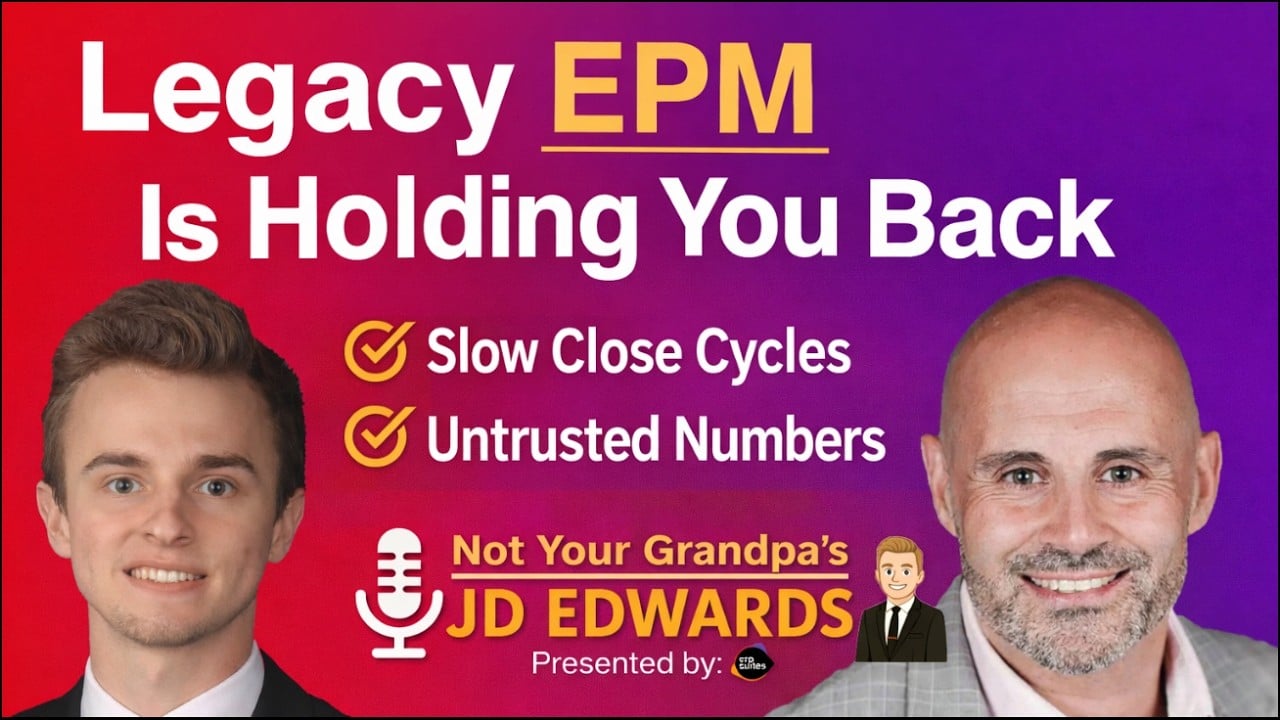
In this episode of Not Your Grandpa’s JD Edwards, we explore the hidden risks and rising costs of legacy EPM systems and why modern finance teams are moving to cloud-based platforms. Host Nate Bushfield sits down with Mike Piloto to break down how outdated tools like Hyperion slow close cycles, erode trust in financial data, and limit strategic decision-making. Together, they discuss what a successful EPM migration looks like, how to choose between platforms like Oracle EPM Cloud and OneStream, and why treating EPM as a long-term platform, not a one-time project, is critical for scalable growth, M&A readiness, and finance transformation.
Table of Contents
- Introduction
- Real Cost + Warning Signs of Legacy EPM
- Why Legacy Systems Are No Longer Strategic
- Migration Roadmap and Post-Go-Live Success
- Choosing the Right Platform and Oracle vs OneStream
Transcript
Introduction
Is your finance team still leaning on legacy EPM systems to close the books? What's the cost of maintaining outdated EPM tools when your business needs speed and accuracy? Today we're digging into the real risk of legacy EPM and how modern CF OS are migrating to cloud based systems that drive faster closes and cleaner numbers. Stick around. We'll break down the migration, pass key players like Oracle EPM and One Stream, and how ERP suites help enterprises get it done right.
Welcome to Not Your Grandpa's JD Edwards podcast, helping you unlock what's next for your ERP and EPM environments. I'm Nate Bushfield, and today we're tackling one of the biggest roadblocks to find his transformation, legacy systems like Hyperion. If you're a CFO or financial leader under pressure to accelerate close cycles, reduce Excel dependency or clean up post M and a complexity, this episode is for you. With me is Mike Piloto, leader of ERP Suites's new EPM services practice. Mike, welcome. And for the viewers out there that don't know you, can you share a little bit about your background and what led to launching this new EPM initiative?
Mike, welcome. And for the viewers out there that don't know you, can you share a little bit about your background and what led to launching this new EPM initiative? Absolutely. And, and thanks for having me. I'm extremely honored to be part of today's podcast on my Plotto, you know, Vice President at ERP Suites, where I'm going to be leading the EPM and analytics practice. I bring 20 years in consulting where I had leadership roles at PwC, Accenture, IBM, and Navisite, where I was delivering for, you know, complex solutions for the IT and finance organizations. And I'm extremely, you know, excited to be on this journey with the RP suites because my passion really lies with empowering CFOs to really trust their data, give them, you know, insights that are going to be, you know, you leveraged to make critical strategic decisions on leveraging the top tier EPM solutions that are out there.
Yeah. And when you say top tier EPM solutions, could you maybe name a few of those just so our audience knows what we're talking about throughout this episode? Yeah, 100%. You know, the top ones that or you're going to hear across the board is going to be, you know, one stream Oracles EPM, there's a legacy system called Hyperion. You have your ETA plans, you have your plan falls. So we have a lot that we can offer because we're an agnostic organization that once again best fit what's for the business needs versus a software that's going to drive those decisions. Yeah, exactly. So you, you mentioned IPA in there legacy system. That's something that you hear across the board when we're talking about JD Edwards or if we're talking about EPM systems and the different sides of that.
Real Cost and Warning Signs of Legacy EPM
But what's the real cost of staying on an EPM legacy system now? Great question. The real cost isn't in the licensing or the maintenance where everyone would think. It's the hidden operation tasks that the business pays every month. And what I mean by that is, you know, the manual efforts on the finance organization really worrying about getting the data into the systems versus analyzing them. So legacy EP Ms., you know, solutions, you know, are slow decision making, create manual, you know, workarounds. And in the end it actually erodes the confidence in the data as well as, you know, the numbers to the leadership teams, right? So you talk about the numbers, they're like they can't be trusted. What are maybe some signs that these CF OS or maybe even a VFPF finance should watch for that indicate that these numbers can't be trusted? You know, the, the, the big red flag is, you know, when the same question is being answered differently by different people as well as referencing different spreadsheets. You know, when ACFO and you're meeting with leadership, they have to come into the meeting and start off and say, are the numbers final? You know, those are definitely red flags that are just, you know, saying to the organization that it's not taking us where we need to be. We're we're questioning. And when we start to question our own ability to trust the data, the business is already evolved at that point, right? And how do issues maybe like long close cycles, manual reconciliations and maybe even lack of trust in the numbers, how do those truly show up? I know you mentioned that maybe they walk in every day and say, are these numbers trustworthy or are they correct? But is there maybe a different way that you would see that in the day-to-day conversation? Yeah, No, it shows up as friction everywhere. And what I mean by that it's, you know, when you're, when you're expected to close the books in three to five days, but it's taking 8 to 12, you know, puts pressure on not only the leadership, but on the people and the resources that are actually doing the work. And again, it takes away from, you know, being analyzing the data versus, you know, worrying about is the data in and etcetera. So it, you know, these legacy EPM systems, don't get me wrong, they were great, you know, for what it was in the past, but the business and the world has changed. So the OP model, it does not fit these legacy systems anymore, right?
Why Legacy Systems Are No Longer Strategic
So let's dive in a little bit deeper on that. Why are these legacy systems no longer a strategic investment in how to maybe how do vendors signal that at this point? So the legacy systems, you know, especially if you're on an on Prem version, you know, these software providers are not investing any new functionality in that. So the big push is on to again these top tier that we mentioned as well as the cloud solutions out there. That's where all these software solution providers are investing. So even if you're able to get through a month and close, you're losing the capabilities of AI, you're losing the abilities of the system working for your organization versus your organization taking manual, you know, workarounds to get what these new newer systems are providing. And there are a lot of customers that are out there that are maybe they're stuck in their ways and they want to stay on these legacy systems.
What's the risk of delaying a move off these legacy systems? You know, delay compounds risk. And what I mean by that is, you know, we all know, you know, companies, the leadership, private equity owned companies, you know, they're looking for speed, transparency and confidence in the numbers. Legacy systems, you know, work against all three of those. So those are the three major ones that you know, again as the business and market shifts, we the systems and the business also has to abide by that.
So what benefits would a company see from an EPM migration? The most important is confidence and again, the confidence in the numbers, speed and decision making and finance ability to support growth. Those are the majors and as we listed out, you know, in the past conversation was, you know, shrinking close cycles, eliminating manual effort, reliability on Excel, you know, other members building out their own up model to support as a safety net because they don't trust what is currently being provided them because of these systems. Yeah. So you talked about the trust, like these legacy systems aren't really trustworthy.
Is that something that's been around since they came out or is it more of a because of the new stuff that is coming out, there's less of a trust in these older systems that aren't getting updated? Yeah, again, you know, these systems worked, you know, 10 plus years ago. But as you know, the new demand, as you know, market shifts and the business transforms, the system also has to follow and they haven't. And going dating back to these legacy systems, most of these software, you know, providers are not going to reinvest into the legacy systems they're looking on. How did they come up with the new systems, you know, the two dot O versions that are going to support not just the current business issues, but also three to five year plan out, right.
Migration Roadmap + Post-Go-Live Success
So if we're talking about a road map here that maybe some of these customers are actually thinking about making the switch and upgrading to the new systems and getting off the legacy systems. What would a road map look like from the assessment to a go live for companies moving in this way? Yeah, that's great. You know, here at ERP Suites, what we going to do is we're not going to focus first on technology. It's focused first on the business, understanding where they're currently business is, what their future growth model looks like, and then going about, you know, OK, let's then do the assessment, you know, their current state, pain points, then the visionaries piece of that of where they want to go. And there's some dependencies around that. Their current tech stack, talking about their ER PS, their cloud, their data, you know, strategies. We want to align with that because we don't want to over complex the situation by adding another, you know, spot of a system that's going to be a targeted system from these other, you know, ER, PS, etcetera.
And then we do the, you know, normal of a project methodology where you do the design, build, test data transformation and then as well as, you know, the go live and then the stabilization. Yeah. So the stabilization, that's something that ERP suites, at least the people that we've had on this podcast, they really do focus on. It's never the go live is not the goal, it's the six months after.
So how do you ensure the long term success post implementation? So that that's a great question. And long term success is treating the EPM as a platform and not a project. Project is OK, you go live and you're done as a platform you want to and again, if we're looking at companies that are doing a lot of M&A activity, we want to be able to scale. We want to build data models, dimensionalities that fit a model of being easy to integrate as well as carve out. So those are the kind of things that you know, we look at from an advisory as well as a managed services is again as finance doesn't stay still, neither should your EPM product as and what we want to do is give back to the internal resources where they could be more strategic, doing more strategic initiatives and focus on analyzing the data versus worrying about getting the data in. And that's where we come in to be an extension of their organization with a white glove approach to, you know, give them back those hours that they can concentrate on how to run their business, right?
So you're giving back the hours when we're talking about the managed services or is that maybe something a little bit deeper there? It is in the sense of more aligning them to strategic initiatives that their leadership or private equity may have for them if it's M&A activities, etcetera versus keeping the lights on, on the daily operations of running a EPM platform, right. So it's more focused, OK, So it's more focused on the business side trying to build up others or maybe like a partnership some would consider this, right, Correct. And the way we look at it, you know, when we hear partnerships, I'm big with, you know, especially in my past and I know this is how we support across ERP suites with other services that we offer. It's more of being a true extension to their organization. OK, interesting.
Choosing the Right Platform and Oracle vs OneStream
So how would you choose the right modern EPM platform? Yeah, great question. You know, again, we don't lead with the software driving. It's more of what the business needs and what makes the most sense for each specific client or prospect on what we do do is we can be lock step with you on that journey to really, you know, evaluate because we have all great relationships with the top tier service provider. I mean solution providers that you know, we will walk you through put a decision criteria to make the best decision for that specific business. Need to help you not just solve what your current reporting pain points are, but your growth model 3 to five year plan out right. And when we're talking about these people making this decision, what would be the correct way of thinking about, all right, maybe my company should move to Oracle EPM Cloud or maybe my company should move to 1 stream?
What's the difference there that a company should be thinking about in terms of best fits? So you know, both of those products are top tier. Great what they do provide, but they do have two different philosophies. And what I mean by that is Oracle is built on, if you already have a lot of Oracle ecos, you know, Oracle ecosystem in there. If you're using ER PS that JD Edwards or Oracle EBS, you know, leveraging their cloud solution OCI, it's easier to integrate. So it's a great product and it you know they will scale together as the ERP as their cloud as well as their EPM and reporting platforms. Now 1 stream again is just solely on providing EPM solutions. So they can connect into any ERP, any cloud solution. So it's more of a one off that attaches to any business need in that sense. But again, it's not about the products, they both are phenomenal products out in the marketplace. It's more again of analyzing what is best for your, you know, technology stack and what your future goals of your data strategy, your cloud strategy, as well as how your business is looking to evolve in the next three to five years, right?
So if someone's on JD Edwards now, maybe Oracle APM Cloud would make the most sense for them just because of the flexibility that you can have in terms of using that in your ecosystem. But maybe someone that's looking to shift their JD Edwards and maybe go to a different ERP planning system, then maybe they would choose A1 stream. And am I right in that?
Yeah, shorter, again, the one stream can tap in the two critical things as they're going. If I'm ACFO and ACIO, the things that I would be listening and really gearing in towards is integration. So again, there's a lot, you know, these top tiers will have direct connects into your top tier ERP systems. Again, it's easier on Oracle's platform if you're staying Oracle just because it's, you know, they integrate seamlessly, but the questions then become, you know, to ACFO or CIO.
And here's the decision criteria that we would put together would be meaning, you know, the integration points, do you want it native or do you want a custom, you know, that will cause data latency. So these are the kind of questions that we will bring to the table to again to ensure that again, we're not picking the wrong solution from a software perspective. We're figuring out what's the best fit moving forward on a business growth, you know, model.
So if we're talking about going custom versus maybe like again an easy native integration there would one be more expensive than the other to implement because it's custom versus native or would it be around the same?
It would be the same from a cost on an implementation perspective. But the where the challenge will be is again, their stand alone kind of solutions so that you know brings the risk of, you know, reconciliation issues again, resource of that specific whatever the custom integration is versus a native that comes right out-of-the-box.
And then as well as you know data latency. So those are the key areas, you know to look at when again, it's not on a similar full stack solution provided by that software provider, right.
So you bring up latency, but what's maybe a different benefit of having a single unified platform versus stitching together multiple tools?
So from a CFO perspective, it's one source of truth and that's big. So again, you don't have these point solutions where you're trying to solve and again, there's a products that you know, solution providers, our top tier versus having this unified approach.
When you have a unified approach, it's doing all the functionality that a CFO is looking for and that goes from, you know, consolidations from budgeting, planning, forecasting, tax provisioning, accounts reconciliation. When it's in one place, it is one source of truth and that gives, you know, a lot of ease as a, a ACFO is sitting there.
And again, as they're looking at the numbers, it's easier to trust with these, you know, pointed solutions. Again, you it's the data trust is integrations as manual intervention. As the world is evolving, especially with AI, they're looking to minimize this stuff.
So that's why if you can't get that unified approach, that's the best, you know, moving forward for the majority of the businesses of that are out there.
So it's interesting you bring up AI because if you do have AI that is consistently looking through your data and making sure that there aren't any red flags that are in it, would there still be that trust issue if you're going with like A1 stream that's an outside source coming in? Or would that kind of be mitigated?
If you set it up correctly, it would be mitigated. So that's why a lot of these and again, the top tier ones, they're coming with AI, you know, solution sets to again minimize these manual efforts. Because again, in the bigger picture, what we want to be able to do is align with all these software solutions that will be able to minimize those manual work alone, the workarounds.
Interesting, so say a company is on JD Edwards but maybe they're looking to switch, would they still have the option of going with an Oracle EPM cloud? Or when they do switch to maybe off an Oracle based ERP system, would they have to make that switch to 1 stream?
No, they wouldn't. And again, it's it's standalone product. But now as we were mentioning, you know, where Oracle fits well is when it's their ecosystem has a lot of the Oracle products. That doesn't mean that if they go in SAP that they still cannot leverage Oracle APM.
But what I would do and suggest and recommend is that's a, you know, trigger to do it in evaluation to see what other products are out there and again, what makes the best.
Bit for what they're trying to accomplish business wise but the one thing that I do want to highlight on that as clients are looking to evolve their ERP, the EPM again could be a single source that helps not only you know for the CFO organization, but it also exposes and helps standardized business processing.
So as ER PS are moving or you have 10 or 15 ER PS out there and you're looking to consolidate, the EPM is a still a single source that could be the leading front to help minimize these issues that you know will come about from a business processing and everything that's going on on the ERP side of the house.
Interesting. So no matter which way you're truly wanting to go, it's more of a you have to plan it out and make sure that it would make sense for your company instead of, oh, if you choose one path you have to go with this versus you have to go with that.
Am I right in that?
Yeah, you have 100% right And that's where the advisory that we want to bring to the table, you know, we've been doing this for 20 plus years in that sense where we want to be as they're changing or if it's a technology stack that's changing or if it's their business, we are able to guide and give them the best options, you know, with all these top tier solutions out there.
And again, you know, I reiterate, we have great relationships across the board with all the top tier ones. And it's just a matter of again, making it right for the business and the team and the organizations how they shift, All right?
So not going to push One Direction versus another for some unforeseen bias that's behind the scenes.
OK, If you're facing pressure to close faster, clean up your reporting or retire legacy EPM tools like Hyperion, let's talk ERP suites brings advisory, implementation and ongoing support together.
Purpose built for complex enterprise scale environments.
Head to erpsuites.com to connect with our team, connect with Mike and connect with the rest of our EPM team.
Thanks for tuning in tonight, your grandpa's JD Edwards.
Huge shout out to you, Mike, for sharing how today's finance leaders are stepping beyond legacy systems like Hyperion.
Like share and subscribe and stay tuned as we explore the tech and tactics modern enterprises are using to transform their operations.
Catch you later.
Topics: