

Digital Workforce in JD Edwards: What Changes Over the Next 3 Years?
October 26th, 2026
28 min read
By Mike Moorman
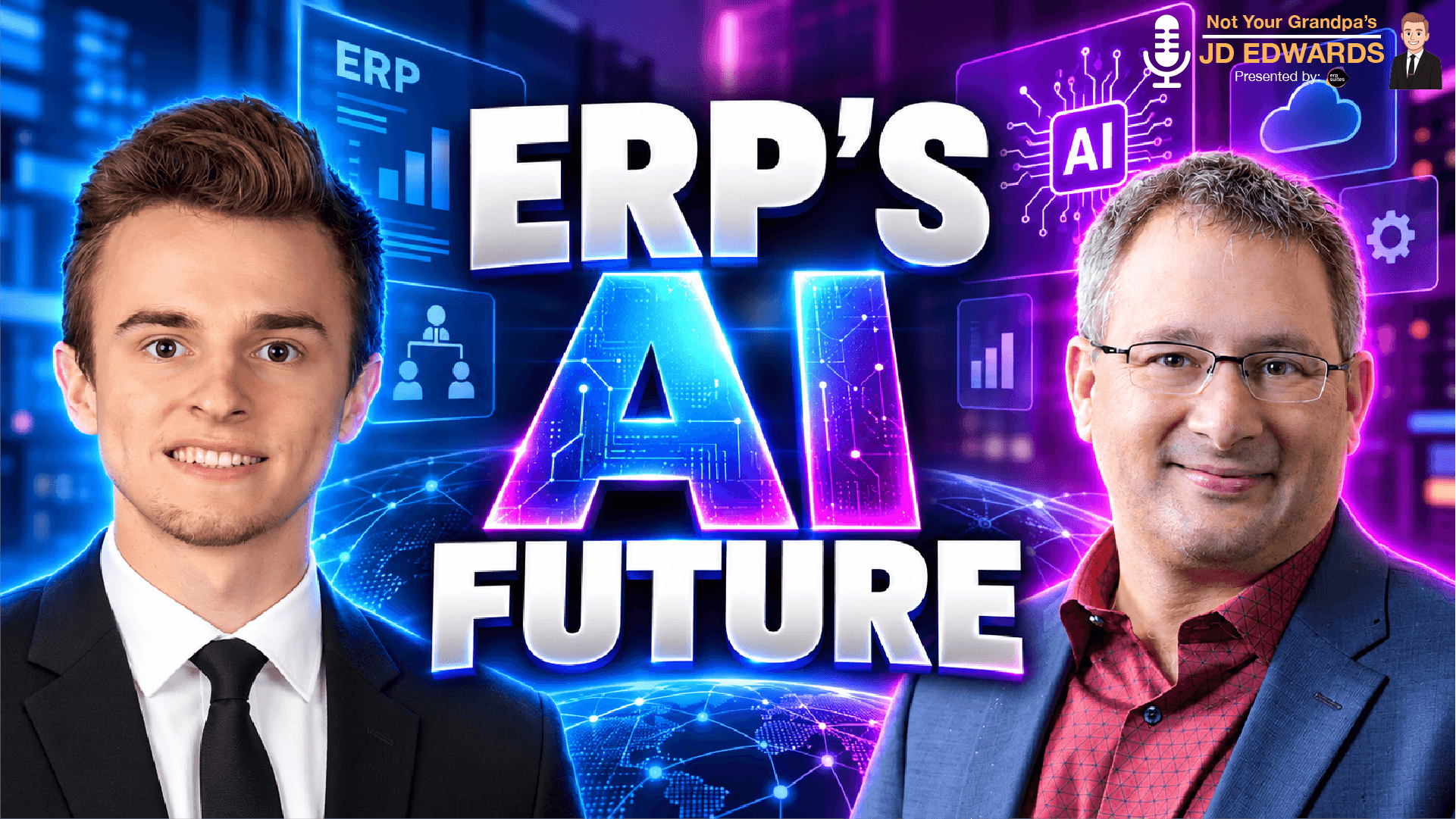
What will the JD Edwards workforce look like three years from now? In this episode of Not Your Grandpa’s JD Edwards, ERP Suites CEO Mike Moorman explores the future of AI agents and digital workers, how they will transform business processes, and what this shift means for employees and the role of JD Edwards. Discover why organizations need to start preparing for an AI-powered future today.
Table of Contents
- Introduction: The Future of the Digital Workforce
- What Will a Digital Workforce Look Like in Three Years?
- The Competitive Advantage of AI Agents
- Humans vs. Digital Workers: Who Does What?
- The Future of JD Edwards in an AI-Powered Enterprise
- Transforming Business Processes and the Evolution of JDE Roles
- Preparing for AI: What CIOs and CFOs Should Do Now
- The Risks of Waiting and the Importance of AI Governance
- The Future of Agent-to-Agent Communication and Closing Thoughts
Introduction: The Future of the Digital Workforce
Introduction: Why AI Agent ROI Matters in JD EdwardsWhat happens to your JD Edwards organization when some of the people doing the work aren't people at all?
And if AI agents begin owning parts of business processes, is your JD Edwards environment actually ready for that?
Today, we're looking three years ahead at what the digital workforce could mean for JD Edwards, your people, and the way work gets done.
By the end, you will have a clearer idea of what to start preparing for now and what not to run into.
Welcome back to Not Your Grandpa's JD Edwards. I'm your host Nate Bushfield.
And today we are looking beyond individual AI tools and asking maybe a bigger question. What happens when digital workers become a normal part of the enterprise? How does work change? What happens to the JDE business analysts and developers? Does the ERP screen become less important while the ERP itself becomes more important?
And if the future is only a few years away, what should leaders be doing now?
But joining me today is ERP Suites' CEO, Mike Moorman, to help us look ahead and separate what's realistic from what's hype.
Mike, welcome to the show. For those out there that maybe haven't met you yet, could you give them a little bit of background around JD Edwards?
Sure. Well, thanks for having me on. First time being on so should be exciting. Looking forward to this.
So a little background, Mike Moorman, I'm based here in Cincinnati, OH. So just give you a little bit of my experience. I've been in the IT field since 1998, been working with JD Edwards since then as well. So a lot of technical background, but also a lot of business as well going forward.
So a little bit of my role here at ERP Suites is to really help guide the company and where the future is going and what we want to do and try to do here. So I think that'd be pertinent to today's discussion.
So looking forward to see what the future holds for everybody.
Exactly. You are definitely in a very specific position to give a little bit of an insight of where we're going as a company, but also where ERPs in general are really going with the whole new AI initiative.
I say new, but it's been around for a few years.
What Will a Digital Workforce Look Like in Three Years?
But when you picture an enterprise three years from now, what does a digital workforce actually look like?
Yeah. So I, I, I think it's an exciting time, to be honest with you, because, you know, we have so much repetitive tasks that people do today and stuff that, you know, we necessarily don't enjoy a lot of times, right?
And if you take a, if you take a lot of JD Edwards users, the number one complaint we always hear a lot of times is like too many screens to go to, too many clicks, right?
And so what we're going to start seeing over in three years is this hybrid workforce that we're going to have. We're still going to have humans. Everybody's still scared about that, right? So everybody's scared, hey, I'm going to lose my job, right?
But I think the work for humans that you're going to see becomes just more important and more meaningful than doing necessary redundant tasks that you have.
So I think what you're going to see if we give it a little bit and start here, I think we're going to see companies kind of start off slowly with a digital workforce.
And, and, and reasons for that is, you know, really kind of yeah, the word I always love and we use it in sales all the time. It's about trust.
And there's this big trust that's going to have to happen within the industry to really trust through these AI agents. Are they going to do what they say to do? Are we going to have the right guardrails, the right governance around it, right? They're not going to get outside their sandbox.
Honestly, that's a big topic nowadays, right? And, and run rogue, right?
So right now the industry is very skittish. So I think what you're going to see, we're going to start off slowly, but I think in three years, what's going to be fascinating is the number of digital workers that are going to be a part of a company.
And those digital workers, what I, I envision is you're going to have a lot of them working with each other and also with a hybrid human side, right?
But those digital workers, even though we might be talking a little bit about JD Edwards, they're going to work with other digital workers. They're going to work with digital workers outside your, outside your organization, right? And really going to automate and really help in, you know, processing so much faster than what we have today.
Now we talked a little bit about the human side, right? And the human side changes a little bit, like I said, it becomes more meaningful.
So they're going to have to manage these workers just like they do today. People still have to manage these workers.
So, but at the end of the day, the relationships, the judgment, the different things that I think the humans still going to be involved and very important in there is just going to add more meaningful activities to their plate versus having to do the things, the daily tasks that, you know, these agents are going to be able to do more efficiently.
Yeah, it's good that you brought up those tasks. Now, are we looking at heading towards like more of a few specialized agents that we're going to be seeing or is it going to be like hundreds and hundreds of digital workers that own different parts of the business?
I think we'll see, I think it's going to be a little bit in there.
I think in the beginning, in the first year or two, we're definitely going to see specialized agents, right, and talked a little bit about that trust.
But and there's going to be specific parts of the business that we can really, yeah, they're going to be pain points. They're going to be things that we can take advantage of to help, help kind of progress the companies that, you know, in, in, in those areas that are, you know, manual, a lot of manual type tasks that workers are going to get through.
So these specialized agents, I think you will also see not just like in accounting, for example, right?
You're going to see specialized ones in accounting, but it's really going to be in the different parts of the, of each company and they're going to look at their business and say, you know, for example, in a homebuilder side, right?
You know, what in the homebuilding industry can we take advantage of them?
They're going to be very specific and we're working on some today like the community setup or closing a house, right?
Those are very specialized honestly to those companies, but they're very critical to that nature, but also a lot of manpower that takes into for those, those processes.
So I think our business is going to pick and choose what part of their business makes a lot of sense in that, you know, from specialized agents.
Again, I think you're going to add more and more agents on, but you know, I don't see, I don't know.
I, I think at the end of the day, I think you'll, you'll see, I don't know how to say this. I want to say maybe, you know, a 60/40 split maybe down the road of, you know, agents versus humans that you see in there.
So, so yeah, I think definitely specialized. But at the end of the day, they'll grow more and more over the three years that we see.
Yeah. And I like, I like that idea there where, yeah, they're going to start off with more specialized. But even though they can take out more parts of your business, it doesn't mean that they're any less specialized.
They can be certain pieces of this puzzle and they can just grow to a certain amount. Will it be hundreds? Maybe, maybe not.
But we have seen them grow over time even in this last year of us really focusing on them to the extent that, yeah, in the next three years there could be that jump.
That 60/40 split is very interesting to me too, because, yeah, I mean, we're at least the agents that I've seen us make. They can take over a certain process, a certain part of each business.
But yeah, I can see that down. Give us more time then.
Yeah, it can take over in a certain, certain extent, I should say.
But when we're talking about the word—no, sorry, go ahead.
The Competitive Advantage of AI Agents
I was going to say, I think we're, we're when we look at three years, I think what we're trying to tell customers, and this is a very interesting kind of idea.
You know, today, if, if you look, you know, like, let's, let's take the, let's go back to the homebuilder industry for a minute, right?
They, they have their typical competitors, right? And that's the one most of us always concentrate on is who are our competitors today that are doing, you know, the same things, OK.
They're going to reduce, you know, their human workforce with these digital agents, are going to save costs on there, right?
So it's kind of that race to, you know, can I, how much money can I save? Can I build a house cheaper than the next guy that I have?
But what we're trying to tell customers today, when you look at these agents, it's not the competitors that you see in front of you. It's the competitors you don't see.
And the reason we say that is, and there's a great example I've been using here lately, it's the, it's the new startup.
They will build the homes. They're still going to have the subs, but at the end of the day, all the back office stuff, all the general administration stuff that they have on their books, it's probably going to be done by the digital workforce.
So they will have this competitive advantage because today your competitor has a human workforce that they have to work through and with the digital workforce, but the competitors back, back in the day or the new, these new competitors won't have that kind of debt that they have, right, that they have to work through.
There's an interesting company today called Instinct that I just heard. They're valued at $10 billion, right?
And saying you're sitting there now that's a valuation. It's not necessarily what their revenues are.
When you sit there and you look at it, the next line was amazing to me. They're valued at $10 billion and they have 14 employees.
So obviously they're doing a lot of things with the digital workforce.
So if they only got 14 people and then be able to be a $10 billion thing, those are the new competitors that we're trying to preach to our customers to say, hey, be careful here.
This is why it's going to be important.
I know we'll get more into that, but this is one of the reasons you got to be careful of the new competitors that are coming up that don't have that structure in place with all the, with all that workforce, the human workforce they have today.
Humans vs. Digital Workers: Who Does What?
Yeah. So what would you say? Like what work would really move to agents and what work would maybe stay with those 14 humans?
Sure. So think of it this way, anything that, any type of work kind of doing part that we call it anything that could be around a set of rules-based, any tasks that have rules-based, right.
And those are going to be very easy to learn those, what those rules are and how to handle those tasks that you have.
So very repetitive type tasks can be in there. It can be information gathering, it can be reconciliation type tasks.
So a lot of different type tasks that, you know, that these agents are going to be able to perform. And again, they're going to have a set of rules usually with it, right?
And the beauty of it, to be honest, right, is, you know, if, if they're on their, let's say, home closing, if we go back to the industry and they're on their 20th home closing, you and I might get tired of doing it when an agent is not going to get tired, right?
And that, you know, you and I are going to take a break, right? And hopefully go home and, and rest up and do other things versus working all the time where these agents don't.
So from a, from an agent side, you're going to see those tasks that, that are going to be pushed off to the agent in that.
So then what's left to the human, right? What's left to those 14 people that we have in there?
So a couple of things that are going to be in there. One, anything that needs judgment. And so again, kind of that rules versus judgment.
So if, if, if something in there you need to make a judgment call, an agent is not going to be good at that.
The only way we know that is unless it's like, hey, I've seen this 100 times. You answered the same way 100 times, right? You did the same process 100 times. And it's like, OK, I know how to do that.
But if you have to make a, a judgment call and it's different each time, an agent won't be good, won't learn how to do that.
So that's going to be number one. Number two is really going to be around relationships.
Yeah.
So handling, it could be a partner relationship, it can be leadership, it could be in, in within employee relationships, right.
So agents aren't going to do a really good job of calling your partner and doing any type of negotiations, right?
They're not going to be good in any of those kind of relationships, kind of building parts.
So, you know, those, those type of tasks will be still left with humans, you know, and I think you'll see too from that judgment side where it frees them up to allow them to look at things, right, to do the exceptions, right.
And we're going to get into an example, I think down the road, we'll talk a little bit, but it allows them to investigate certain areas that could be potentially like fraud, for example.
Yeah. And it's, it's interesting how I feel like we've talked about this on the podcast before of the separation of duties.
It's almost like having interns in a way. Obviously some interns can build those relationships too, but for the most part, they're not really doing that.
They're more the behind the scenes and doing the little things, repetitive processes just to make our lives a little bit easier.
But that's not even, yeah, but to the extent of in the next three years, I mean, we could see agents from one company interacting with agents from another company to set a meeting or to figure out a specific price.
Probably not that one. That one's still in a negotiation side and maybe a far-fetched dream, but we might see that in the future, which is interesting.
So let's maybe make it real a little bit. Let's picture an accounts payable department three years from now.
What do the employees do? What do the agents do? And what does JD Edwards do?
Yeah. So if we take an example of our, you know, payables agents that we've created, and let's say Susie, for example, is the payables clerk, right?
So what you're going to see the agents do is when an invoice comes in, and that invoice could come in via an, in your email inbox, you could upload the invoice. It could be on a file, a file share, right? And all that.
An agent is going to be able to get a pull. And what's nice is they're going to, the agent's going to pull out all the different line items it needs and then it's going to go ahead and start matching it via two-way or three-way match to the PO receipts, right?
Where before, if you think about that in, in JD Edwards in the screens and we got to talk a little bit about all those steps.
A person, you know, what they're going to get out of doing is actually having to input that invoice into JD Edwards manually, right?
And I'm sure most people if I asked today, that is not a fun process to do, right? It's a tedious manual process that they got to go do right in that.
So what's going to be nice is AP clerks should never have to do that again, right? There's no reason for them to do that, especially with the technology that we're talking here.
So from the human and like you said, great example.
So now Susie, right now I, if I'm Susie, I don't have to do any of this feeding it. I don't have to create, you know, the vouchers are going to get created for everything that matches in there.
However, through that process, the agent's going to find these exceptions potentially, right?
An exception could be a, let's say a duplicate invoice.
The one I like a lot is, hey, there's a different bank account number this month versus last month or there are other invoices that they have.
So that's going to get flagged in an exception, right?
It could find an exception with like freight, you know, typically our freight's within this range, now it's, it's a higher rate. Why is it a higher rate given to us, right?
So those exceptions, let's say there's seven exceptions, will get kicked out.
And that's where Susie now comes into play, right? And Susie's going to take those exceptions.
And now I'm going to research this. Where the judgment kind of comes in, right?
And some of the relationships we talked about here in a minute, but they're going to have to go and go.
No, we understand why the freight was or yes, that seems, you know, out of the ordinary.
So let me call up the vendor. Let me call up and say, hey, why, why is our freight? Let me do the investigation.
I love the, the duplicate bank account or to change the bank account number, right?
Because that's the biggest part for fraud that we see, right?
And where somebody will try to send a fake invoice in or copy an invoice and then put a different bank account so that you pay into that bank account.
Well, now Susie's freed up to go, hey, and the agent's smart enough to, to flag it, right, and send it to Susie and say, now, hey, let's let them go investigate, let them call the financial institution, say, is this correct?
Do you, you know, is that a bank account right, first of all, or go back to the partner and say, did you change your bank account, right?
And honestly get that answer in there.
So, you know, now we're preventing fraud, right, which costs people a lot of money, right?
Those are the meaningful tasks that we can be doing for a business versus just creating the invoice, matching the invoice and doing the things, you know, there's 10, 12, 14 clicks inside of JD Edwards that people usually complain about.
The Future of JD Edwards in an AI-Powered Enterprise
Yeah. And it's, it's interesting to hear that because I always thought that like, you know, maybe JD Edwards would potentially take a back seat to all these agents that are out there.
And that's really not the case. It doesn't necessarily disappear in this future. It may just become less visible to the user.
But that kind of raises my next question. What happens to JD Edwards itself and to the people who support it?
So if people spend less time inside JDE screens, does JD Edwards become less important or does it really become more important?
It definitely doesn't become less important just because you're less time in screens.
You know, JD Edwards definitely still has a very important role. Like any, you know, it's going to be any ERP system, right?
It's going to be your system of records. It's going to do your transaction, it's going to perform the transaction behind the scenes.
So one creates a voucher, right, that, that is the job what JD Edwards is doing.
It's got business logic built into it. It's got its security, all those pieces, approval processes and workflows that are going to be in that.
So all that is still very important in that.
And I think what's, what's so interesting about it is years past, right? We would always get people that would say yeah, my ERP's getting long in the tooth maybe or I'm going to, I'm going to switch over to XYZ new ERP, right.
I think with the advent of AI and these agents, right, I think the ERP's still just as important, but as long as you have the ERP system, there's no need to necessarily have to go to another ERP system.
You can now with these agents, one, if, if there's, you know, it's 14 clicks in one and only five in the other one or the user interface is nicer than the other ones.
Those are becoming less important.
You still need kind of what we call, I call it all the time. It's always interesting. I think of it as plumbing, right?
So you're going to have plumbing, it's still going to do that same, same things that you needed to do right now.
Why change out plumbing for another set of plumbing when it's going to do the same job, right?
So I really see if you got an ERP system that becomes relevant, becomes just as important and you build your agents around it to whether to enhance the business process or to, you know, make your automations that you need or fix some of the sins of the past that you might have, right.
So yeah, that's, that's a really cool perspective.
I didn't even think about that because, yeah, if AI agents are the next big technology, say, then why would there be a need to switch?
If you do have AI agents that can complete the tasks in your ERP system that yeah, maybe another ERP can do as well with AI agents.
But if it's doing it for you and yours, why would you need to switch?
That's a very interesting standpoint there. I really do like that.
So I guess for my next question, does JDE become more of the transactional engine underneath the digital workforce or is there something more to it?
It, it would become more of the transactional engine, right?
You know it and, and like that's what you say. I think the, the business process, business logic that's in there, right, keeping all the things on the process flow that you have and making sure that transaction in their system of record, system of audit too.
So let's not forget the auditors who want to see, you know, who's doing what and what they're changing, right?
That's always going to be a big case.
But yeah, so it's definitely the importance of, of the transactional side.
You know, like we were just saying before, you know, yes, the user experience is, is things we can do, but now AI can, can easily solve those problems with, with user experience, you know, whether we're doing it with digital agents or we do another side that a user still interacts with, right, those things can be taken care of very easily.
So really the, the ERP now should really be focused really on the transactional side, the, the governance side, the security side, the audit side of it and maybe not as much as, hey, does this form look pretty?
How many clicks are in there?
Because like I said, I, I, I really truly believe now AI can fix a lot of sins of the past, but can fix those things that might not be as advantageous as you want them to be to an end user.
Now we, we can do that and fix a lot of things with digital agents or just AI apps in general that can, that can sit on top of the ERP system today.
Transforming Business Processes and the Evolution of JDE Roles
Yeah. So you say that they potentially can do that, but will companies use AI to transform some of their outdated business processes or are they just looking to automate years of inefficiency?
Then that's, and that's going to be where to really.
So yeah. So let's take the inefficiencies first, right?
So today, even in a lot of these, in years past, we could always automate and if we automate the inefficiencies, right, it's still inefficient, right, kind of process, right.
So if we do that with AI, just kind of if your data is bad, your process is bad, it's still going to be bad.
On the other side, when you do AI now, maybe it's quicker, maybe the agent can, can fix some of those data problems, which they will be, right?
So you'll gain some things in there.
Well, what we're, what we're doing with customers today and where we see this is to really utilize AI to its fullest potential, right?
So if you're going to go into AI and we're going to actually utilize this technology, I'm not sure why you wouldn't want to use it to its fullest potential and not just a Band-Aid kind of fix, right?
Where we are taking customers first is really do an assessment and that assessment really on the business process that you have.
And it could be a specific business process, right? And understand, we'll understand the pain points of it.
But then we start looking at where can we transform that business process?
Does it make sense to take certain steps out? Does it make sense to add certain steps that we can now or, you know, how, if we can reimagine this and anything's possible, what's the best way for businesses to do that?
We know in our industry, especially in JD Edwards, we have customers who probably implemented JD Edwards 20, 25, 30 years ago that's been running there.
And a lot of our customers and a lot of people in JD Edwards have kept up to date, kept the system up to date.
But what they haven't really done was their businesses 20, 30 years ago probably do not look like what they are today, right?
And, but the system's still designed from what they were 20 or 30 years ago.
Now we got to figure out how do we, how do we get them and how do we actually utilize the system and investments they have.
And this is a great place to start doing that with AI because now this can truly transform that, that process, right?
And, but it's going to take some work first to assess and then kind of redesign and then figure out how I utilize the technology today to make that transformational, right?
And that's where we're trying to guide a lot of our customers.
You can, you can fix a lot of things with AI quickly, but to get your most investment out of it is really sit down and really understanding, OK, how's my business processes and what's the best way I can do that and where's the cost savings potentially in that, right, that I can get out of the business process?
Yeah. And that's an interesting point there because typically you would see JD Edwards analysts and business analysts and even developers kind of went out those changes and make those changes.
So how do those roles change and what should maybe these developers or business analysts start learning now to get in front of this AI change?
Yeah. And this is again going to be a new concept for people.
And one of the things here at our company that we're, we're, we're starting to look at and how do we, how do we, how do we train our own people into this, right?
So you're going to, now we always had the, like you said, the business analysts, developers, more times they were separate roles.
They were, you know, separate, separate groups that they were in potentially, right? And, and they did various jobs.
What you're going to see now is these two roles actually kind of merging together.
And the reason for that is one, when these business analysts before were a lot understanding the business, business first and how the business works.
But now they had to start taking an understanding of the AI technology that they have.
So there's this concept called forward deployed engineers. That is a new concept that's coming into our marketplace.
So this is this three years that we're talking about.
This is what you're going to see in three years is these what we call forward deployed engineers and what those engineers are in development.
So you're looking at both sides and I think both sides are going to have what they're going to learn the skill of the others.
Basically, what's going to happen and those engineers are going to be able to sit down with the business user and they're going to be able to look at the process, solution it and solution it from an AI perspective, right?
And so they're going to need to know and start learning these technologies and, and, and a developer's going to have to learn AI too, but I think they're going to have to learn more the business side in order to really maximize this.
So we see here today and we're working our own programs of how do we develop these, what we call forward deployed engineers, what the industry is calling that because to me it's a little bit of a unicorn to find these type of people.
They're not going to be out there right now. So we're definitely going to have to train and develop that.
So if you're a business analyst today or a developer today, those are kind of going to be the skill sets that they should learn because that's where I think the requirements are going to be for them, especially two, three years in there.
And I, I think if you see if you're just a developer, honestly, we know development, right, with all these AI tools are getting easier and easier.
So yeah, the development skill set is not as critical, but that's where the business process is, right?
And so there's definitely going to be a skill change and it's upskill that these roles are going to definitely have going forward.
Yeah. It's not that the role is going away. It's that it's evolving.
It's a different look on the same thing to a certain extent.
It's the next step in the evolution of business. I mean, that's how it, that's how life cycles work.
In terms of where we're at now, like back before I was born, it probably looked a lot different, but nowadays it's starting to change again.
It's, it's interesting in that way.
I mean, I'm sure Y2K was an electric time, don't get me wrong, but glad that I was barely conscious for it.
Preparing for AI: What CIOs and CFOs Should Do Now
So yeah, the more work that gets handed to digital workers, the more important the foundation underneath them truly becomes.
And that puts CIOs, CFOs in a tricky position. You don't want to wait too long, but you also don't want to chase AI for the sake of AI.
So what should leaders actually do now?
So let's take it from you. If you were advising a CIO or CFO running JDE today, what would you tell them to start doing today?
So first thing, one of the debates, the big debate today is for companies is do I build, like you said, the foundation, the AI foundation, or do I buy a foundation that's already been built by a company like ERP Suites or somebody else right now?
Obviously, there's going to be pros and cons in that.
And I think if we step back even from that build versus buy decision and kind of what I think you need to look at, here's where I look at this, right?
Where's going to be a competitive advantage, right, for companies, right?
And if we look at AI and there's this fear of missing AI, right? So there's a lot of that going on.
There's a lot of investment dollars, right? So everybody's seen these investment dollars by the hyperscalers, see the billions and billions and, you know, dollars going into these buildouts.
I see it going to be missing something and the digital workforce, finally, the digital agents from the digital workforce finally is kind of the intersection where it really makes AI feasible for enterprises, right.
And it's not just a chat assistant, chatbot. Or a digital assistant, whatever it might be.
Yeah. Now it's agentic, it's learning, it's doing the things that it can do for a business.
So the competitive advantage, if I look at this and look at companies and where I advise them is in order to get that, you got to figure out how you are going to get these digital workers into your workforce to start reducing the cost inside your business.
So the sooner people can start reducing that cost against their competition, the cheaper it is to build a house, the more margin you can do or you can start pushing people out.
So I really feel like, yeah, AI can mean a bunch of things, but at the end of the day, it's really going to be number of hours saved, right?
If I can do a task, you know, if I need 10,000 people to do certain tasks and I can reduce that down to 5,000 people doing that task, humans, and the rest by digital workers and save money, that gives me a big competitive advantage back to the 14 people, right, that we talked about with that company.
So waiting way too long to see if technology kind of, is it going to work? Do I trust it?
You know, take the time to trust, your competitors are already going to be there and already going to have that cost advantage on you.
And that's where you have to be careful in the build versus buy, back to that decision, because when we look at customers, there's some customers who have great skill sets internally, right, and are technology type people that can build that.
But most customers today, that's not, that's what, that's not their specialty, right?
There's, they go back to the homebuilding, it's about building the best house that they can or, you know, putting those things in there.
It's not building an AI platform, right?
So usually try to encourage people is, is speed to market, but the right speed, obviously, like when we talked about just don't do AI for AI's sake, but figure out which digital workers, how you can implement this, how those can transform your business to really get the competitive advantage in there.
So, you know, I think the build part's going to be a longer road for people.
And to be honest with you, I think they're going to, you know, get bypassed by people who can hit the ground running in the next month or two with, with their first digital worker, right.
And I think that those people are going to start having the, the competitive edge on there and, you know, will be able to fend off the, the new competition as well because they'll already be there.
Yeah. And you brought this up and touched on it, but I kind of want to go a little bit deeper of it.
So like if a JDE customer wanted to start tomorrow, wanted to start AI tomorrow, where should they look for their first meaningful opportunity?
Yeah. So obviously like I said, I, I, we always like to start with kind of doing an assessment and that could be a three to four week assessment, right.
But you, you want to look in part of your business where you think first like where if I'm, if I have in a homebuilding industry, because we've been talking with some homebuilders lately.
So I can use that if I'm closing a home and that closing takes a lot of people and at month end that's really important.
But if I can do that at click of a button versus having somebody reconcile and look at these sheets and, and do the different things, right, that can save me a lot of people's time, manual effort in there.
So that makes a lot of sense for a homebuilder to say, hey, let me look at the house closing side of things where that could be a significant savings.
Now some other companies might look at, hey, closing my books are taking too long.
There could be financial penalties with that.
So looking at a reconciliation agent or looking in there.
So really looking at some of the pain points in the business.
One, maybe it's a pain point, but two, where do I have a lot of manual labor that if I cut that manual labor out now I can get that cost savings back, right?
So there's a couple areas that we try to work with our customers or, you know, what a lot of these businesses have secret sauce.
What's that secret sauce I can exploit even more to give me more potential margin on top of what we have.
So it is really customer specific. There's no one size fits all.
Now you might, the other end of that spectrum, you might say, hey, I like to start small like we talked about a little bit, give me an agent that I can build my governance around.
I can start playing with it. I can trust it, I can do some things.
A payables agent makes a lot of sense there. It's not going to cost you a lot.
Some of it's been done automation before, but if you actually look at what we can do with AI, it's a lot better than OCR, but that could be an area to dip your toe in, right.
So we always talk about the, the scale of where you're at with early adopters versus, you know, you want to see where the industry is going.
So then where you might be on that scale if you want to tiptoe in a little bit, doing some of those smaller agents and getting used to that, building your framework, building your governance, right, that can start off would be areas to potentially look at.
The Risks of Waiting and the Importance of AI Governance
Yeah. And I know I gave that example, but what, like what would be the bigger danger here?
Would it be waiting for three years and making that switch and being one of the, like the followers or would it be moving too aggressively today and trying to implement a bunch of different agents?
I would say waiting for the three years. I, you know, this technology has, like you said, it's been out, right?
AI has been around for a while.
Yes, we're at a nice intersection here where it's, it's, it's usable now, I think, in enterprise with these agents.
But if, if you wait too long to get in that game, right, and wait till it's so perfect, right, I don't know if you're ever going to get perfect because it's going to change so much rapidly over the three years, like what we do today.
It's going to be different probably two years from now, which is OK, right?
You're always going to be waiting then.
So now if you jump in and do multiple agents, again, there's risk obviously a lot higher.
There's, there's more risk when you jump into that, but that's a risk you can, you can mitigate if you need to with, with different, different techniques and that.
So my, my point is, I would not be waiting today.
If you look at your, at our company, right?
We've been, we've been in AI, investing in AI for the last probably three years now, right?
And for us, you know, if you're just now starting, it's OK, but you got to start soon, right?
And not, and not get left behind in this because this is, you hear it all out in the news.
It's the next industrial revolution, right.
So, you know, don't keep, don't keep buying the horse and buggy, right?
If, if the automobile's right here, right?
So we got to get on top of it and, and, and start moving.
So the bigger risk is not doing anything.
Yeah, exactly.
And there's a true fear of that, which I agree with, with execs I talk about, right, but it's doing it right.
And it's always that, like you said, if you do it right and you figure it out and you, you have the governance in place.
And that's what we spent a lot of this time over the last two, three years when we're building this platform is making sure we're doing it right, making sure we're doing the governance right, making sure these models aren't being trained on your data.
All those things are important and making sure it doesn't happen, we're taking into fact.
So that's the build versus buy, kind of back to that.
That's what you get sometimes when you're buying it.
You already get all those guardrails and safeguards being built in versus you having to recreate all that.
So those are the areas I would, I would look at, yeah.
And it also comes down to do you trust the business that you're getting the AI from?
Do you?
There is that relationship side too.
And it's not only finding the right agent for you, but it's about finding the right partner that is going to help you build that environment, that digital workforce that'll help you.
The Future of Agent-to-Agent Communication and Closing Thoughts
So three years from now, what will seem completely normal in enterprise AI that sounds maybe radical today?
Yeah, I think having these agents talking to other agents.
And then we mentioned that a little bit earlier, like you, you mentioned a little bit about creating that meeting and going outside of that, but just having your own agent be able to interact with five different systems, companies, other companies, your, you know, your, your other vendors that are going out there, right?
You know, we, we've been almost talking a little bit about, hey, how about payables agents, but you're going to have an agent that's, you know, they have a protocol.
They're called, they're creating an agent-to-agent protocol, right?
And that we're going to see, you know, all these agents are going to be just working together seamlessly between everything.
So the integrations that we have today, like in JD Edwards and the old integration, whether they're flat files or Z-file processes inside JD Edwards and we went to Orchestrations.
Now we're just going to, these integrations are going to be more agent-to-agent.
And so that doesn't, you know, first it's like, wow, if I think about that, that you, you wouldn't think that we'd see that in the future, but that, that's really what's going to happen.
And while your integrations, yeah, the manual integrations we've had to create, you know, will probably streamline by agents talking to other agents, right.
And it's, and it's going to be, it's going to be kind of a wild situation that we're going to see there, right.
So, you know, a lot of us will be governing these agents and making sure they're doing what they're doing right.
So I think that's in three years.
What's, what?
I don't, I, I can envision it, but it's going to be hard to process in, in three years.
That's what it's going to be like.
Yeah. It's such an idea that watching movies growing up makes me a little afraid.
Don't get me wrong.
But I mean, I, Robot, Terminator, I can name a billion movies about AI that do freak me out.
And especially when I was a little kid growing up, definitely freaked me out.
But now that I'm in this space, it's completely different than what we make it out to be in all these TV shows and movies.
It is completely different.
And you're right, it's having the right people in charge of it that are monitoring it, that know how to monitor it, it'll make all the difference going forward.
But if your team is trying to figure out where AI and digital workers fit into your JD Edwards strategy, ERP Suites can help you evaluate the foundation that you have today, from your processes and integrations to your data and modernization priorities.
Visit erpsuites.com today to connect with the team and start building a practical roadmap for what's next.
But that's a wrap on today's episode of Not Your Grandpa's JD Edwards.
The big takeaway is this.
The real risk isn't necessarily AI replacing your JD team.
It's reaching a point where digital workers are normal and realizing your processes, systems, or people weren't prepared for that shift.
You don't have to predict exactly what enterprise looks like three years from now, but you can start building the foundation to be ready for it.
Thank you so much, Mike, for joining.
I know there's a lot of stuff going on in your life.
I'm very happy to be able to have you on the podcast.
I know it's been a long time coming.
We're reaching about 50 episodes now, which is insane.
Never thought I'd be doing the podcast, but I also never thought that we would have a podcast.
So this has been a lot of fun.
But if this episode was helpful, subscribe, leave a like and share it with someone on your IT, finance or your leadership team.
But until next time, keep modernizing, keep asking better questions, and remember, this is not your grandpa's JD Edwards.
Catch you next time.
